Still scrolling through front door color photos for your gray house with no clear winner in sight? I get it — gray siding is the ultimate blank canvas, but the wrong door color leaves the whole facade feeling flat. We spent serious time browsing Sherwin-Williams, Benjamin Moore, and The Home Depot to bring you 33 curated ideas across every price point, from $35 paint samples to $4,500 custom steel doors. You’ll find bold teals, sharp blacks, warm woods, and that perfect muted blue for a modern farmhouse or traditional colonial. In 2026, earthy-contrast pairings and durable exterior finishes are dominating saved boards — and this list pulls from real homes, not AI renderings. And stay until the end — we break down the most common mistakes that can ruin these looks. 📌 Save this to Pinterest for later — you’ll want to revisit these ideas. This post contains affiliate links; if you buy through them, we may earn a commission at no extra cost to you.
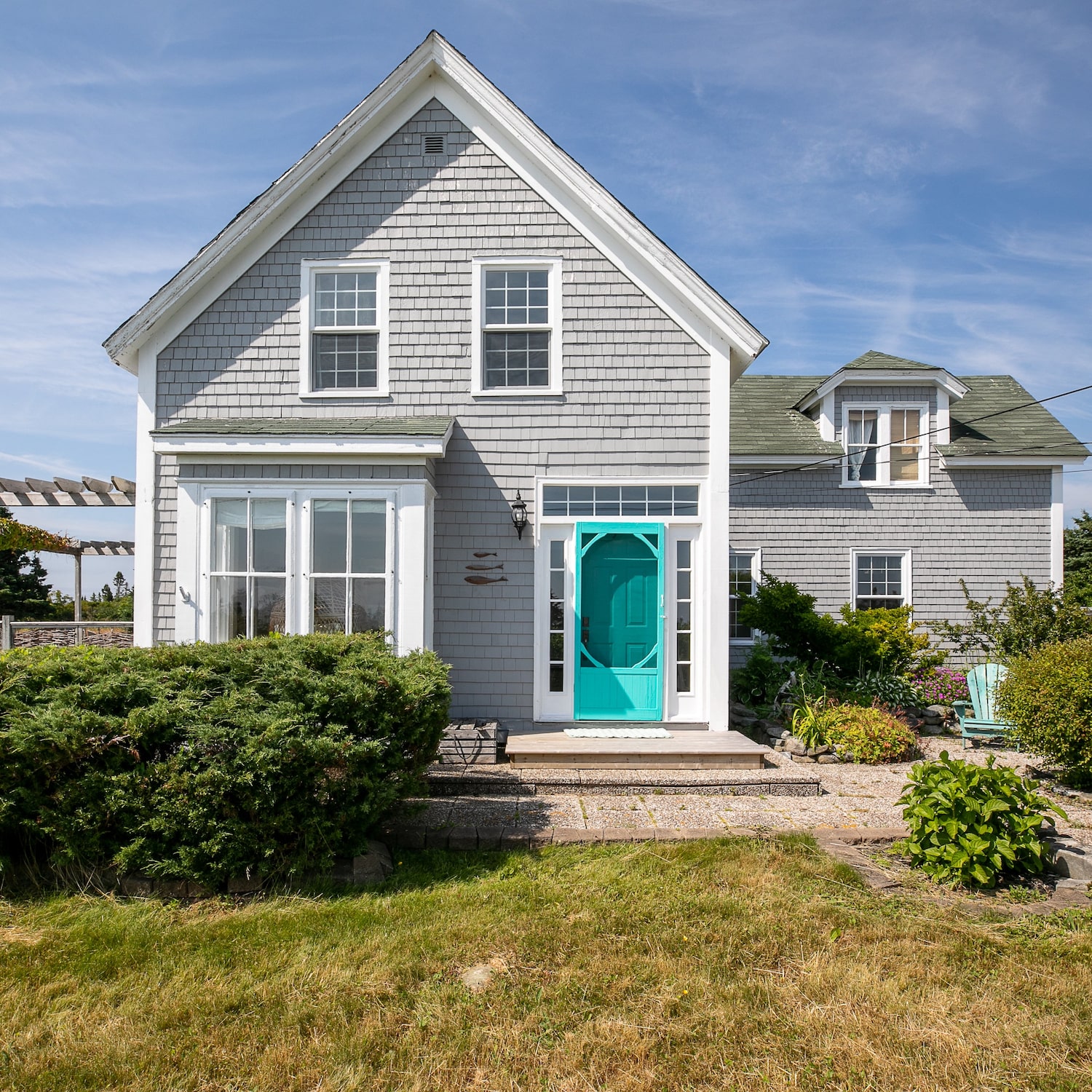
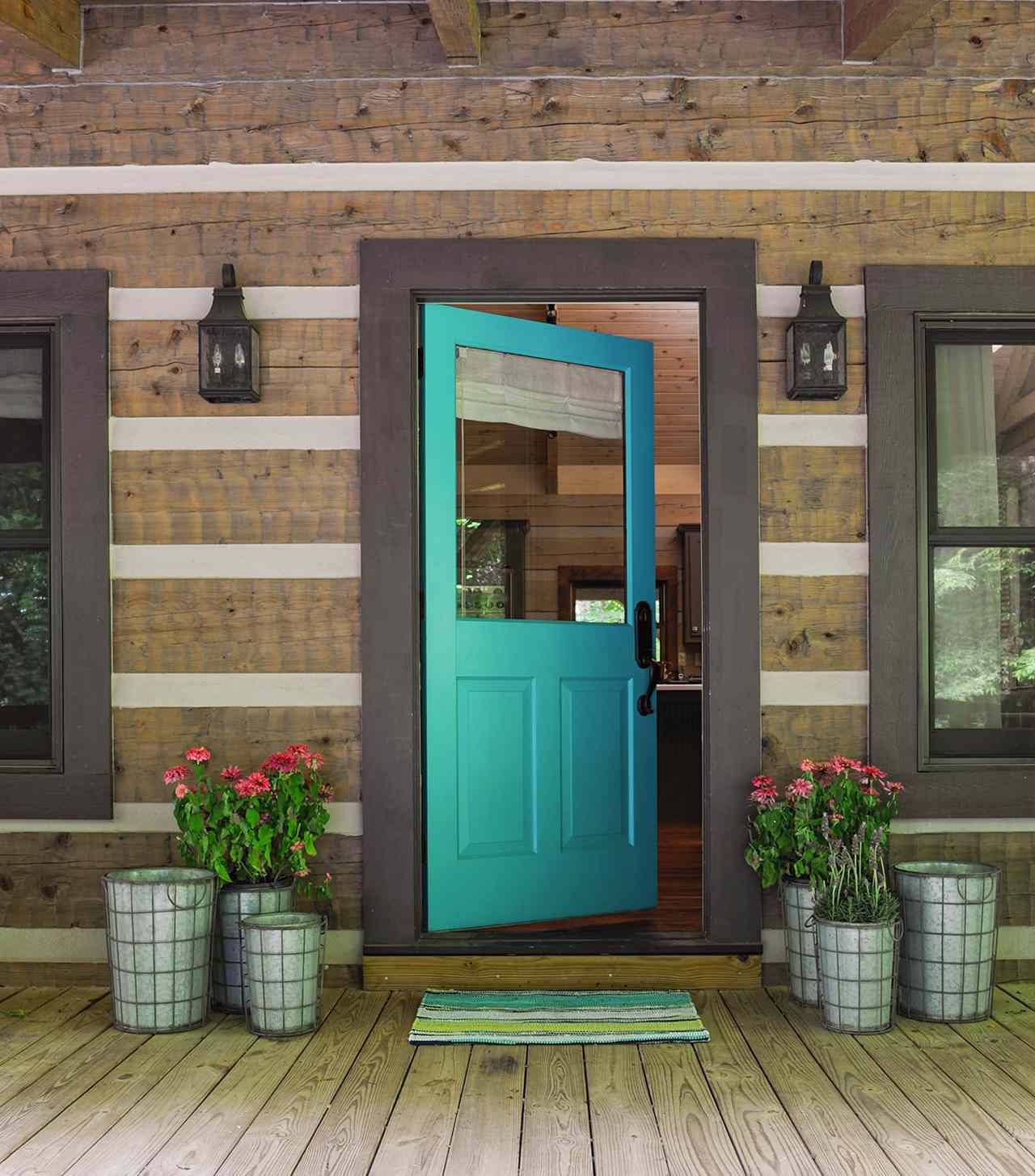
1. Teal Screen Door on a Light Gray Shingle House
A teal screen door like this one does most of the visual work, so you don’t need to repaint the entire exterior. A solid wood screen door with a mortise-and-tenon frame starts around $400 unpainted; exterior enamel in high-gloss teal runs about $35 a quart. Here’s the realistic spread:
“Door and paint: $400–$700 for a pre-hung wood screen door, plus $35–$60 for teal”
- Door and paint: $400–$700 for a pre-hung wood screen door, plus $35–$60 for teal exterior enamel
- Main door: Leave it white or repaint for $50–$120
- Lighting and hardware: $80–$220 for a pair of coastal sconces and a stainless knob
- Landscaping anchors: $120–$400 for low green bushes and a gravel-and-stone path refresh
- Trim and roof accents: $150–$350 for white trim touch-ups and mossy green roof trim if needed
- Total: $835–$1,850
- Budget alternative: Use a standard screen door kit ($180), shop the paint mistint shelf, and split existing hostas to fill beds — you can land under $600.
Make sure the screen door and main door have different paint finishes. Use high-gloss on the screen door so it reads as a jewelry-like accent, but keep the main door in satin or semi-gloss so it doesn’t fight the screen. And leave a 1/8-inch gap at the bottom of the screen door for expansion — coastal humidity and temperature swings will make a tight door stick. Also swap out standard screen mesh for a dark charcoal or retractable screen; it keeps sightlines clean and lets the teal be the star.
2. Deep Red Paneled Door Anchored by White Columns and a Brick Path
The brass door hardware is doing far more than the red itself. Without the warm brass knob, keyhole plate, and kick plate, the red would feel flat against all that white trim and light gray siding. The brass breaks the red into anchored details and ties it to the brick path and the green topiaries. Swap in brushed nickel and the entire entrance loses its traditional warmth.
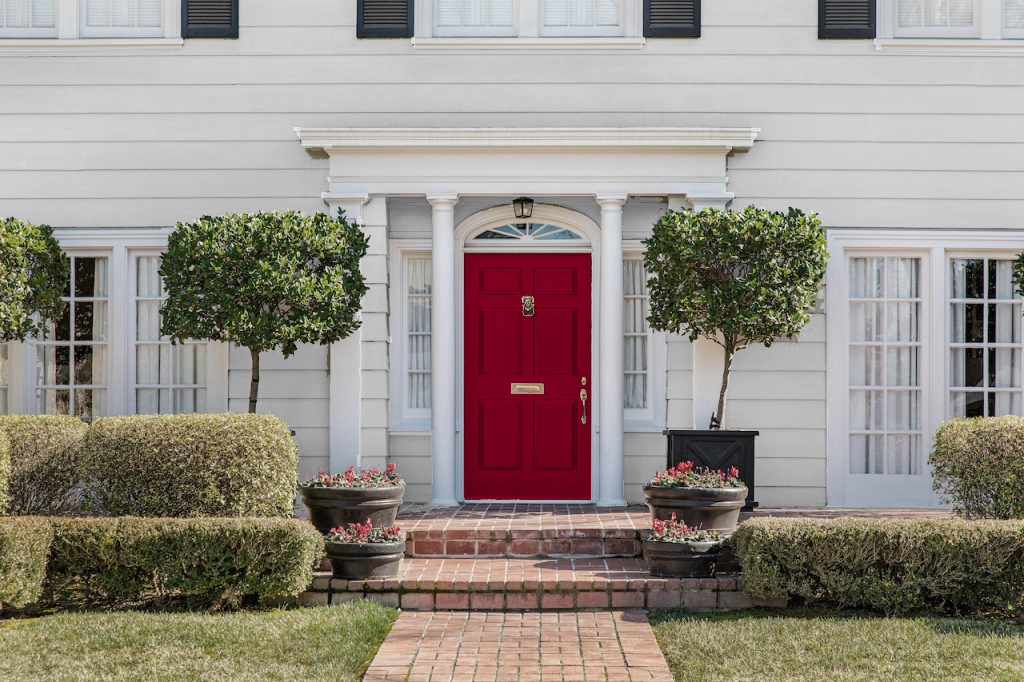
“This works because the red door creates a single high-contrast focal point inside a perfectly symmetrical frame.”
The white columns repeat vertically, the brick path repeats the door’s red-brown undertones, and the dark planters with red flowers echo the door color at eye level. The arched transom introduces one curved line above a rectangular door, which makes the whole entry feel taller and a touch more formal. It’s textbook balance: one bold move, three supporting neutrals, and a clear path to the threshold.
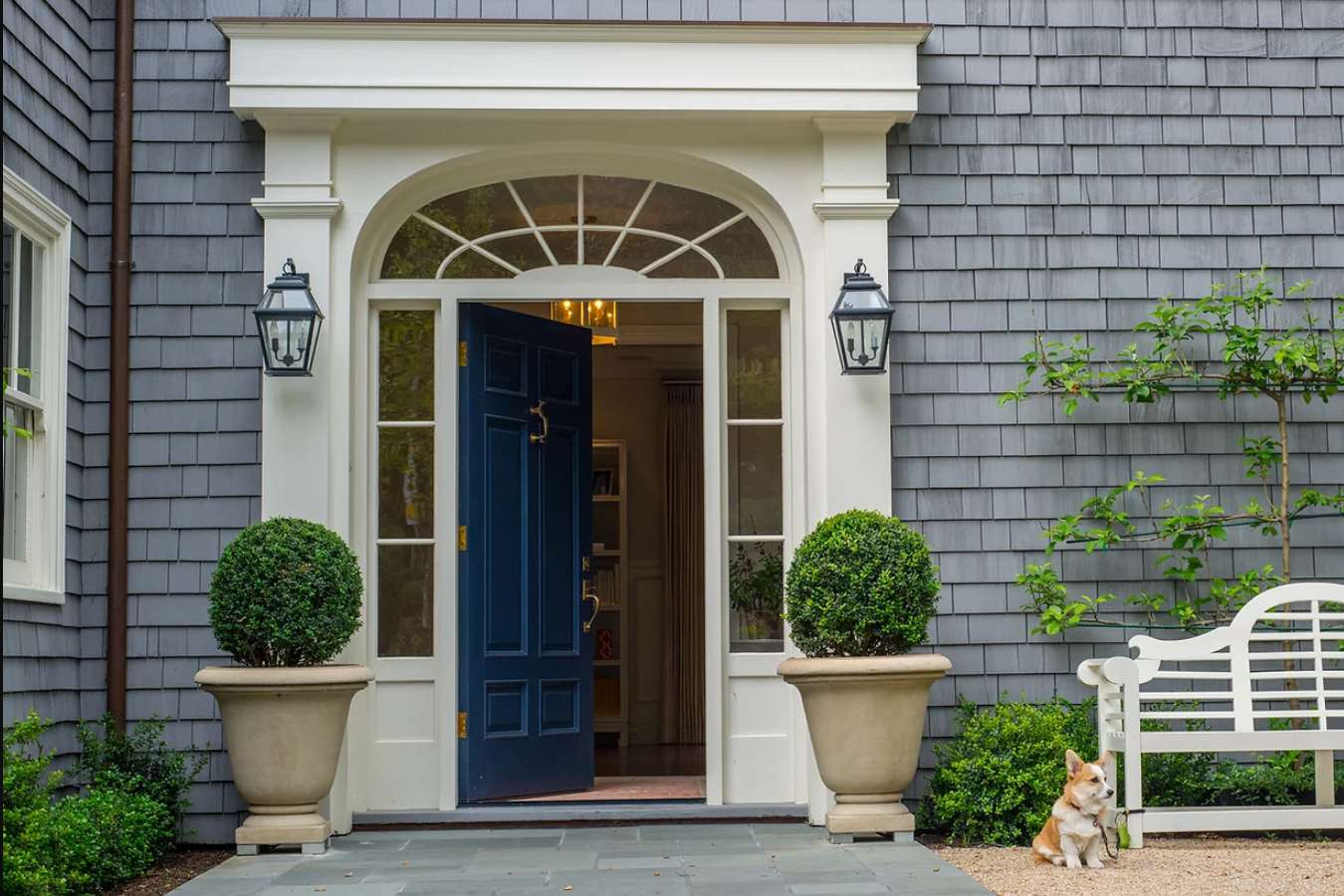
3. Arched Trellis Over a Dark Blue Door on Gray Shingles
The visual formula here is roughly 50% gray shingle, 20% white trim, 15% dark blue door, and 15% living green. That’s what keeps the door from feeling jarring — the blue is a near-neutral next to the gray, and the white trim plus the green trellis do the actual framing. You can swap the dark blue for charcoal or forest green and keep the same ratios; the key is letting the door occupy less than 20% of the facade’s color mass.
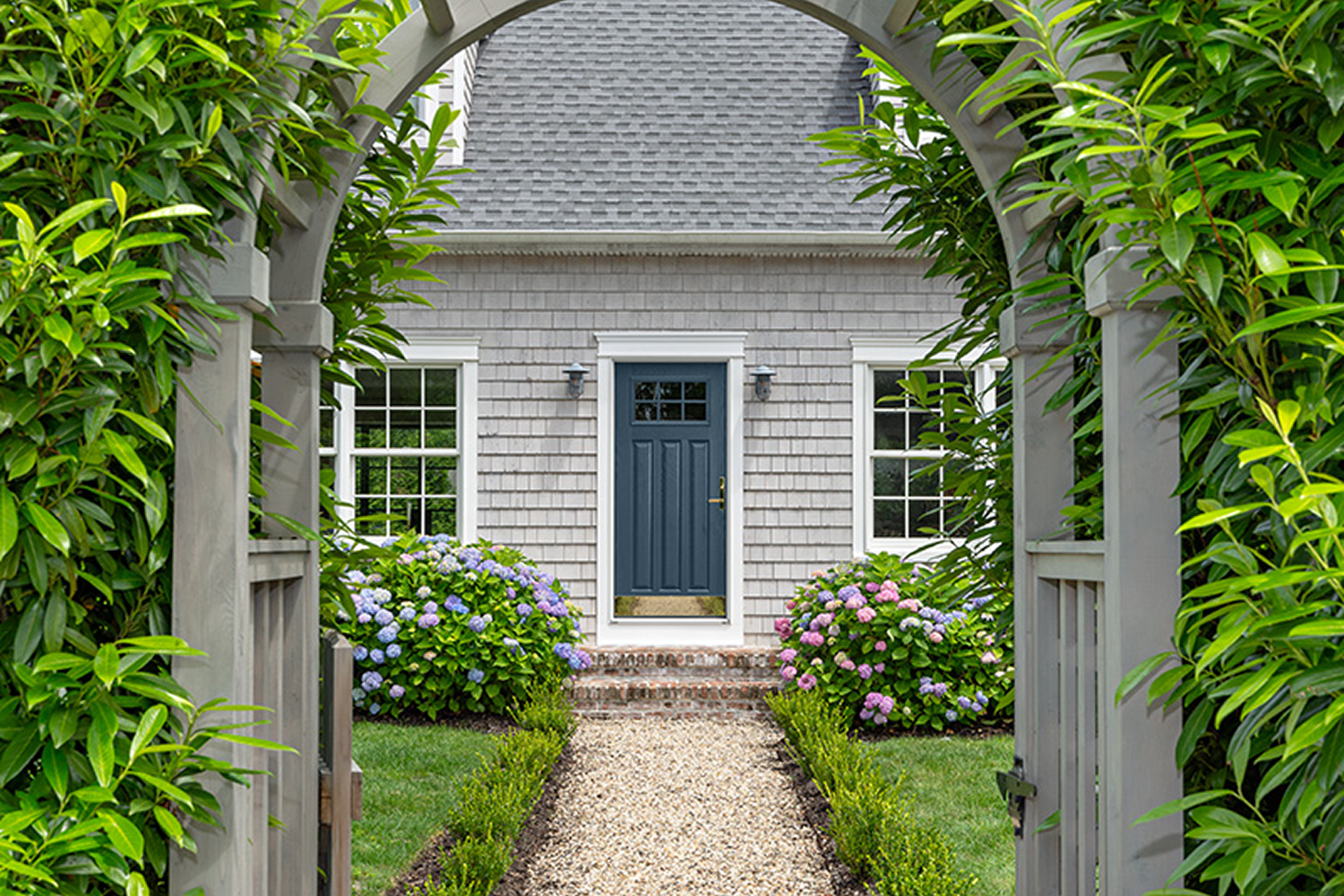
“You don’t need a custom arched trellis to get this look.”
A pre-made cedar arbor from The Home Depot runs $150–$300, and you can train a clematis or climbing hydrangea up it in one season. The dark blue door color can be matched with a $40 gallon of Benjamin Moore exterior paint. If the gray shingle is intact, skip re-siding and just power wash it — that alone restores most of the contrast. A brass kick plate from Amazon is about $35, and two sconces around $90 total.
4. Purple Front Door with White Trim on a Gray-Green Craftsman Porch
A purple door on gray-green siding is a commitment, not a weekend whim. That electric hue will look darker and more subdued on an east-facing porch by 2 p.m., then glow almost neon at dusk. Test a swatch on the actual door and watch it at different times of day for a full week before you commit. Also know that direct sun will fade organic red and purple pigments faster than blues or blacks — expect to repaint every 3–4 years if the door gets full western exposure.
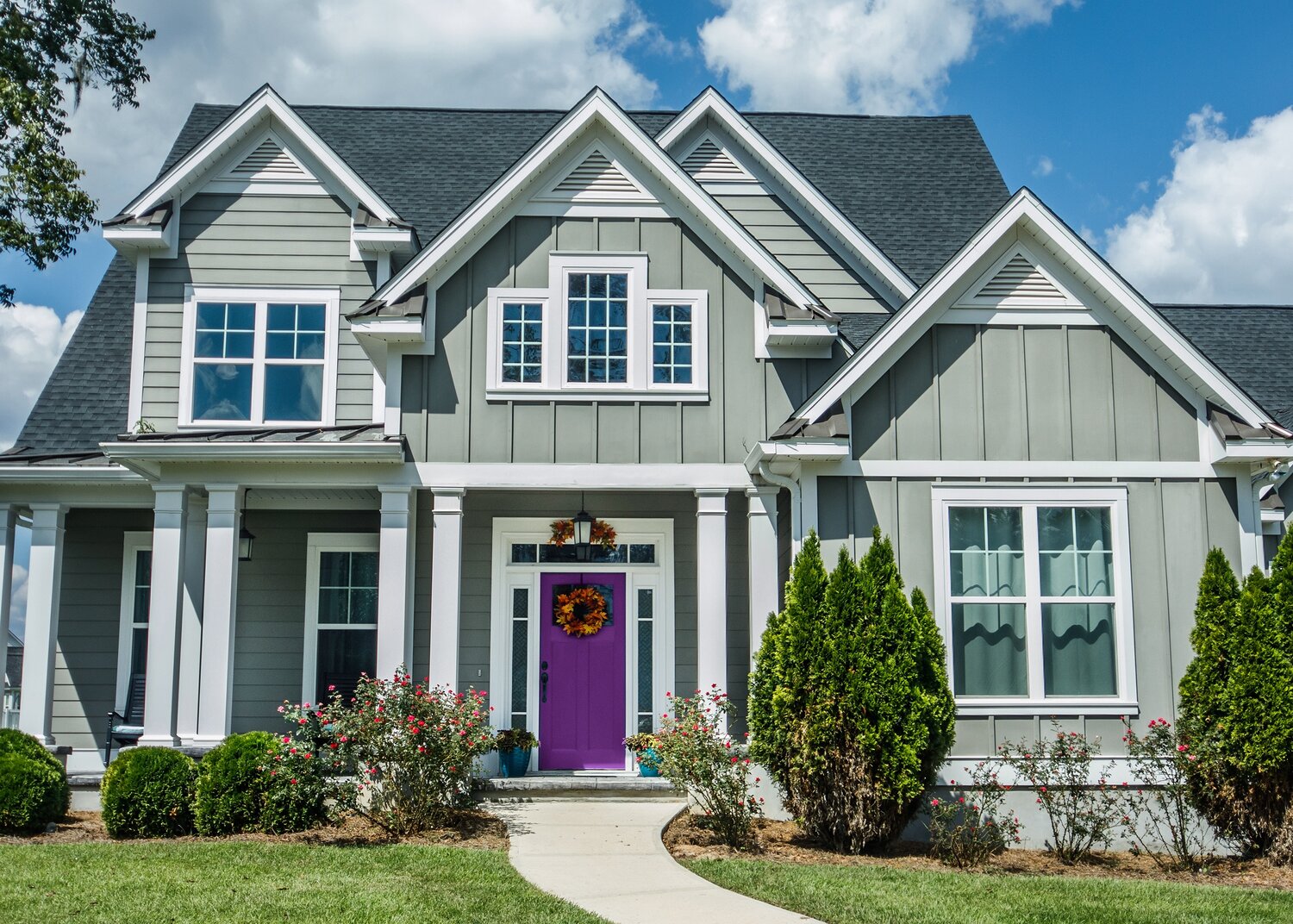
“Choose a purple with a cool or blue undertone rather than a magenta or berry tone.”
The gray-green siding already carries cool sage, and a blue-leaning violet will sit next to it like they were meant to be neighbors. Keep the white columns clean with a slightly warm white (try Sherwin-Williams Alabaster) so the whole porch doesn’t go too icy.
5. Flush Black Front Door with White Trim on a Modern Gray House
The flush door disappears into the facade while still being the first thing you notice. That’s the trick — the black doesn’t add detail, it removes it. The white trim around the door and windows creates the only crisp lines, and the black-framed sconces repeat the door color so the black feels intentional rather than like a hole. The dark green plant in the light gray planter gives the eye one point of life without breaking the monochrome discipline. This is the sleeker sibling of Idea #12 — same gray/black logic, but here the door is flush instead of recessed.
“If you want to convert an existing paneled door to a smooth flush look without b”
If you want to convert an existing paneled door to a smooth flush look without buying a new slab, here’s the step-by-step:
- Remove all hardware and sand the door face with 120-grit to knock down the panel grooves.
- Fill the grooves with exterior wood filler and let it cure for 24 hours.
- Sand again with 220-grit until the surface is completely flat; wipe clean.
- Prime with a stain-blocking exterior primer and let dry for at least 2 hours.
- Roll on two coats of acrylic exterior enamel in black with a 1/4-inch nap roller for a smooth finish.
- Reinstall the door with concealed hinges or swap the visible hinges for black ones.
Time: about 6 hours plus drying. Material cost: $60–$110.
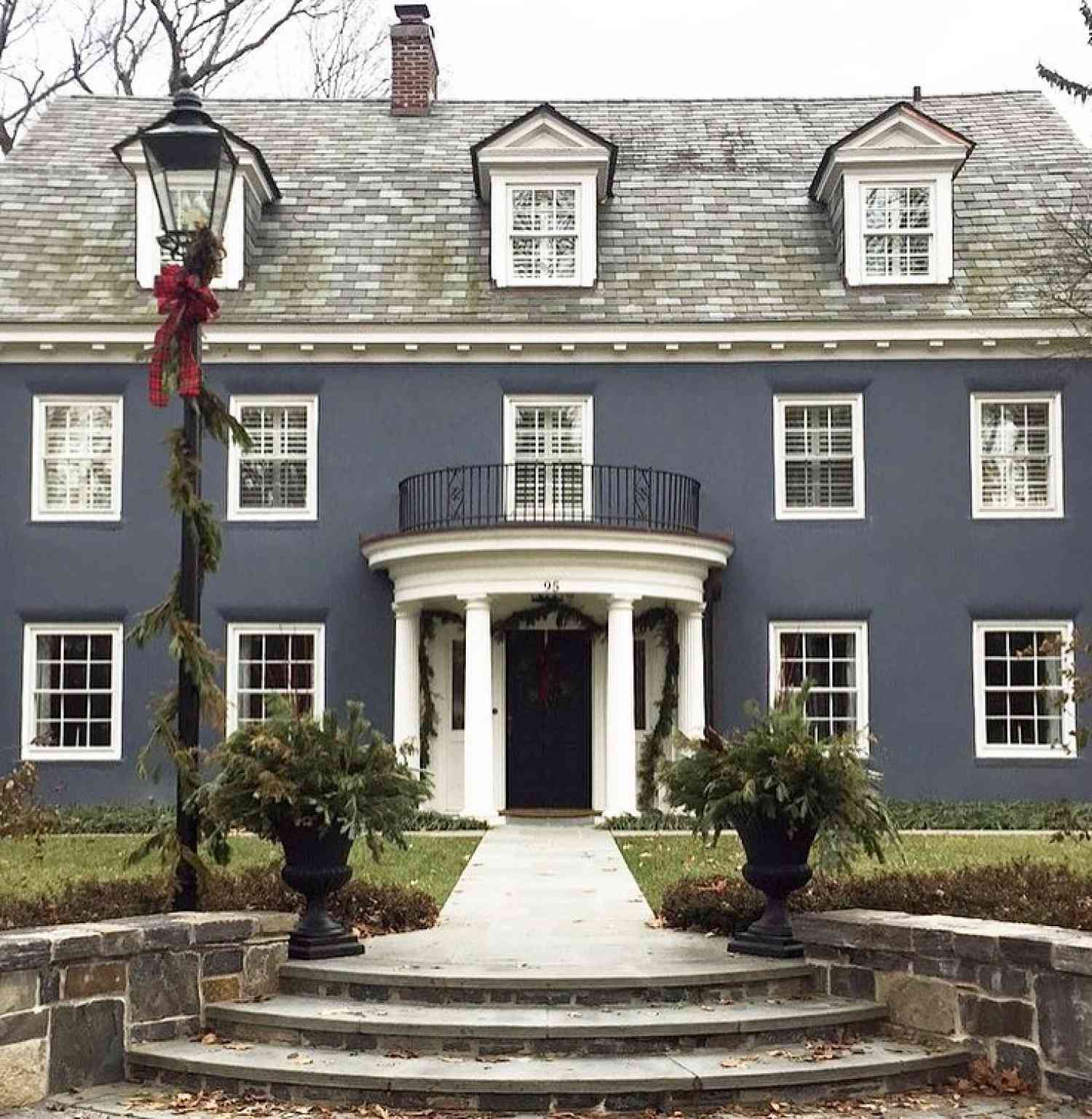
6. Navy Paneled Door with Brass Lion’s Head on a Gray Stone House
The mix of navy and gray stone is everywhere in 2026 for a reason — it reads as heritage without the red-brick weight. Brass lion’s head knockers and oversized black planters with pink and white blooms push this toward the traditional-grand revival that’s gaining traction on Pinterest boards for colonial and Georgian-style homes. What makes it current is the restraint: the door itself is a single saturated navy, not a high-gloss lacquer, and the stone is left unpainted to do the heavy lifting.
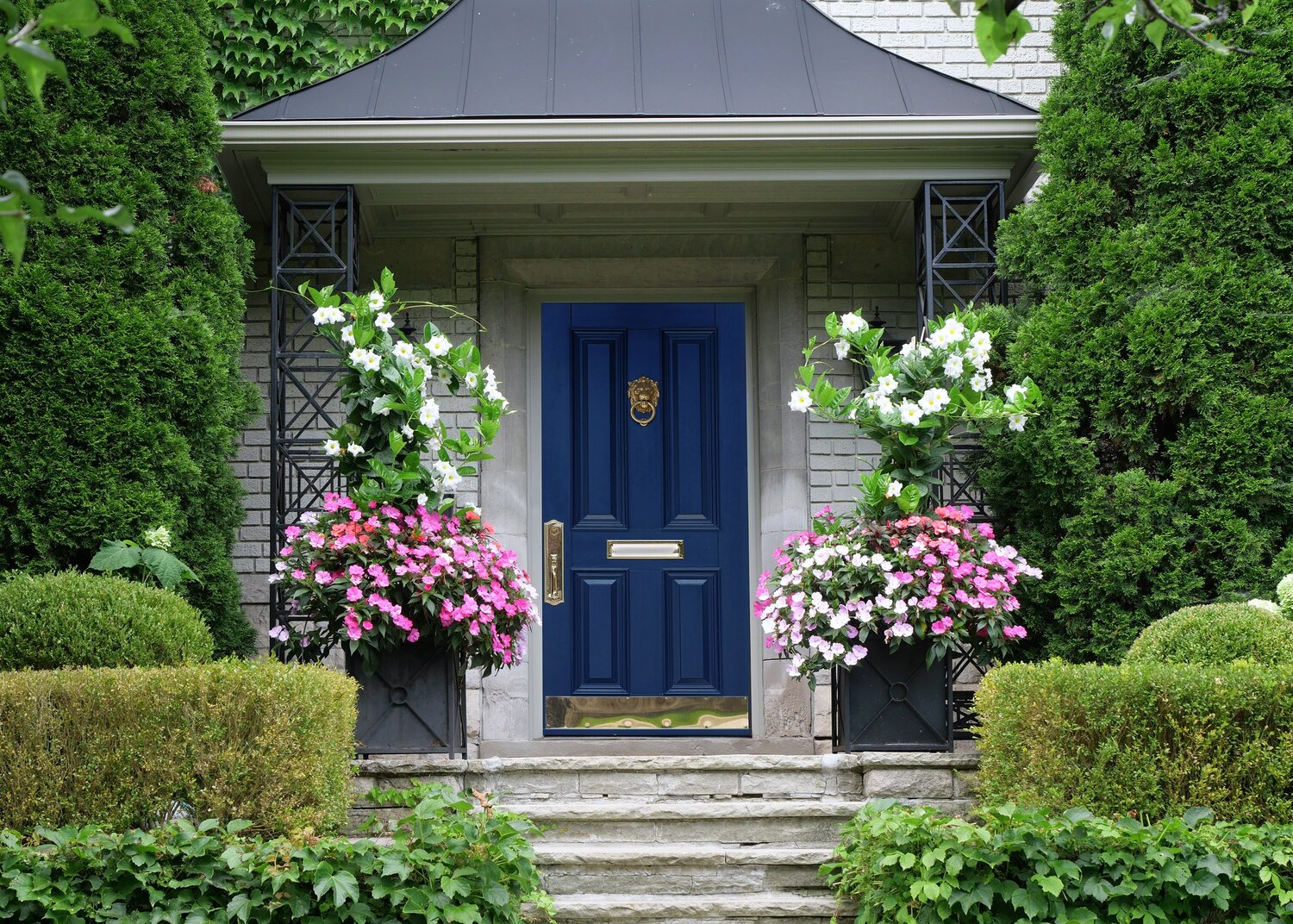
“This facade works on about 60% gray stone, 25% navy blue, 10% black metal, and 5% pink-white floral.”
The black porch supports and planters keep the navy from feeling nautical — they add a formal anchor. If you swap the navy for deep green or even dark aubergine, keep the black supports and brass hardware exactly the same. The formula fails only when one element goes too bright or too metallic.
7. Natural Wood Door with Black-Framed Windows on Warm Gray Siding
This warm gray and natural wood combination works best on a two-story home with at least a 6-foot wide porch or entry stoop. The wood door needs room to breathe — if your doorway is less than 42 inches wide, the glass panels can make the door feel skinny. Compare with Idea #28 where a chevron wood door needs an even wider modern facade. For ranch homes with a single-story porch, a solid wood door with fewer glass panels will hold the scale better.
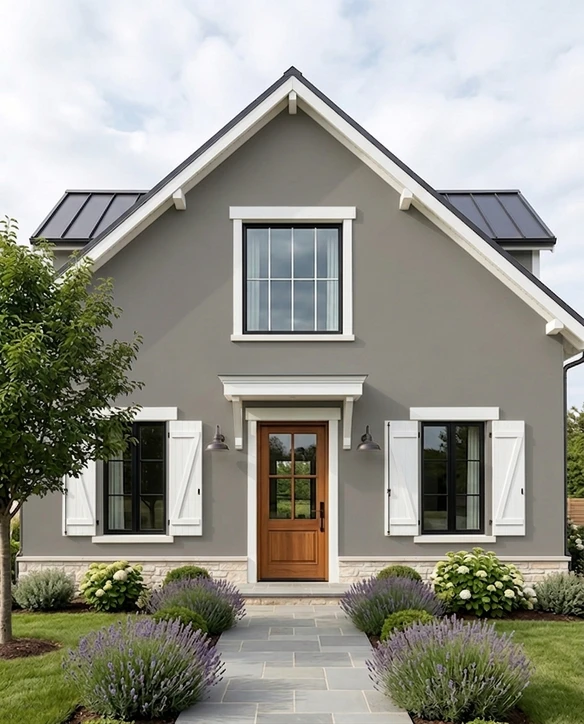
“The black-framed windows with white board-and-batten shutters are what make the natural wood door make sense.”
Remove those black frames, and the door would look like a warm blob against gray. The repeat of black in the windows and dark gray metal roof establishes a rhythm that lets the wood be the only warm note on the facade. Keep the shutters — they’re not optional decoration, they’re the structural color logic.
8. Light Wood Door with Glass Panels on a Dark Brown-Gray House
You can get this exact traditional look without paying for a custom mahogany door. A solid fir or pine door with glass panels from The Home Depot starts around $350–$600, and you can stain it yourself with a natural oak or teak stain for $25. The dark gray siding color can be matched with a $45 gallon of Sherwin-Williams Peppercorn. White trim and black sconces are the easy parts — shop Facebook Marketplace for matching sidelights and you can often find a set under $200.
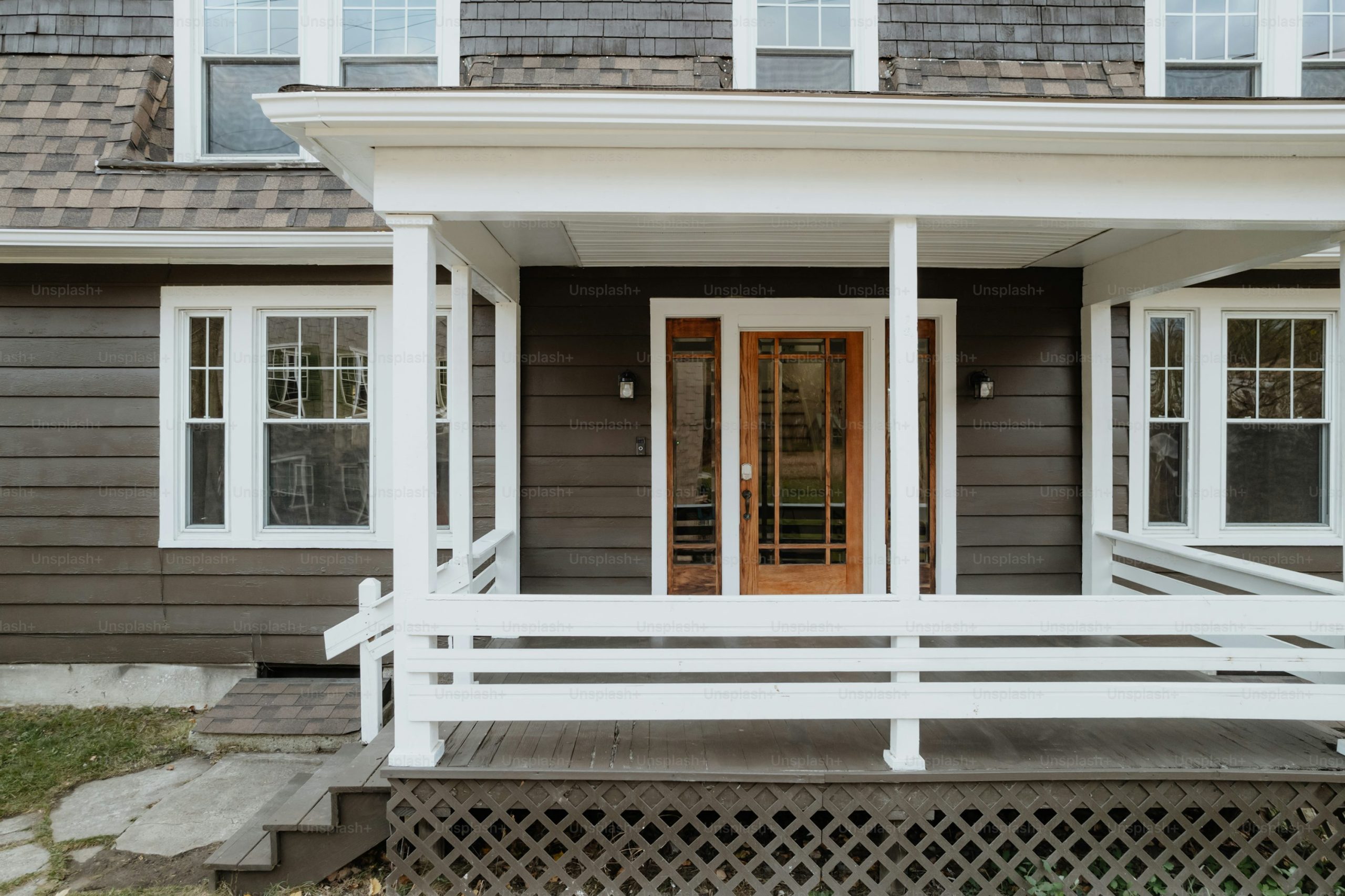
“That light wood door will need a fresh coat of marine-grade spar varnish every 12 to 18 months if it gets direct sun or rain.”
Expect to spend about $40 a year on varnish and 2 hours per coat. If you’d rather not deal with it, choose a fiberglass door with a wood-grain texture and a UV-resistant gel stain — it fades about half as fast and won’t warp. The white porch columns and railings should be touched up every 2 years with $30 exterior semi-gloss.
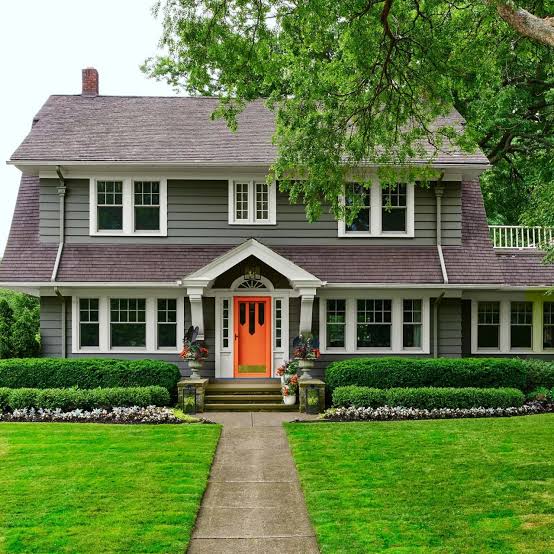
9. Orange Dutch Door with White Fluted Columns on a Light Gray House
For a Dutch door, the hardware matters as much as the color. Use a split handle set with a deadbolt at the top and a separate latch at the bottom, or the door will rattle when the top is open. Position the divider rail at least 40 inches from the floor so the bottom half can safely hold a toddler or a dog without making the top too small. And paint both halves the same orange — a mismatch makes the door look like a mistake.
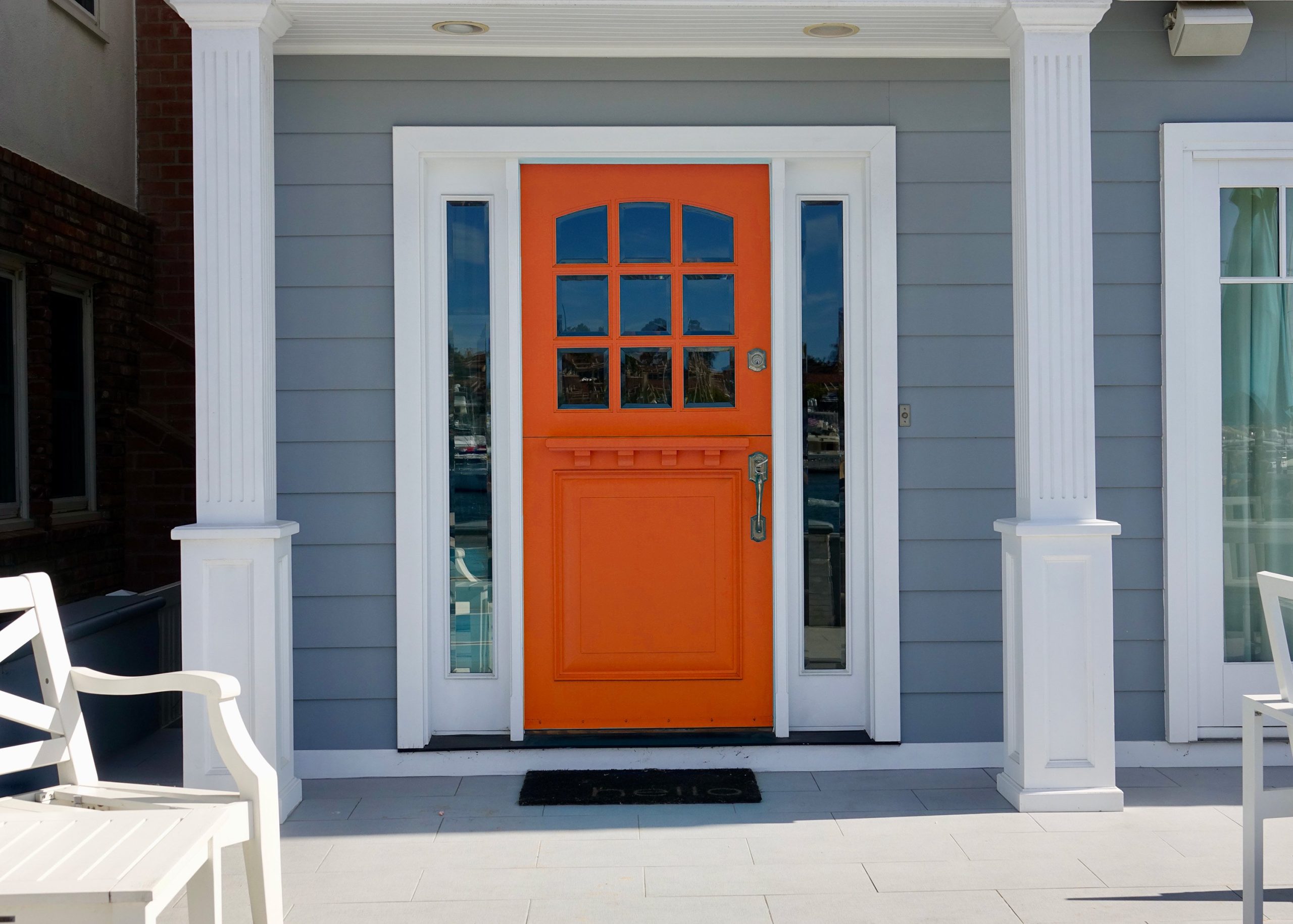
“The formula here is 70% light gray siding, 20% bright orange door, and 10% white fluted columns.”
That tiny orange sliver is what makes the entire facade feel coastal and fresh rather than formal and gray. You can swap the orange for coral, lemon yellow, or even hot pink and the math still works — the columns stay white, the siding stays gray, and the door stays under 25% of the facade’s color weight.
10. Dark Blue Door Behind a White Storm Door on Light Gray Siding
If you need a storm door for winter, don’t let it hide your dark blue door. Here’s how to keep both visible:
“Choose a storm door with full-view glass instead of a half-lite, so the blue pan”
- Choose a storm door with full-view glass instead of a half-lite, so the blue panel remains visible.
- Paint the storm door frame the same white as the trim, not a contrasting color.
- Hang a small wreath on the storm door, not the main door, so it reads as the outermost layer.
- Use a dark blue main door in satin, and keep the storm door glass clean monthly to avoid dirt muting the blue.
Time: 1 hour for setup, 10 minutes monthly. Material cost: $0–$40 for wreath and glass cleaner.
A storm door will always cut some of the saturation from your main door, especially on an east-west axis where the glass reflects the sky. If you live in a cold climate, the storm door is worth it, but know your dark blue will look closer to navy or almost black during overcast afternoons. Choose a blue with a hint of indigo rather than a true dark navy so it still reads blue through the glass.
11. Bright Blue Front Door with Stone Veneer on a Gray Shingle House
Bright blue doors on gray shingle ranches and two-story colonials are having a quiet revival in 2026, especially when paired with light stone veneer and white fascia. The reason is practical: gray shingle ages and darkens, but a saturated blue stays legible from the street. The matching blue accent brackets on the gables are a newer detail that takes this beyond the basic blue door and makes it feel like a deliberate exterior palette.
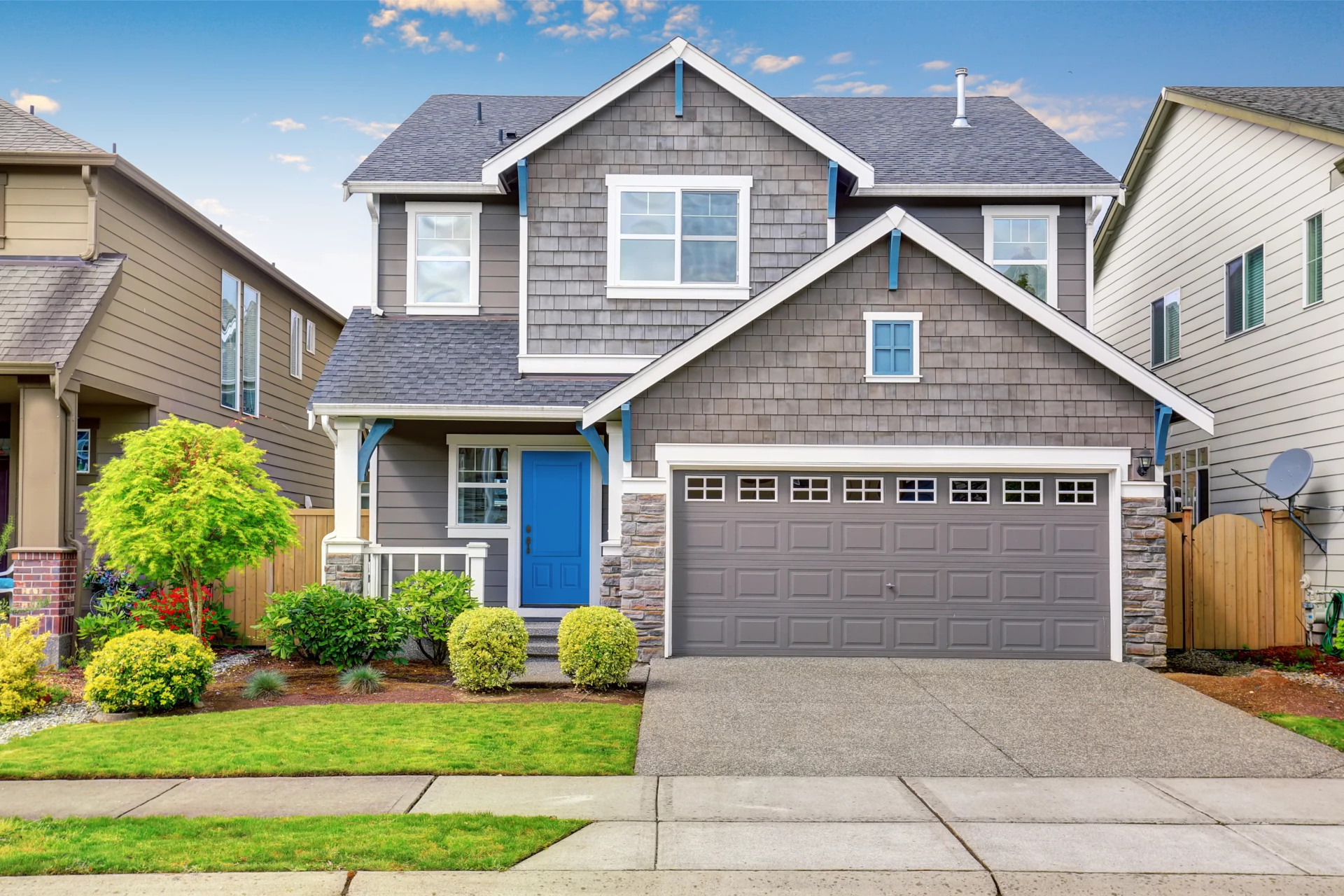
“This bright blue door works on a facade with at least 18 feet of visible width and a two-story entry or gable.”
If your house is a single-story ranch under 1,200 square feet, the bright blue can dominate too much. Scale back by painting the door a muted dusty blue instead and skipping the blue gable brackets. A gray single-story porch can use the same blue but at 60% saturation.
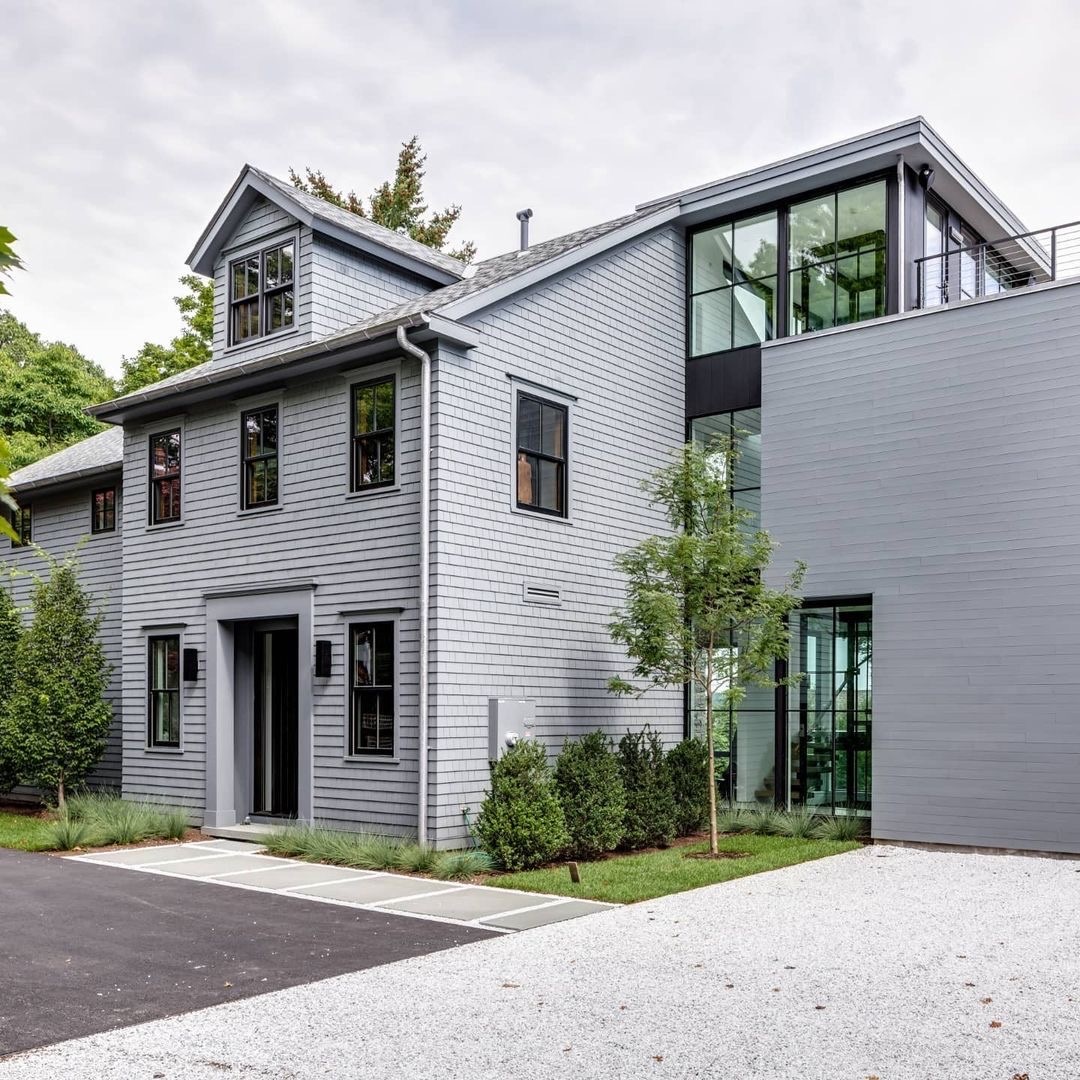
12. Recessed Dark Gray Door Blends into a Modern Shingle House
Getting this recessed, minimalist entry on a tight budget comes down to choosing the right door and surrounding materials. Here’s the realistic spend:
“Dark gray fiberglass flush door: $600–$1,200Black-framed windows and trim: $1,50”
- Dark gray fiberglass flush door: $600–$1,200
- Black-framed windows and trim: $1,500–$3,000 if replacing, or $80–$200 for black trim repaint
- Light gray paver path: $400–$1,100 for about 20 square feet of pavers
- Smooth gray paneling accents: $500–$1,000 for an accent wall or entry surround
- Landscaping: $200–$600 for low green shrubs and grass
- Total: $3,280–$7,100
- Budget alternative: Keep existing windows, use a dark gray slab door from IKEA or a local salvage yard ($250), and lay a simple gravel path with paver borders for under $200 — total around $1,100.
The recessed door sits behind the facade plane, so the facade reads as one continuous surface. That’s why the dark gray works — it doesn’t interrupt the shingle siding’s texture; it just folds into the shadow. The light gray pavers lead the eye toward the entry, while the black-framed windows create an even rhythm around the recess. Compare with Idea #5 — that one uses a flush black door for a similar effect, but here the recession adds architectural depth without any extra trim.
13. Bright Red Door with White Fluted Columns and a White Storm Door
The white storm door is what makes this red door work from the street. The red shows through, but the white outer layer softens the contrast just enough so the entry doesn’t feel like a fire station. If you remove the storm door, you’d need to add a red or brick-colored sidelight frame to keep the same traditional balance. Keep the storm door glass clean and the white shade slightly warm.
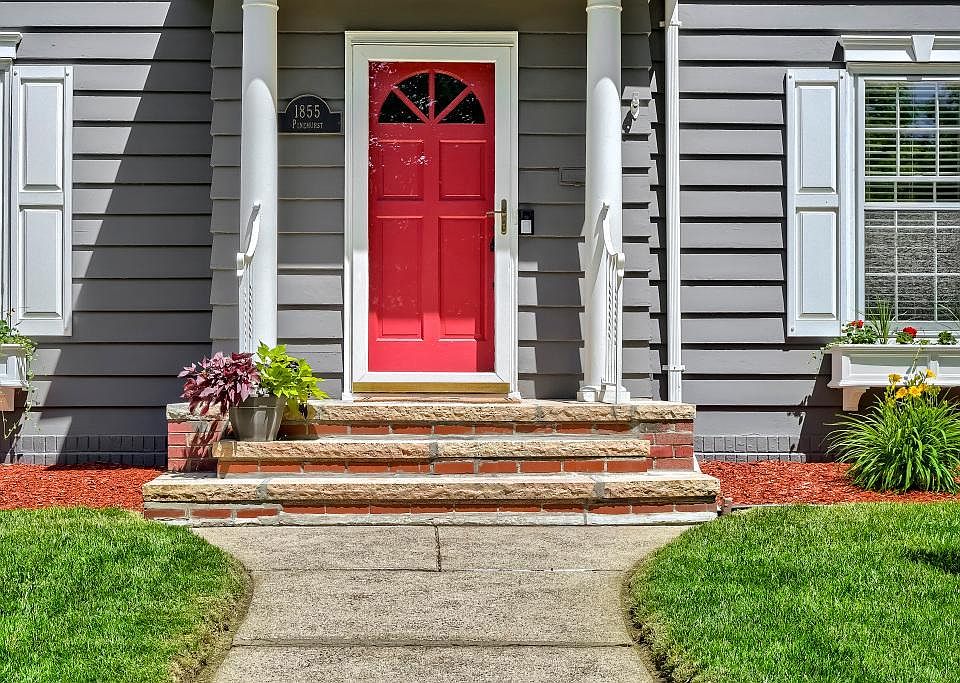
“When pairing a red door with a white storm door, paint the inner door in high-gloss red and the storm door in a dead flat or satin white.”
The two finishes create depth through the glass. Also, use black or bronze hardware on both doors — never silver, which will read cold against the red and gray.
14. White Paneled Door with Frosted Glass on a Gray Siding House
A white paneled door with frosted glass is one of the most affordable ways to brighten a gray house without committing to a bold color. Big box stores carry this exact style for $250–$500. You can frost the glass yourself with a $15 can of spray-on glass frosting from Amazon. Pair it with a $35 black wall lantern and a natural wreath made from dried eucalyptus or boxwood for $20. The whole entry refresh lands under $600.
“White doors on gray houses show every smudge, especially around the handle and lower panel.”
If you have kids or pets, choose a wipeable satin or semi-gloss enamel rather than flat. Also know that frosted glass reduces visibility from inside; if you want to see who’s at the door, choose clear glass with a privacy film instead. The black railing and concrete steps require no maintenance beyond an annual power wash.
15. Crimson Red Paneled Door with Black Lanterns on a Light Gray House
The math here is simple: 75% light gray siding, 15% crisp white trim, 8% crimson door, and 2% black lanterns and hardware. That tiny black layer is what keeps the red from looking valentine-cute. Without the black lanterns and house numbers, the red would feel too sweet; with them, it reads as classic Americana. You can swap crimson for pine green or oxblood and the same formula holds.
“This crimson will fade fastest on a south-facing door.”
Choose an exterior paint with UV inhibitors and expect to repaint every 2–3 years if you use a budget paint. The dark house numbers to the left need contrast — if you replace the door, keep the numbers black or oil-rubbed bronze, not brass, or the facade’s crispness falls apart.
16. Vibrant Orange Door on a Gray Clapboard House with a Raised Porch
To get this rustic-porch look without rebuilding the porch, focus on the door and the styling around it:
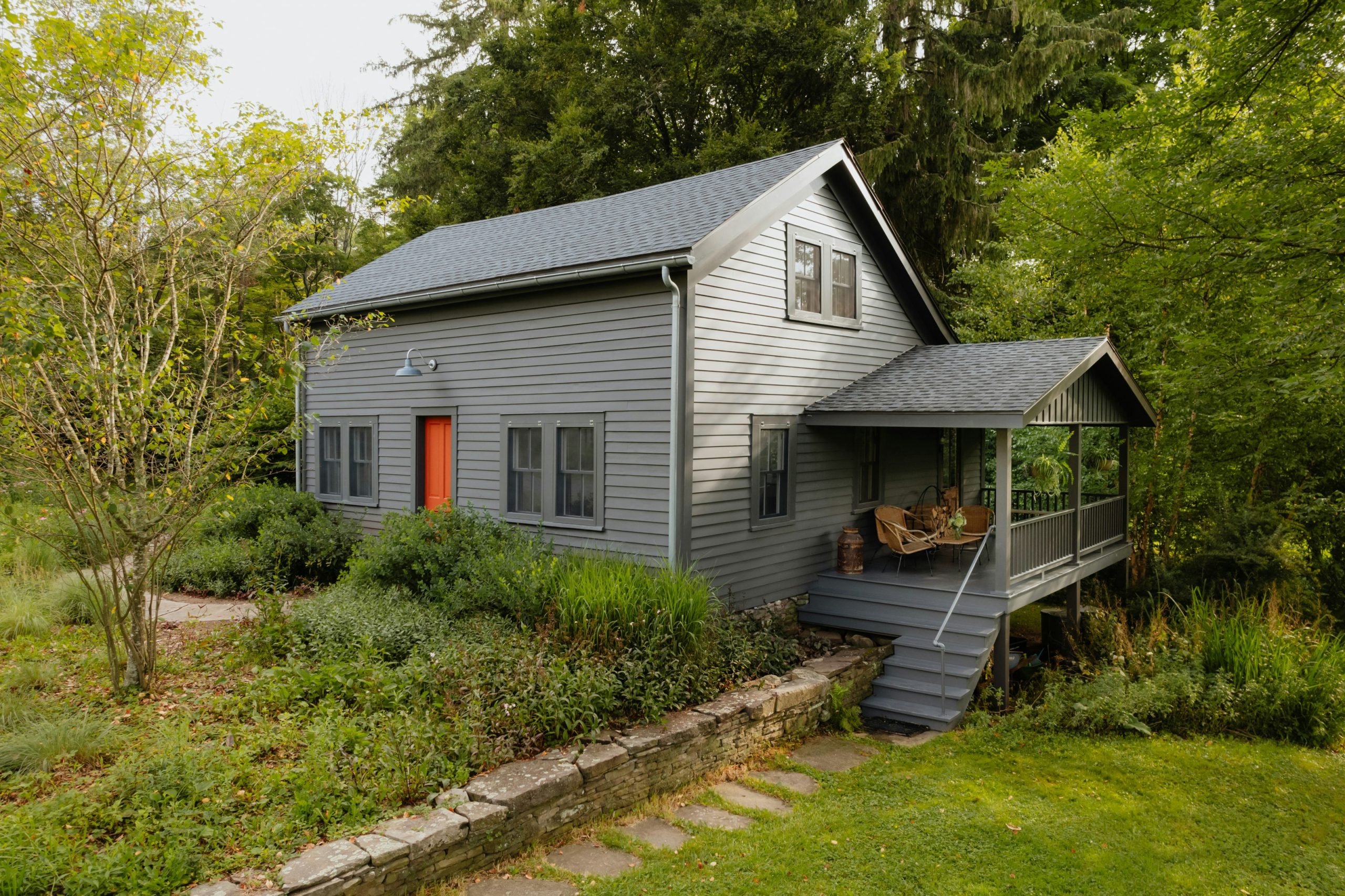
“Sand and prime the old door, then paint it vibrant orange in two thin coats — al”
- Sand and prime the old door, then paint it vibrant orange in two thin coats — allow 4 hours between coats.
- Replace the door hardware with a dark bronze or black set for $30–$60.
- Paint the porch floor and railings a warm gray to contrast with the orange.
- Add wicker furniture with cream cushions, and place a low stone edging planter beside the steps.
- Finish with a woven doormat in natural jute.
Time: 1 full day. Material cost: $80–$180.
Rustic gray exteriors with one bold orange accent are trending because they feel both grounded and playful in a time when homeowners want a touch of personality without changing the whole exterior. The wicker furniture and stone retaining wall signal slow living and outdoor comfort, while the orange door acts like a welcome mat made of color. This one has staying power because it’s easy to repaint when the trend shifts.
17. Warm Gray Paneled Door with Stone Pillar Bases and a Natural Wreath
This stone-and-gray pairing works best on a porch with at least 8 feet of clear width and a ceiling height of 9 feet or more. The stacked stone pillar bases need visual weight — if your porch is narrow, switch to a single stone veneer column base instead of wide pillars. For a single-story ranch with a more modest entry, use the same warm gray door but skip the full-length sidelight and keep the stone bases under 3 feet tall to avoid crowding the door.
“The natural wreath with dried flowers and greenery is the element that keeps this from looking like a model home.”
The stone, gray door, and white trim are all cool and structured; the tangled, imperfect wreath introduces a bit of life and softness right at eye level. Remove it and the entry becomes almost too formal. A faux wreath won’t do — the dried texture is the point.
18. Vibrant Blue Paneled Door with Arched Transom on a Brown-Gray Brick Facade
Brick is easier than you think, but the blue door needs attention. The textured brown-gray brick will hold dust and cobwebs, so plan on a soft brush or hose rinse twice a year. The blue door, especially with brass hardware, should be wiped down monthly to keep the brass from tarnishing and the paint from looking dull. Expect to repaint the door every 3–4 years if it gets southern or western exposure. The climbing rose needs pruning once a year and will stain the brick below if you don’t trim it back from the door frame.
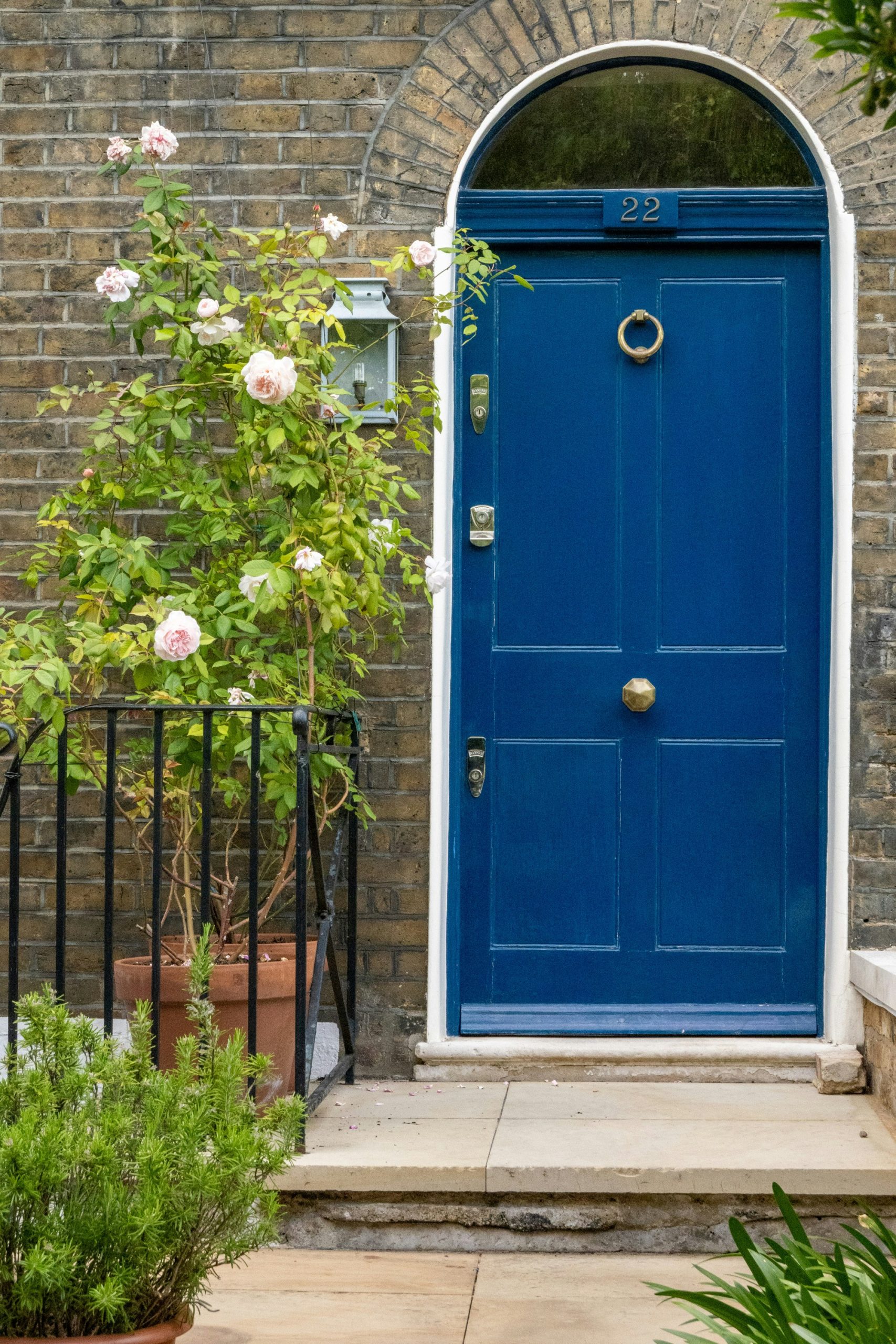
“This facade follows a 60% brown-gray brick, 25% vibrant blue, 10% white trim, and 5% pink rose petals formula.”
The white arched transom is the bridge between the rough brick and the smooth blue door. The light stone steps add a final neutral layer that keeps the eyes moving up. Swap the blue for deep teal or mustard and the ratio still works; just keep the brass hardware and white trim fixed.
19. Dark Double Doors with White Trim on a Light Gray House
For double doors, symmetry is the whole game. The two doors must be exactly the same height, width, and paint finish — but they should operate independently with a dummy handle on the passive side. Use a continuous weatherstrip and a center astragal to block drafts. Hang a wreath on only one door to keep the entry from looking too static; the asymmetry lets the eye rest. Large dark-framed sconces should be mounted 60 to 66 inches from the porch floor, centered on each door.
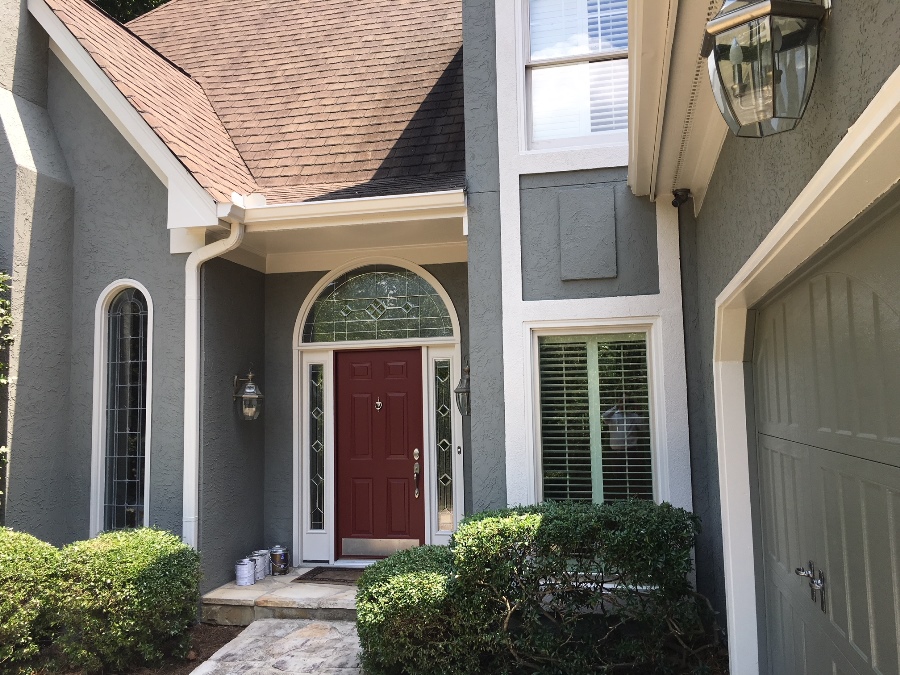
“Two custom dark doors can cost $2,000–$5,000.”
To get this formal look for less, buy two pre-hung fiberglass doors from The Home Depot at $300–$500 each and have a local carpenter join them with an astragal for about $200. Paint both doors yourself for $60 with a dark charcoal exterior enamel. The large sconces can be found on Facebook Marketplace for $40–$80 a pair. Total cost: under $1,200.
20. Classic Red Door on a Medium Gray House with Stacked Stone Foundation
The stacked light gray stone foundation does more than the red door. It creates a horizontal visual base that anchors the entire facade, so the red door doesn’t float. The dark-finished wall sconces bracket the door and pull the eye up to the white trim. The red only works because it’s kept to a small percentage — maybe 10% of the facade. The green shrubs soften the transition between stone and siding. This is the more classic sibling of Idea #25 — same red door, but that one sits on a modern farmhouse exterior.
“The red door will impact your entry’s light inside.”
If the door faces north, the red may look almost burgundy in winter. Consider a brighter orange-red rather than a deep crimson if you want year-round warmth. The stacked stone foundation should be checked every spring for mortar cracks; repairs run $200–$600 if caught early. The green shrub landscaping needs a trim every 6–8 weeks in growing season.
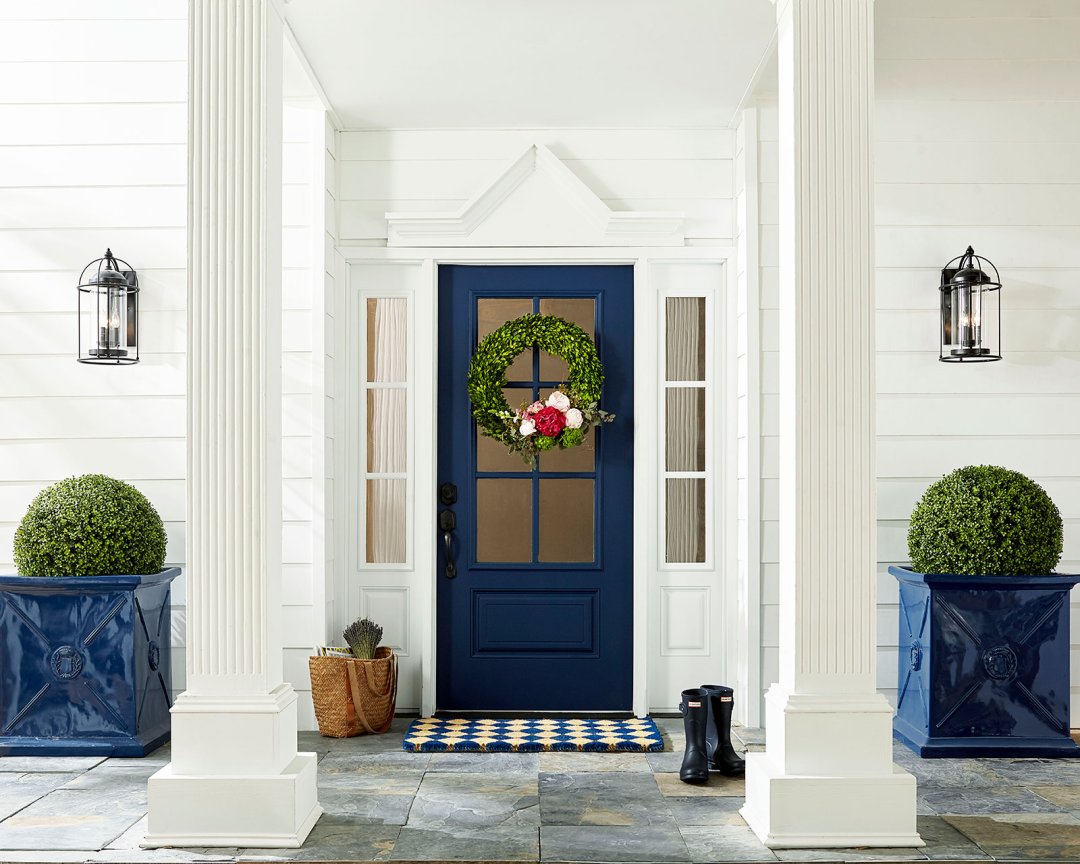
21. Deep Blue Door with Glossy Blue Planters on a White Plank House
To get that glossy planter-and-door pairing exactly right:
“Paint the front door deep blue in a satin exterior enamel; let dry 48 hours.Choo”
- Paint the front door deep blue in a satin exterior enamel; let dry 48 hours.
- Choose two planters with the same undertone as the door — glossy royal blue works because the door has a green or purple undertone, not a flat navy.
- Fill the planters with green topiary shrubs, not flowers, so the blue stays the color story.
- Set the planters 12 to 18 inches from the door jamb, leaving the gray flagstone visible in front.
- Mount black lantern sconces at 60 to 66 inches from the floor.
Time: 2 hours. Material cost: $120–$250 for paint, planters, and shrubs.
This crisp white plank with a deep blue door and glossy blue planters is a modern take on classic East Coast entryways. In 2026, the trend is toward monochrome blue accents — door, planters, even porch accessories in the same hue — instead of matching the door to the shutters. It reads fresh and curated, but the white columns keep it from feeling like a beach house. Expect to see this blue-on-white formula continue through the decade because it photographs incredibly well.
22. Terracotta Door on a Modern Gray Brick House with Wood Soffit
Terracotta and wood are the warm neutrals everyone is pairing with gray brick in 2026. The reason is that gray brick can feel cold and corporate; the terracotta door and wood-paneled soffit inject natural warmth without going full rustic. The tall concrete planters with red foliage double down on the earthy palette. This is a considered, architectural take on the modern organic trend that’s dominating Pinterest for exterior design.
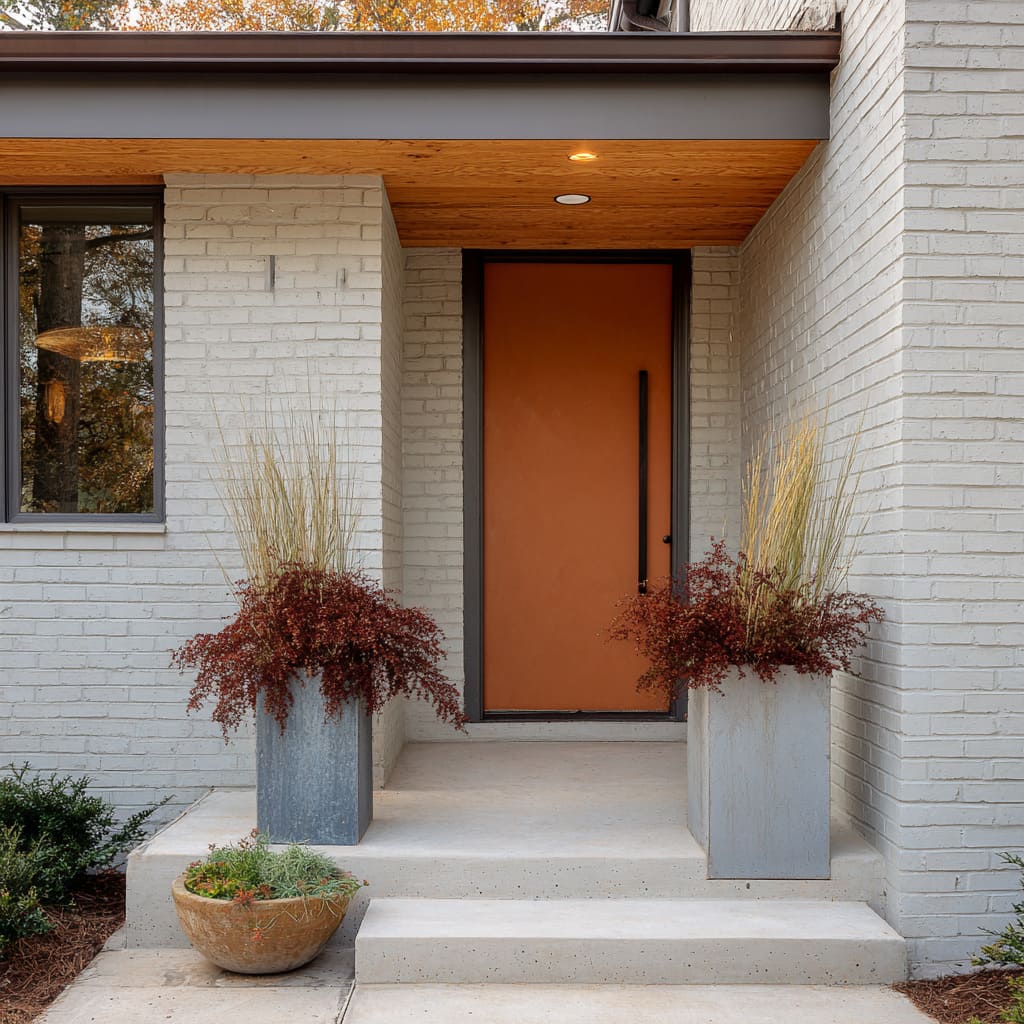
“This look works best on a modern or contemporary facade with at least 10 feet of entry width and a covered porch or overhang.”
The wood soffit needs a ceiling height of 9 feet or more to feel intentional, not cramped. If your entry is under 6 feet wide, skip the double concrete planters and use one tall planter on the latch side only. Compare with Idea #28 where a wood door carries the warmth; here the door is the only warm plane against cool concrete.
23. Turquoise Door with Black Shutters on a Light Gray Brick House
The black louvered shutters are what make that turquoise feel vibrant instead of tropical. The shutters repeat the door’s dark and light contrast, and the black urn planters at the base of the brick steps anchor the dark accents down low. Without the black shutters, turquoise on light gray brick would lean too Miami-beach. The black frames the turquoise like a gallery mat frames a bright print.
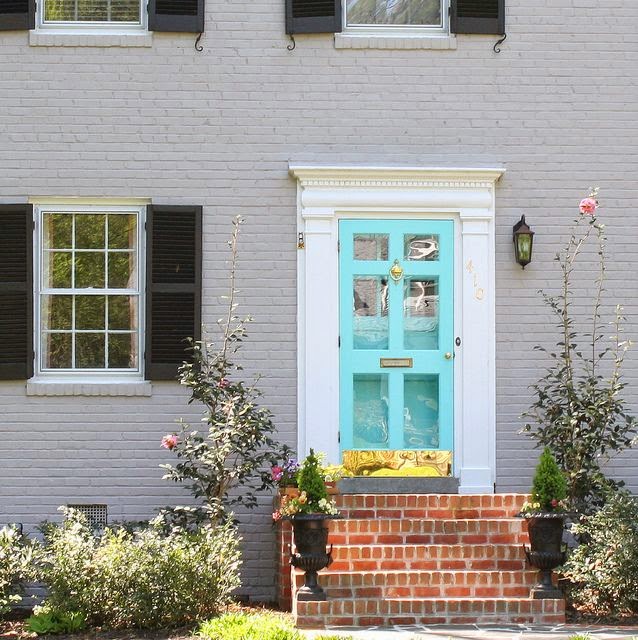
“Turquoise exterior paint will fade and chalk faster than almost any other hue.”
Use a paint with high color-retention pigments and plan to repaint every 2–3 years if the door gets full sun. The red brick steps will need occasional moss removal, and the black urn planters should be drained or emptied before winter to prevent cracking. Budget $100–$150 every other year for door repaint supplies and brick cleaning.
24. Muted Blue Craftsman Door with Wood Planters on Light Gray Siding
This muted blue Craftsman door is one of the easiest looks to recreate on a budget because the door itself is the main purchase. Here’s the cost breakdown:
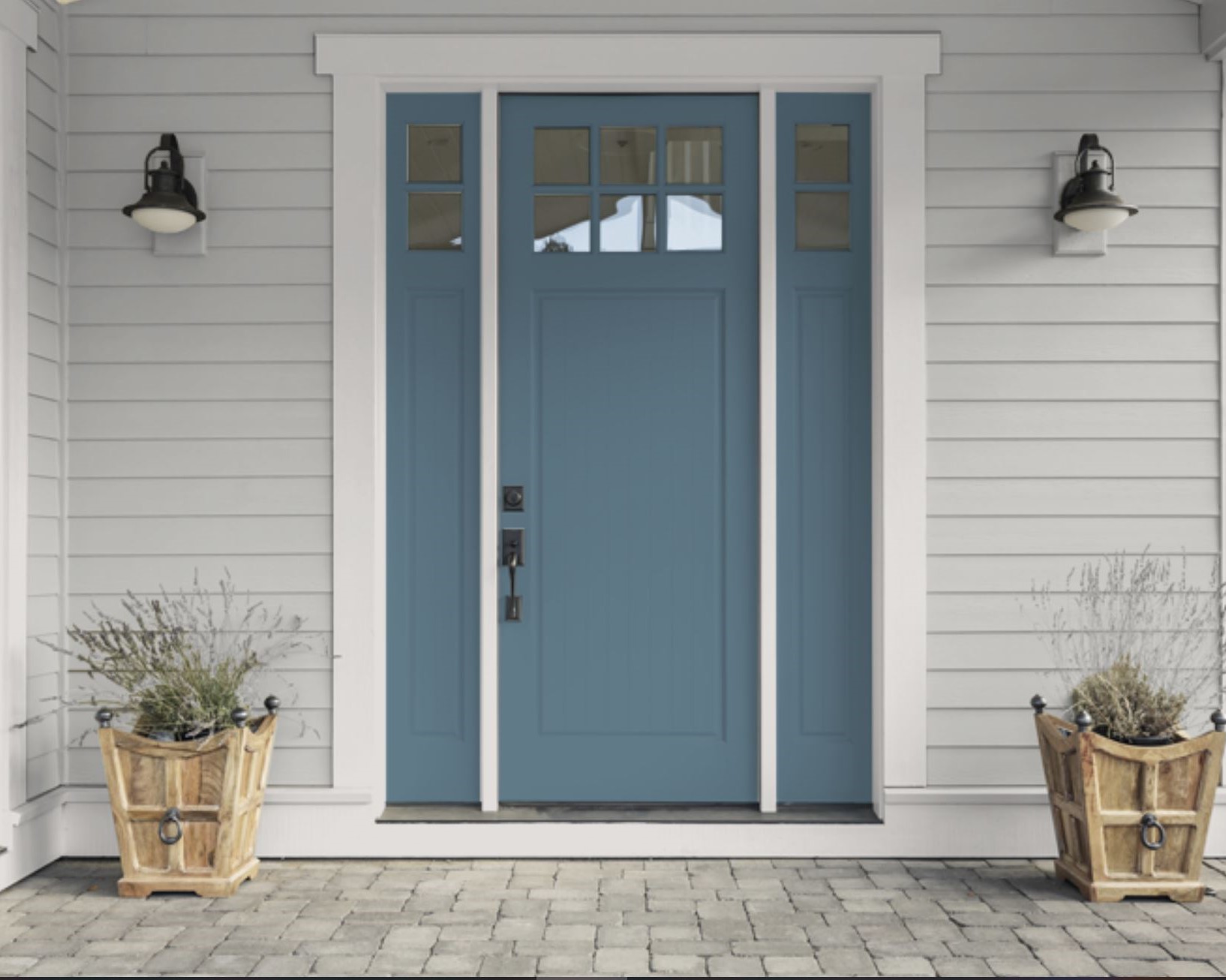
“Craftsman-style door with sidelights and transom: $800–$1,800 pre-hung, or $200–”
- Craftsman-style door with sidelights and transom: $800–$1,800 pre-hung, or $200–$500 for a used door
- Muted blue exterior paint: $40–$70 for a gallon
- Black metal sconce lights: $50–$140 a pair
- Natural wood square planters: $60–$120 each, or $20 each for cedar deck planters from IKEA
- Gray paver entryway refresh: $150–$400
- Total: $1,120–$2,650
- Budget alternative: Keep your existing door, paint it a muted blue with $40 of paint, add secondhand planters for $40, and lay a simple paver landing for $80 — total under $250.
The muted blue works because it isn’t trying to be a statement. The door recedes into the gray facade, allowing the wood planters and sidelights to carry the entry’s texture. The black sconces provide just enough contrast to read as intentional. This is the calm version of the brighter blues earlier in the list — compare with Idea #11 if you want more saturation. The muted tone also ages better than a vivid blue, making it a smart long-term choice.
25. Bright Red Door on a Light Gray Modern Farmhouse Board-and-Batten Exterior
Modern farmhouse board-and-batten is pricey to install, but you can mimic the look on an existing wall with pre-primed MDF battens from The Home Depot for $2–$4 per linear foot. The red door itself is cheap: a solid fiberglass red door starts at $300, or you can paint your existing door with $40 of cherry red exterior enamel. Dark wood porch columns can be wrapped from pressure-treated 4x4s and stained for under $150. Black-framed windows are a bigger splurge; if you’re not replacing them, paint the existing frames black for $60.
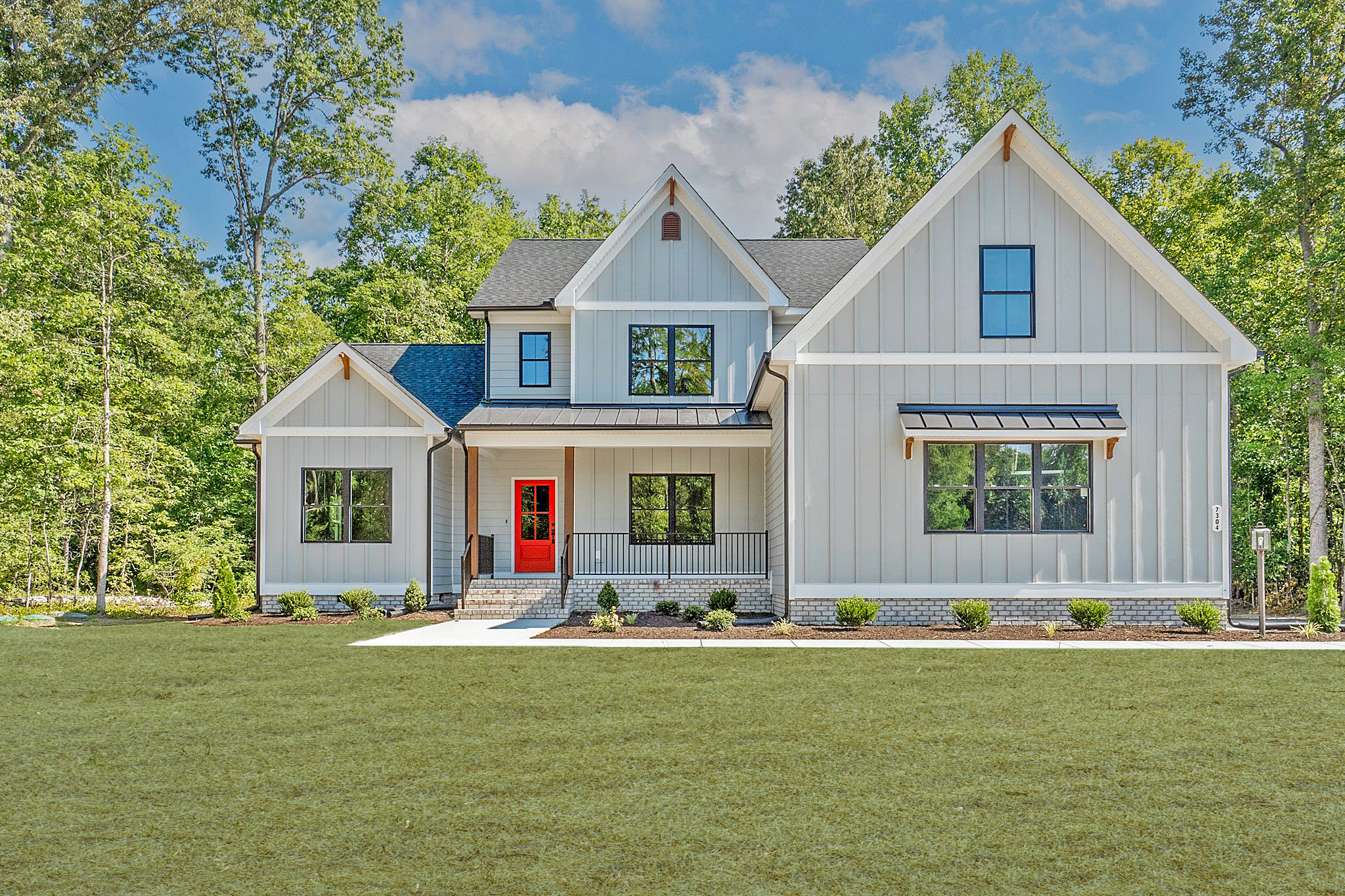
“The formula is 70% light gray vertical siding, 20% white trim, 8% red door, and 2% black frames and roof.”
The dark brown wood columns add a warm neutral layer that keeps the red from feeling too primary. You can swap the red for deep green or black and the farmhouse feel remains. The key is keeping the door under 10% of the facade — if the door gets lost, add a wreath or paint the ceiling of the porch light blue for an instant Southern touch.
26. Vibrant Teal Door on Cool Gray Siding with White Trim
To get a crisp teal door without brush marks:
“Remove the door and hardware, and lay it flat across sawhorses.Sand with 180-gri”
- Remove the door and hardware, and lay it flat across sawhorses.
- Sand with 180-grit, then wipe with a tack cloth.
- Apply one coat of gray-tinted primer; let cure for 2 hours.
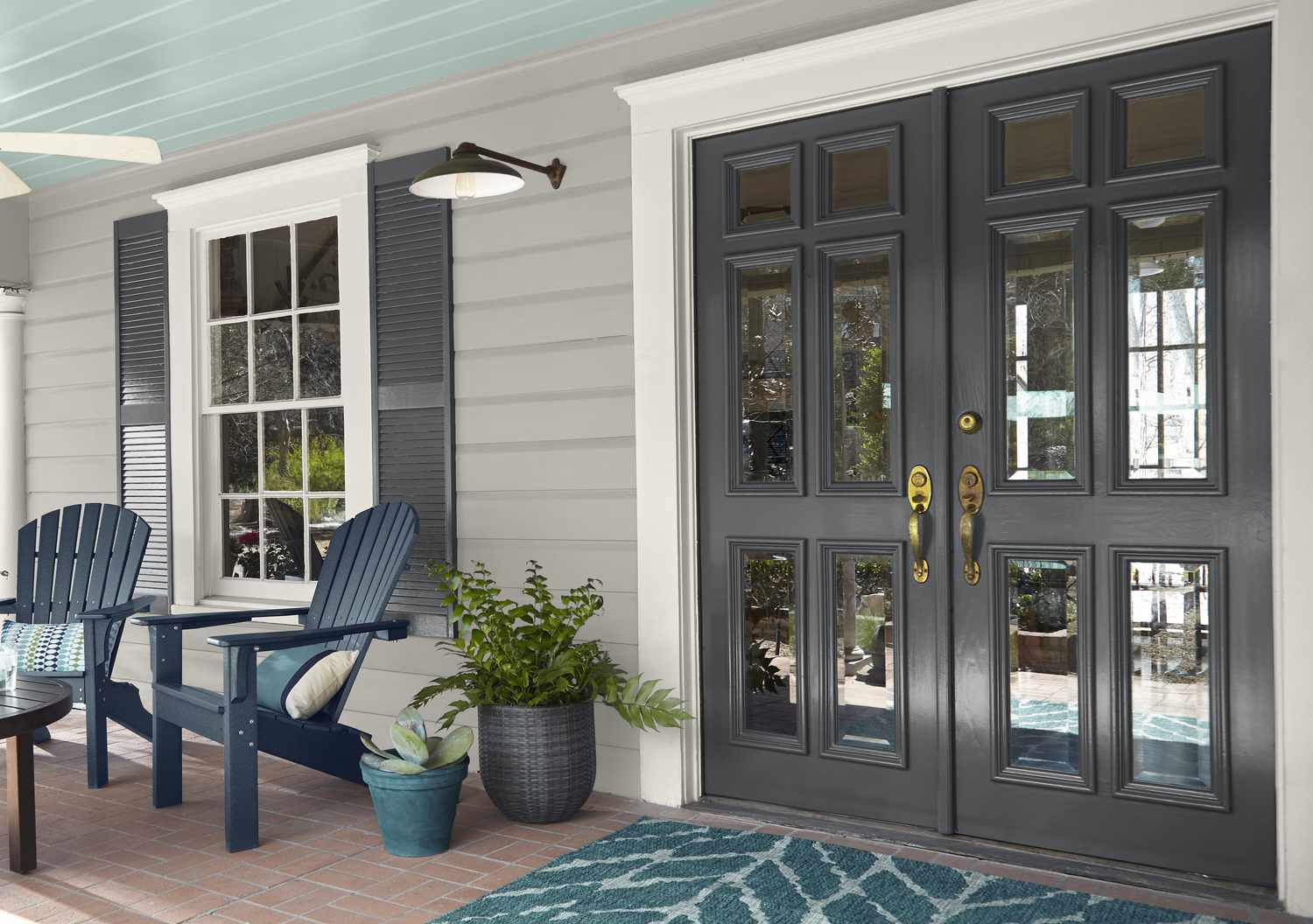
- Roll on two thin coats of high-gloss teal acrylic enamel, using a 1/4-inch nap roller.
- Let the door dry 24 hours before rehanging; reintroduce hardware with a felt buffer behind the strike plate to avoid chipping.
Time: 5 hours plus drying. Material cost: $50–$80.
Teal on cool gray looks fresh and contemporary, but it can turn greenish under LED porch lights at night. Test your exact swatch under the same light temperature you’ll use outside. Also, if you have a black wall-mounted light fixture, aim it down rather than out — glare on the glossy teal will create a hot spot that ruins the effect. Expect to repaint every 3–4 years to keep the teal from fading to aqua.
27. Pale Yellow Door with Potted Flowers on a Slate Gray House
Pale yellow doors on slate gray are gaining traction as an anti-trend palette — soft but not pastel-prissy. The stone veneer column base and black hanging lantern keep it from drifting into Easter territory, while the cluster of potted pink, purple, and yellow flowers turns the porch into a living color bridge between the yellow door and gray siding. In 2026, this front-porch-as-container-garden approach is everywhere, especially for otherwise neutral exteriors that need a seasonal refresh without repainting.
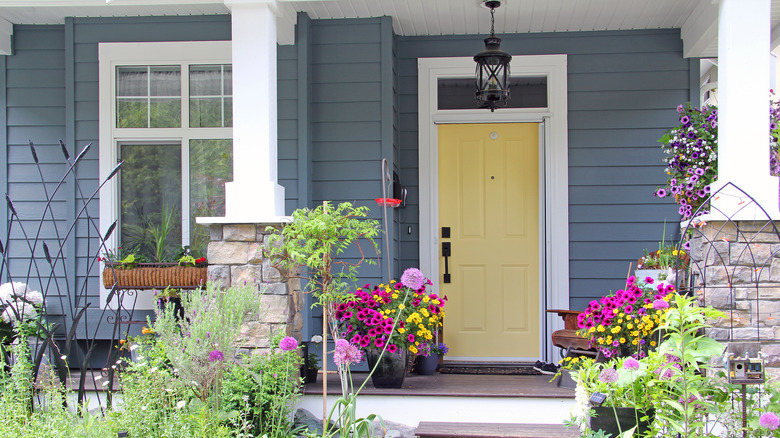
“The stone veneer column base is the surprising anchor.”
That small stacked stone detail ties the slate gray horizontal siding into the ground plane and gives the pale yellow door a material weight it would otherwise lack. Remove the stone and the door can feel a little floaty, like the yellow is just painted on with no foundation. The potted flowers work only because the stone and black lantern establish a neutral base.
28. Chevron Wood Door with Corrugated Metal Siding and Concrete
This modern entry needs a dramatic facade. The chevron wood door with diagonal glass panels wants at least a 10-foot-wide entry and a ceiling height of 10 feet or more to land. The dark corrugated metal siding and concrete walls demand an architectural context — if your house is a traditional colonial, this door will look out of place. The concrete overhang should extend at least 3 feet beyond the door to protect the wood from direct rain. For a more transitional version, swap the corrugated metal for dark gray smooth siding and keep the wood door simpler.
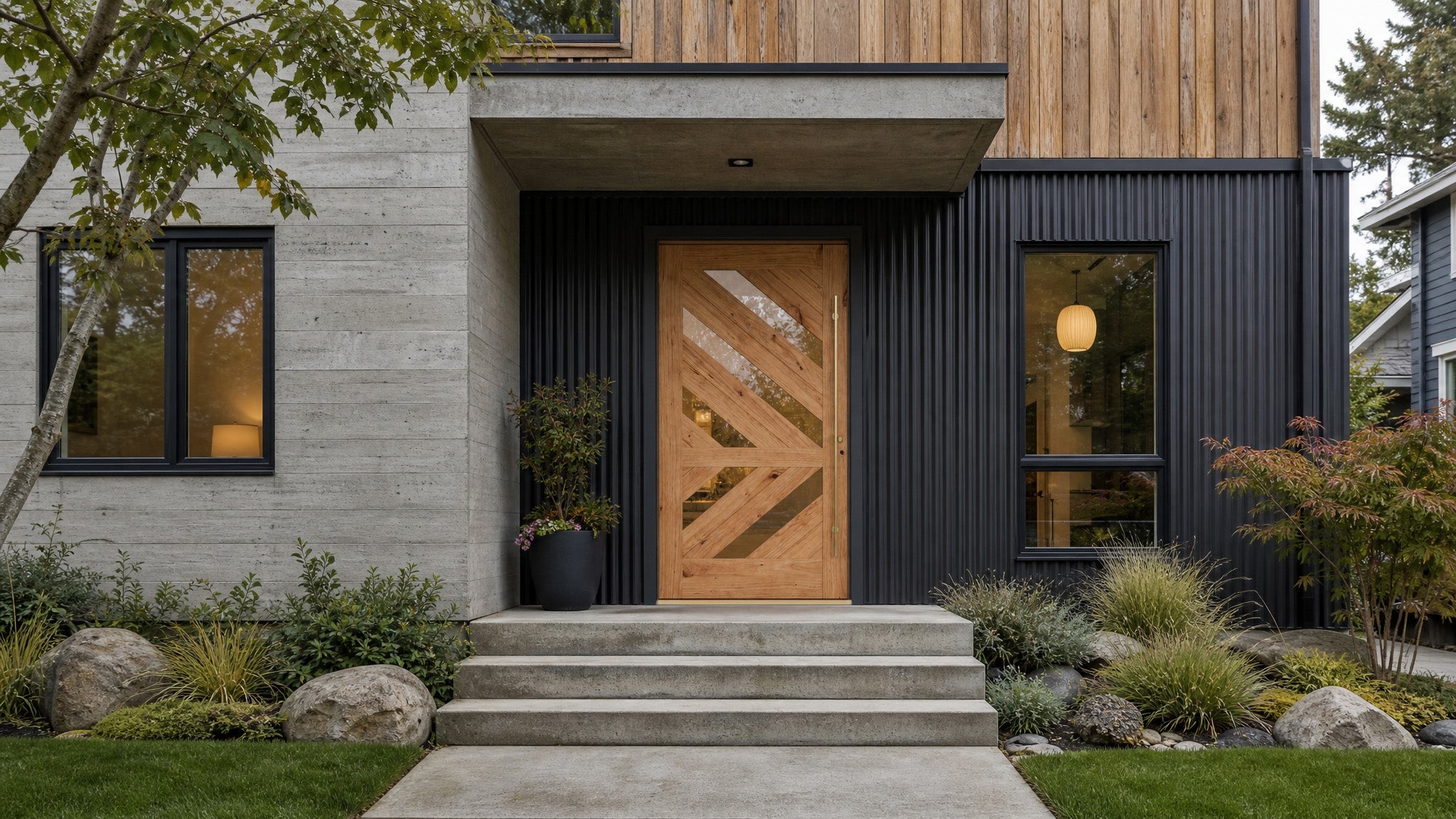
“The long brass door pull should be 48 to 72 inches long for a door like this, and it should be centered vertically at 40 inches from the floor.”
Use a pivot hinge if possible — it carries the weight of a solid wood and glass door much better than standard butt hinges and eliminates sag over time. Set the concrete steps at least 6 inches wider than the door frame on each side to create a platform-like arrival.
29. Vivid Teal Door with Lush Green Plants on a Light Gray Contemporary House
The dark cylindrical planters frame the vivid teal door the way parentheses frame a sentence. The teal is bright, but it doesn’t overwhelm because the eye hits the dark planters first, then the dark wall-mounted light fixture, and finally the door. The lush green foliage repeats the door’s cool undertone while adding softness. The silver door hardware is the only metallic reflection, which keeps the modern facade from feeling busy. This is a more plant-forward version of Idea #1 — similar teal, but here the door is a paneled solid, not a screen.
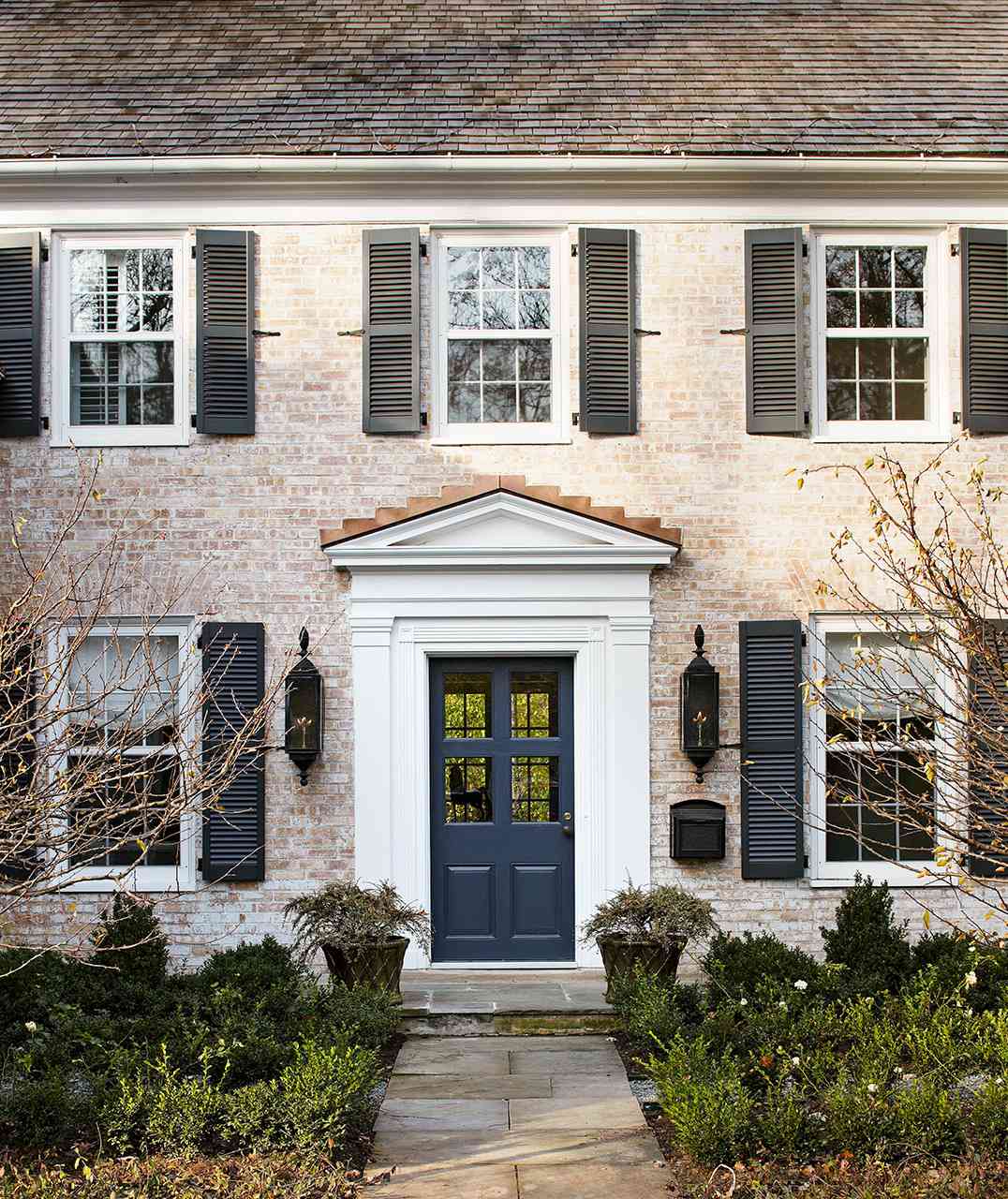
“Large cylindrical planters can be expensive at designer stores, but you can get concrete-look planters at Target or IKEA for $30–$60 each.”
Fill them with a tall snake plant or faux olive branch if you don’t want to maintain real greens. The teal door paint runs $40 at Benjamin Moore, and the dark light fixture is around $40 at Home Depot. For under $200 you can recreate this entire entry if your siding is already light gray.
30. Bright Red Six-Panel Door on Light Gray Siding with Dark Steps
The formula is 70% light gray siding, 15% white trim, 10% bright red door, and 5% dark gray steps and black sconces. The dark steps do crucial work — they visually weight the bottom of the entrance so the red doesn’t float. Same with the black metal sconces, which bracket the door and prevent it from looking disconnected. Swap the red for mustard or cobalt and the math still holds; just keep the steps dark gray or black.
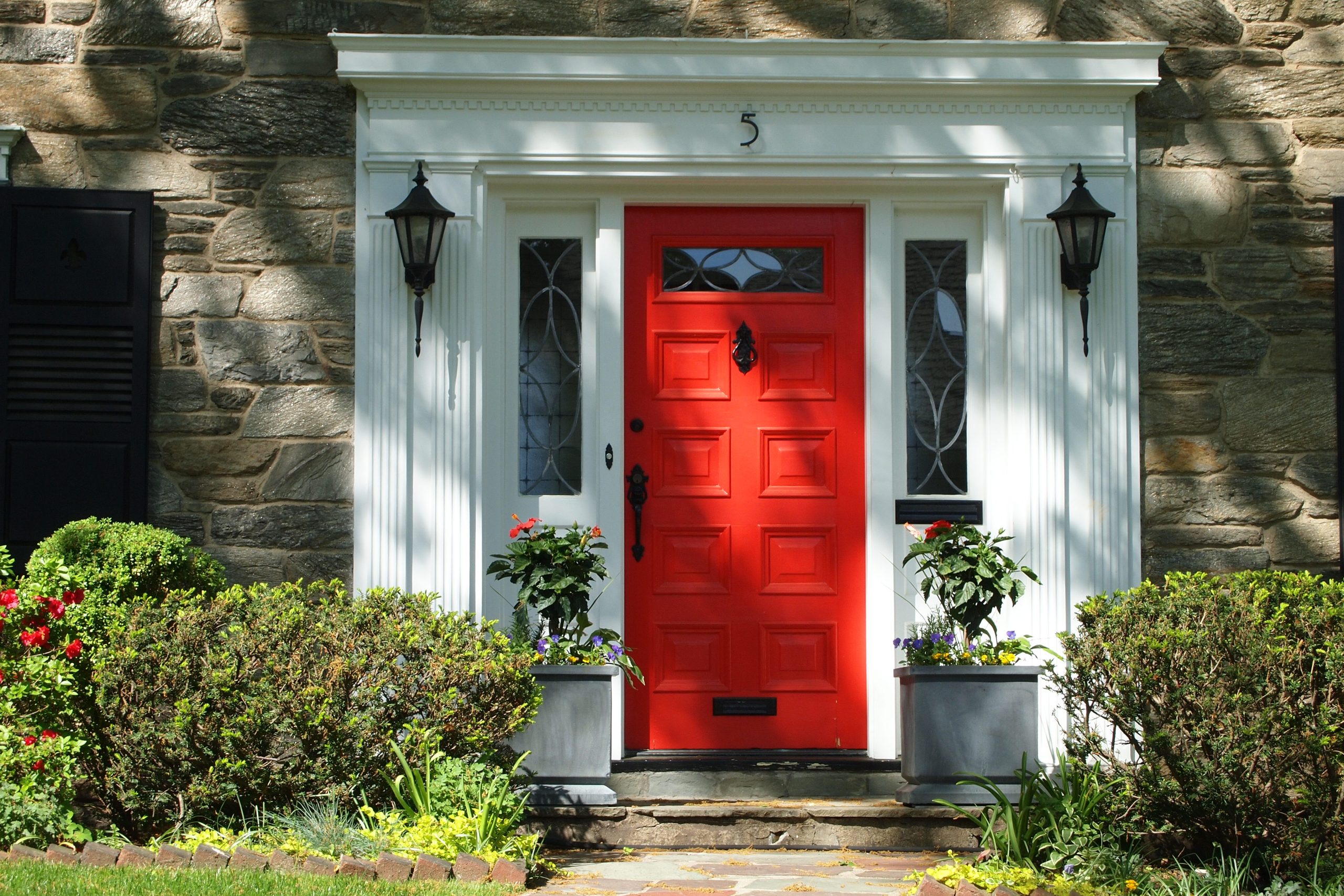
“A bright red six-panel door is classic for a reason, but it can look cheap if the paint is too glossy.”
Use a satin or semi-gloss, not high-gloss, on the panels. The dark gray concrete steps need resealing every 2–3 years to prevent efflorescence, and the green shrubs should be trimmed back 12 inches from the door to keep the red visible from the curb.
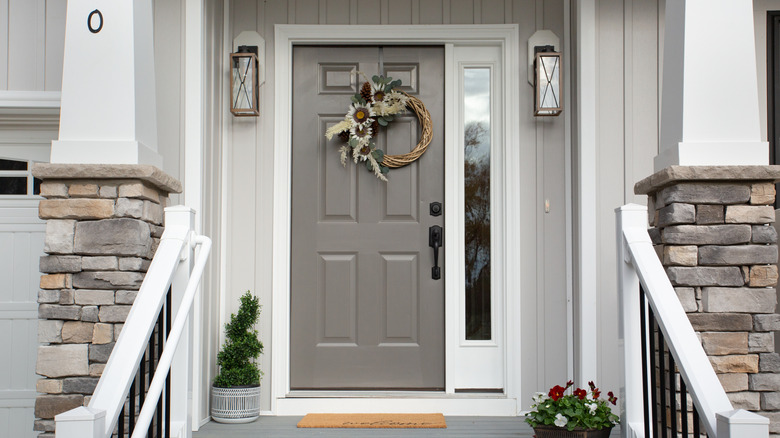
31. Gray Paneled Door with Natural Wreath and Stacked Stone Bases
The natural vine wreath with white sunflowers and pinecones is the piece that gives this entry its quiet personality. The gray paneled door, white porch railings, and stacked stone bases are all neutral and tidy; the wreath introduces texture and seasonal warmth without adding a new color. Remove it and the entrance becomes a blank slate — still lovely, but forgettable. That’s the difference between a house and a home.
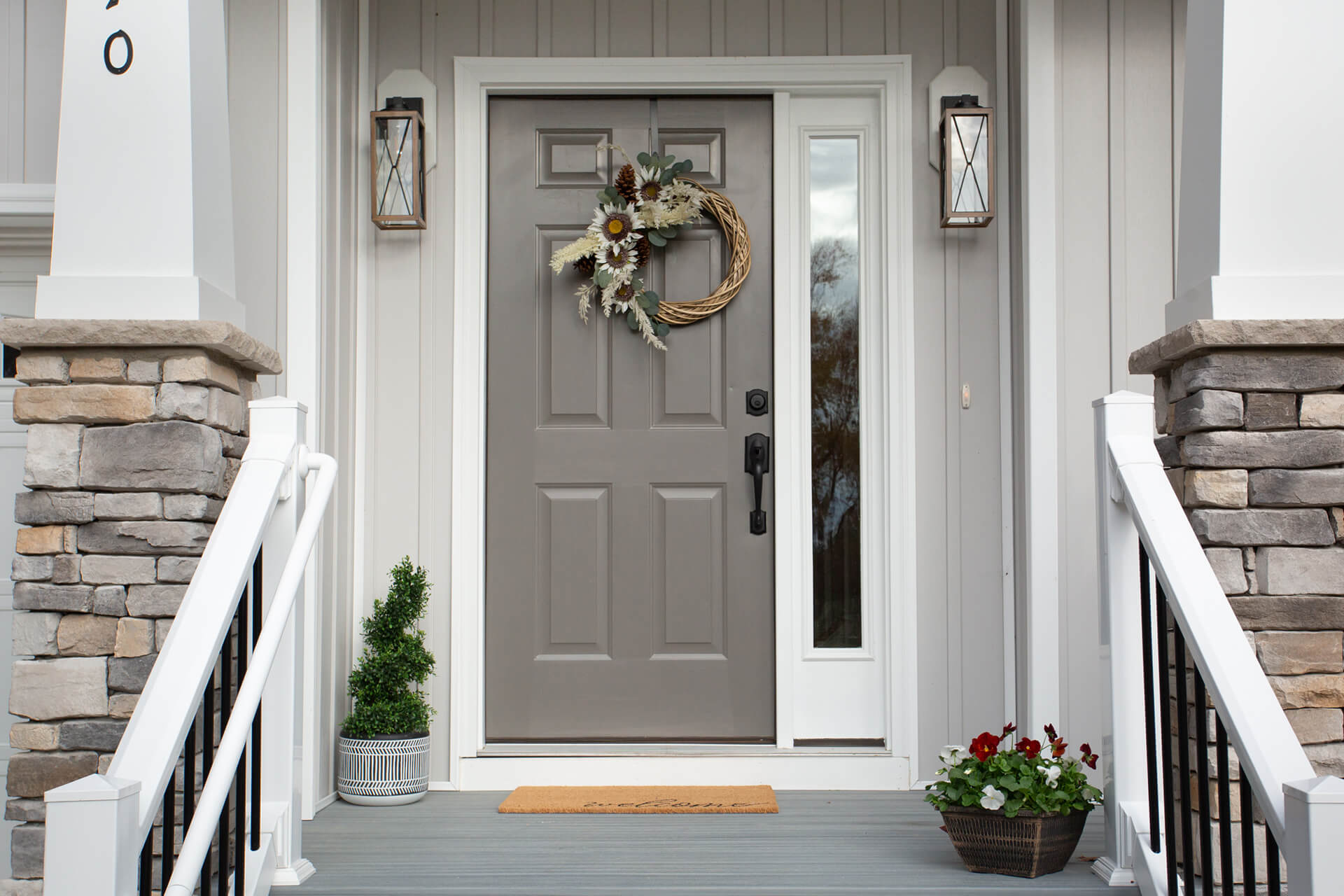
“The natural wreath will only last one season, so budget $20–$40 to replace it each fall or early spring.”
The gray-blue porch decking should be swept weekly and pressure washed once a year. Stacked stone bases need little upkeep, but check the mortar joints every spring. The real maintenance here is the black balusters on the white railing — they show dust and spider webs quickly; a quick wipe with a damp cloth every two weeks keeps them sharp.
32. Burgundy Door with White Trim and Green Potted Plants on Gray Siding
Burgundy is the quiet luxury of red front doors, but it can read almost black in low light. If your entry faces north or is heavily shaded by a porch, choose a burgundy with more red undertone, not brown. Test the color on a cloudy day, not just sunny. The green potted plants help pull the burgundy toward a natural, wine-and-botanical palette, but they need watering every 2–3 days in summer — not the lowest-maintenance pairing.
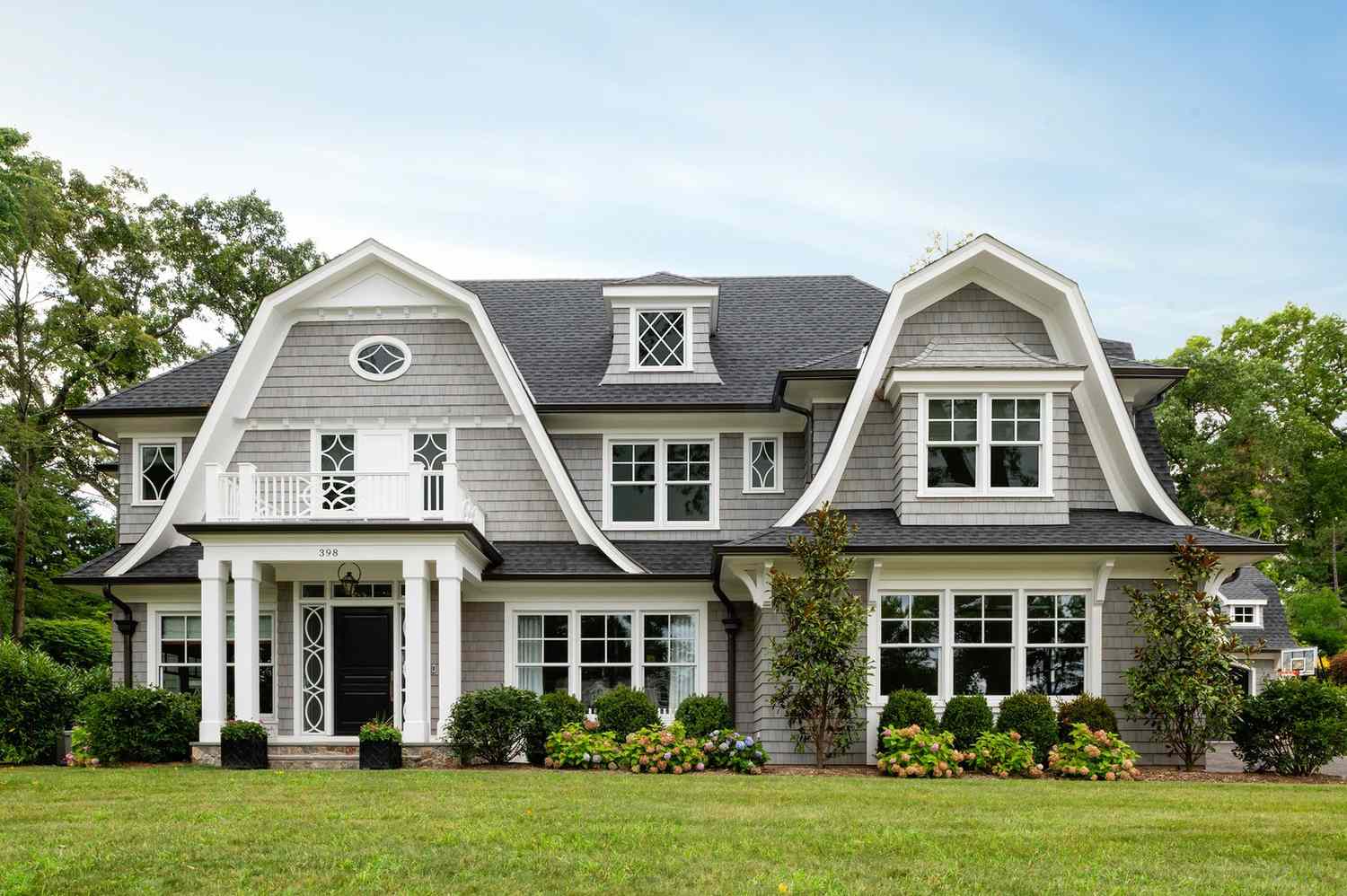
“This burgundy door works on a wide range of home sizes, from a compact 1,400-square-foot ranch to a 3,000-square-foot two-story.”
The key is the white trim contrast: as long as the door is framed in at least 3.5 inches of white trim, the burgundy won’t get lost in the gray. For a single-story house, place the green potted plants directly on the steps rather than on raised planters so they don’t compete with the door height.
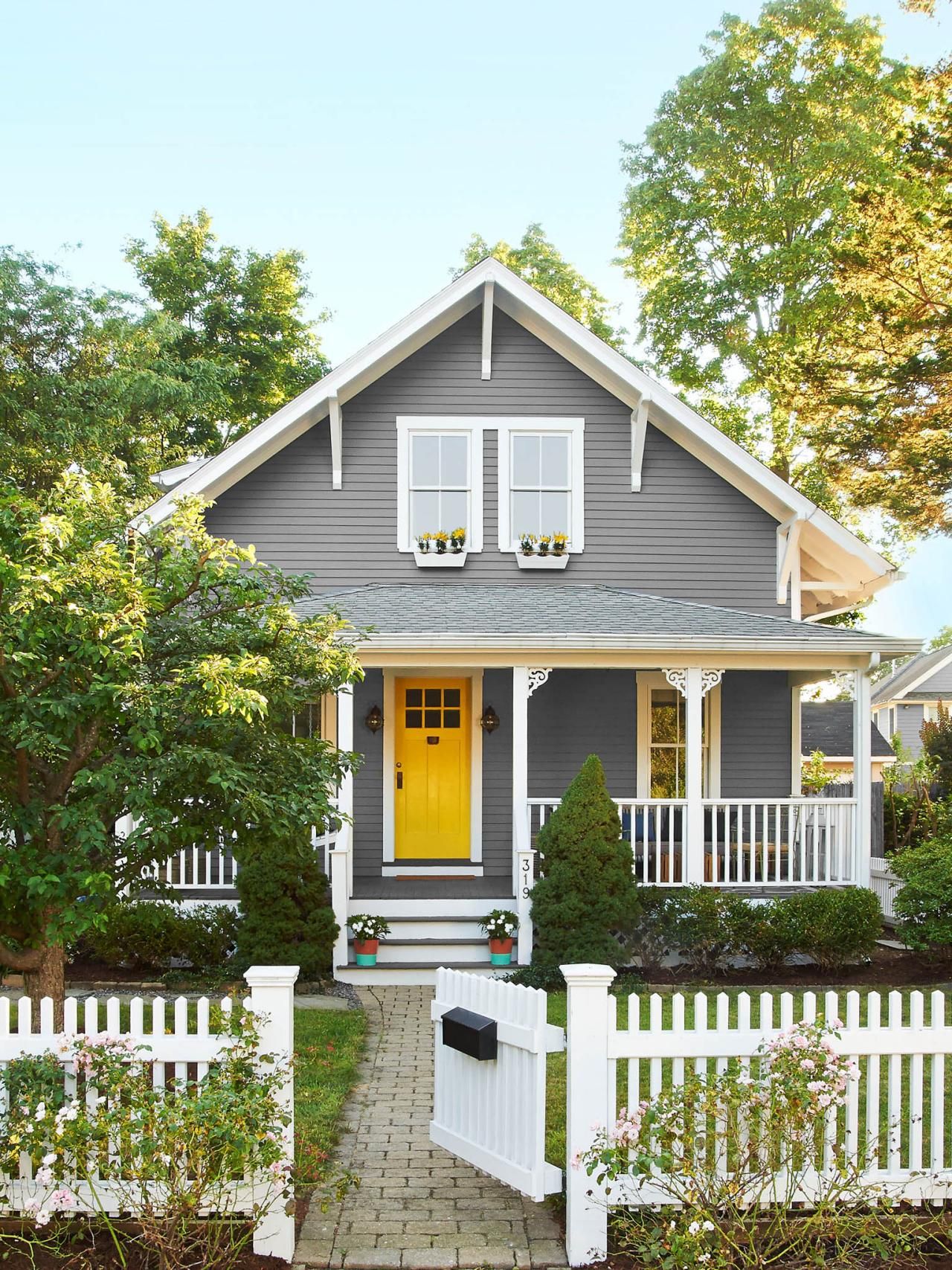
33. Bright Yellow Door on a Dark Gray House with White Porch Trim
Dark gray exteriors with a single bright yellow door are the biggest high-contrast entryway trend of 2026, especially on two-story homes with white-columned porches. The yellow acts like a beacon, while the black door frame prevents it from looking sugary. White garage doors and trim balance the dark siding so the house doesn’t become a monolith. This palette has staying power because one gallon of yellow paint is an easy seasonal refresh when you want a change.
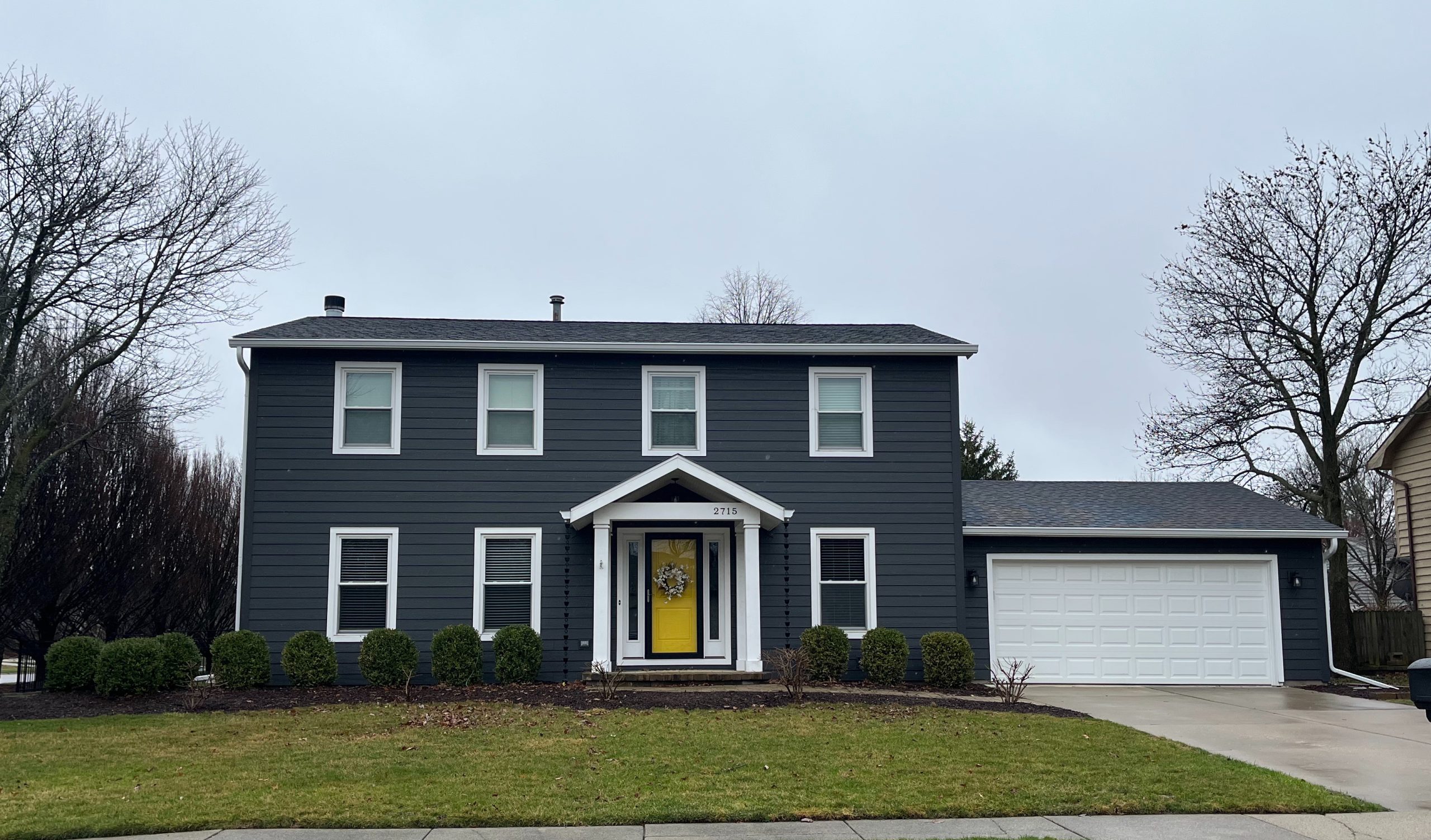
“If your dark gray house has a white porch overhang, paint the door frame black, not white.”
The black frame creates a strong edge between the bright yellow door and white trim, which makes the yellow look more expensive and less like a preschool sign. Also, use a semi-gloss finish for the yellow to repel dust and fingerprints, and keep the white porch columns in a slightly warm white so the black frame doesn’t feel too severe.
Your Gray House’s Front Door Is Ready for Its Close-Up
Ready to paint? Pick one palette from these 33 and test a swatch on your actual door before committing. When you’ve painted yours, tag us — we love seeing gray houses get their color. Pin this guide to your Front Entry board so you can find it when the weather’s right for painting.