If your yard feels flat, landscaping with large rocks adds instant structure and a natural focal point. Big boulders anchor garden beds, define paths, and pair well with water features or modern patios.
This article covers 32 ways to use large stones outdoors, from building retaining walls to creating tropical retreats. You will get practical layout ideas and material tips for any garden size.
Create a Dramatic Water Garden with Multi-Tiered Rockery
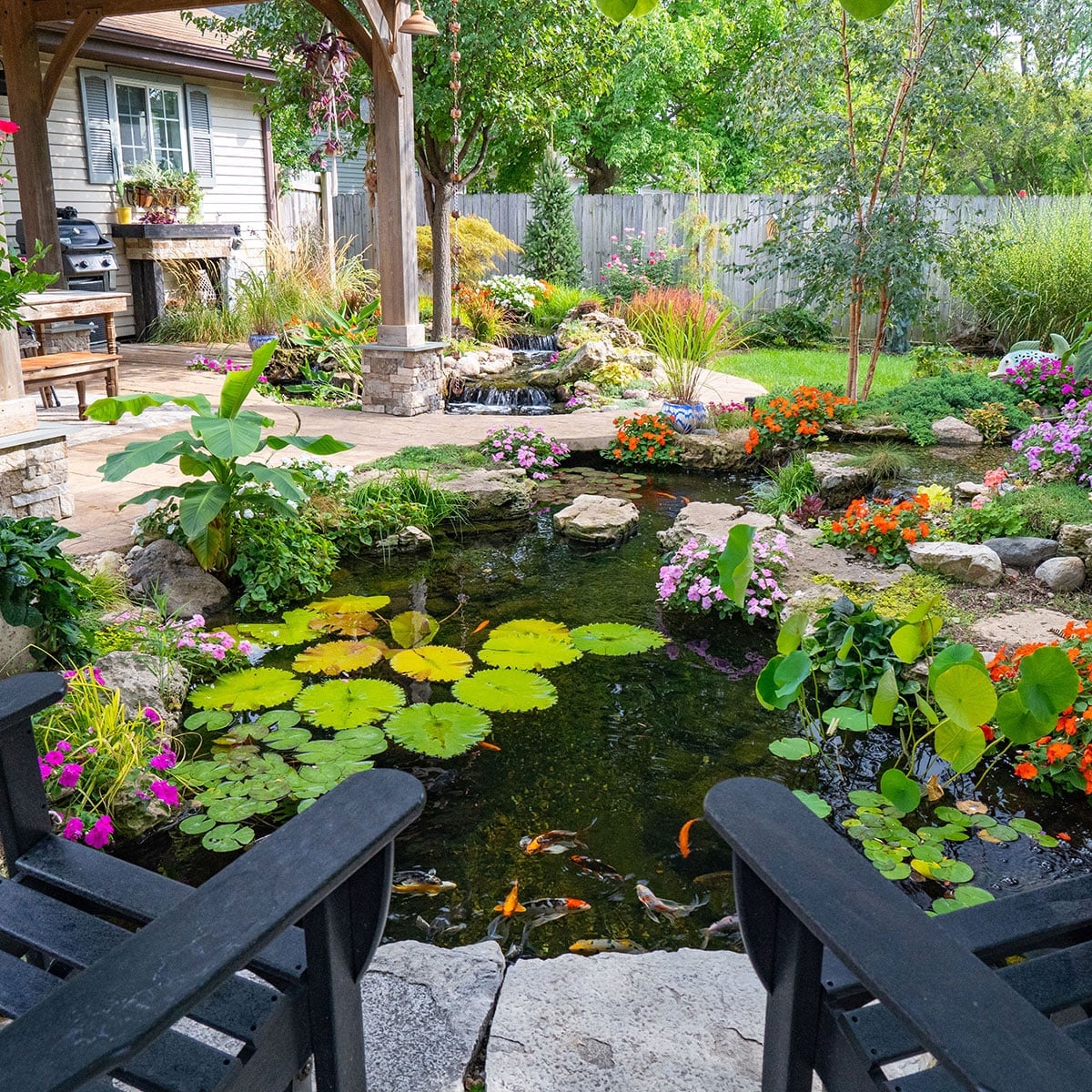
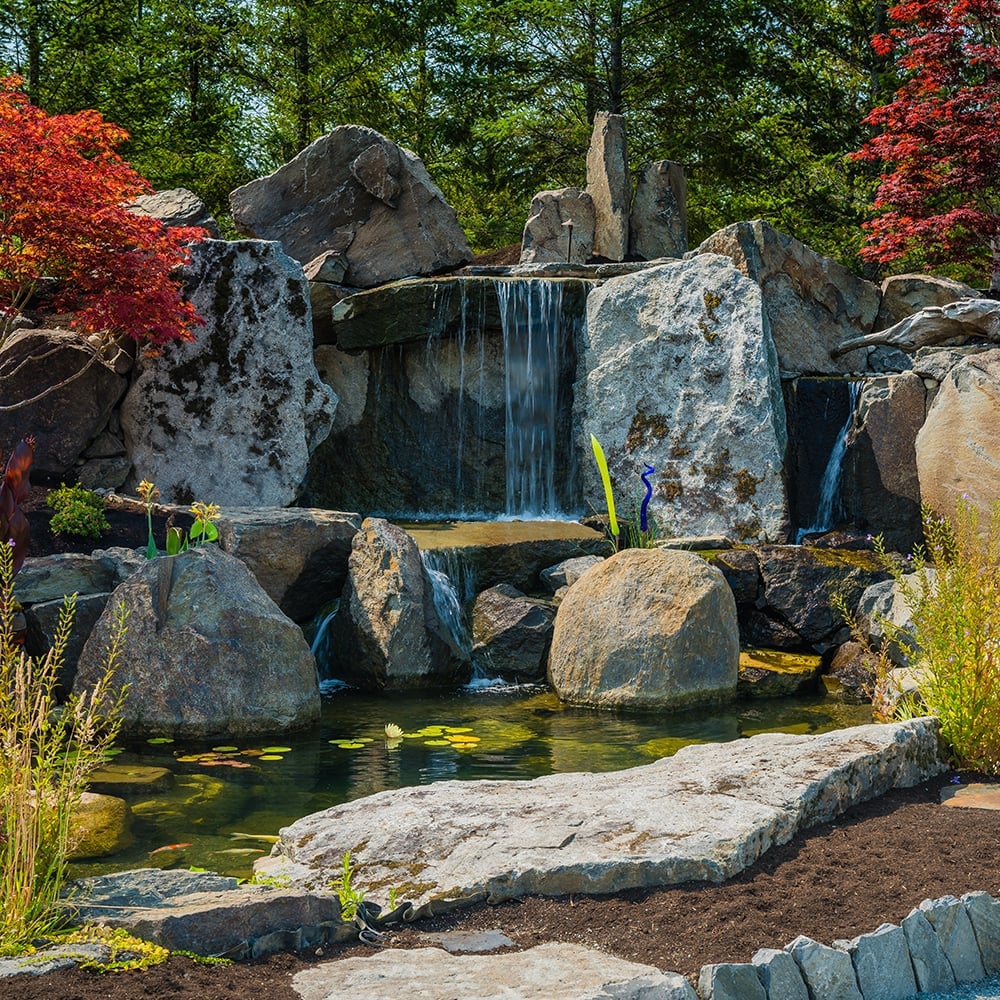
A multi-tiered rockery waterfall that drops into a pond stocked with koi creates a garden feature that draws the eye from every corner of the yard. The layout stacks large rocks in uneven ledges so water spills from one tier to the next, mimicking a natural stream. That vertical structure also lets you plant moss or ferns in the crevices, softening the stone. The pond below reflects the sky and surrounding greenery, which makes the whole setup feel larger than its actual footprint. One useful layout principle: set the lowest tier at least a foot deeper than the pond’s surface so the falling water stays quiet rather than splashing onto the lawn.
Design a Modern Xeriscape with Strategic Boulder Placement
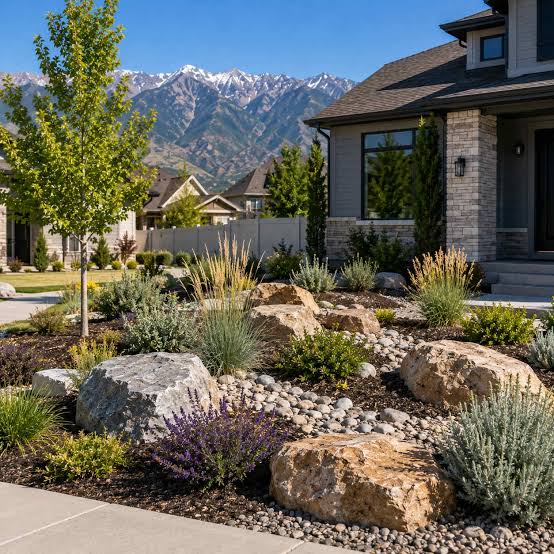
A modern xeriscape garden with large boulders relies on scale and proportion to feel intentional rather than random. The palette here pairs gray stone with purple lavender and tan gravel, creating a cool-warm contrast that reads as curated. The largest boulders anchor the front yard bed, while smaller ones cluster near ornamental grasses to repeat the shape without competing. A useful rule for scale: bury about a third of each boulder into the ground so it looks settled, not dropped. Leave enough space between rocks for plants to grow into the gaps. That spacing keeps the garden from feeling crowded as the lavender matures. The result is a dry landscape that still feels lush through texture and careful placement.
Emphasize Contrasting Textures in a Rock Garden
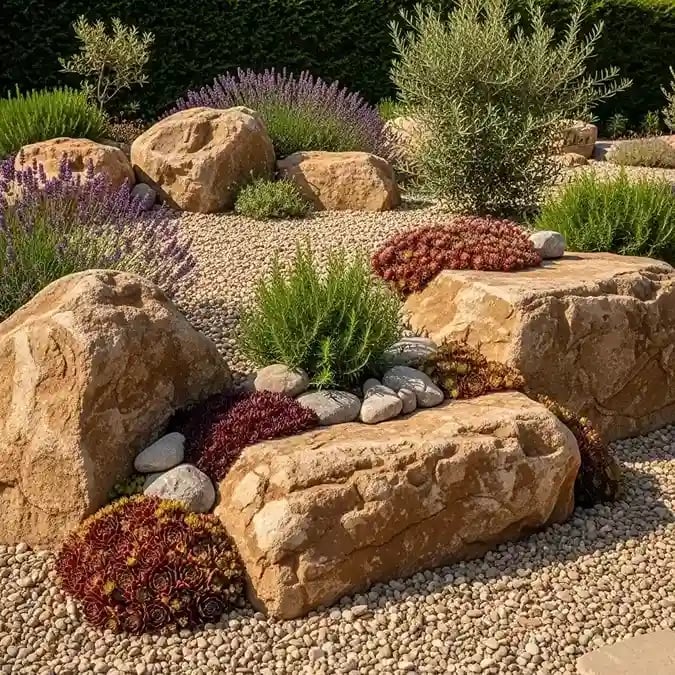
How do you keep a rock garden from looking like a pile of rubble? The trick is to pair materials that have nothing in common. A modern rock garden with large tan boulders and succulents puts rough, porous stone next to smooth, fleshy leaves. The tan boulders catch the sun on their jagged edges, while the succulents stay matte and cool. Gravel covers the ground between them, adding a third texture that ties the two together.
The palette stays tight on purpose: tan, gray, green, and a hint of red from a few succulent tips. That limited range lets the texture do the work instead of fighting multiple colors. When you choose plants, go for ones that stay low and spread out. Tall plants would hide the rock faces, and the whole point is to show off the stone. A useful materials principle: lay down a weed barrier beneath the gravel so the contrast stays clean and you are not pulling weeds out from under a boulder.
Use a Large Boulder as a Focal Point in Tropical Landscaping
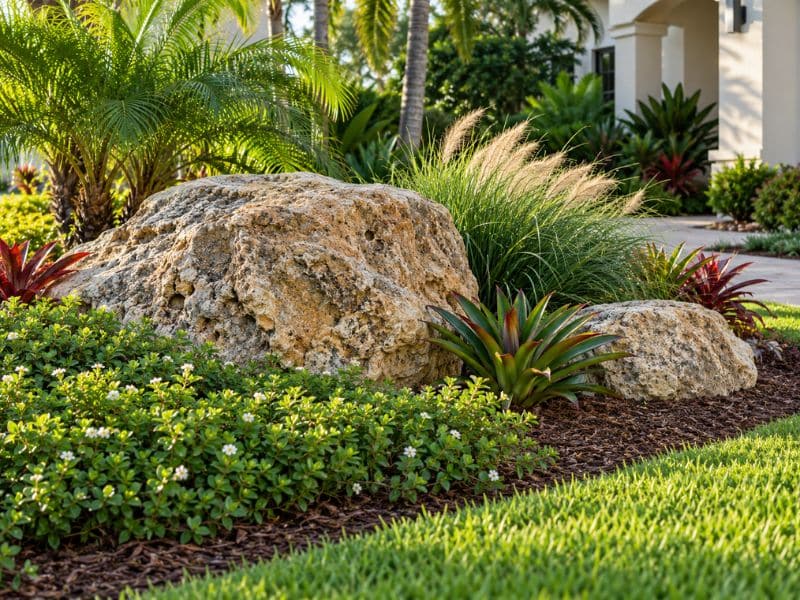
A single large textured boulder can anchor a tropical garden bed better than any statue or pot. In this design, a tan boulder sits among ornamental grasses and low shrubs, its rough surface standing out against the soft, arching leaves around it. The boulder becomes the hero element because everything else in the bed steps back. The plants stay shorter than the rock, and the mulch beneath it is a neutral brown that does not compete. One useful hero-element principle: place the boulder off-center rather than dead middle. That slight shift creates a more natural flow for the eye and leaves room for layered planting on the wider side.
Cluster Large Rocks Around a Water Feature for a Modern Garden
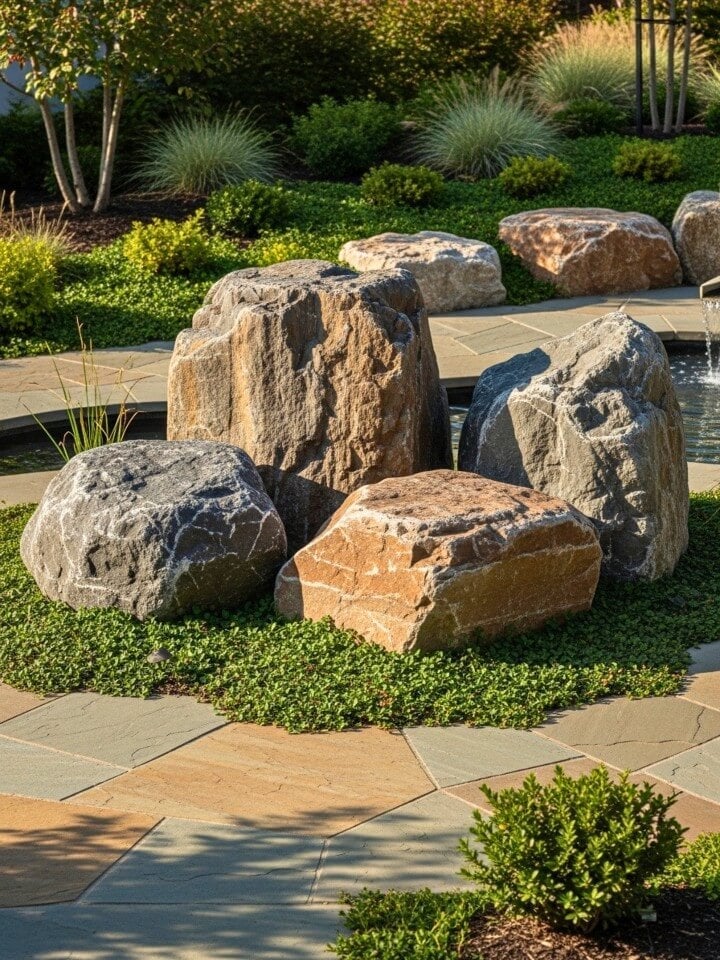
A practical rule for placing rocks around a water feature is to cluster them in odd numbers, with the largest rock closest to the water source. In this modern garden, several large boulders surround a raised fountain, their brown and gray tones echoing the stone tile base. Low groundcover spills over the edges of the rocks, softening the transition from hardscape to grass. The cluster creates a visual anchor that keeps the fountain from floating alone in the yard. For layout, leave a gap of at least two feet between the fountain’s edge and the nearest boulder. That space gives you room to clean the pump housing and trim any plants that creep too close.
Integrate Large Boulders into a Naturalistic Water Garden Pond
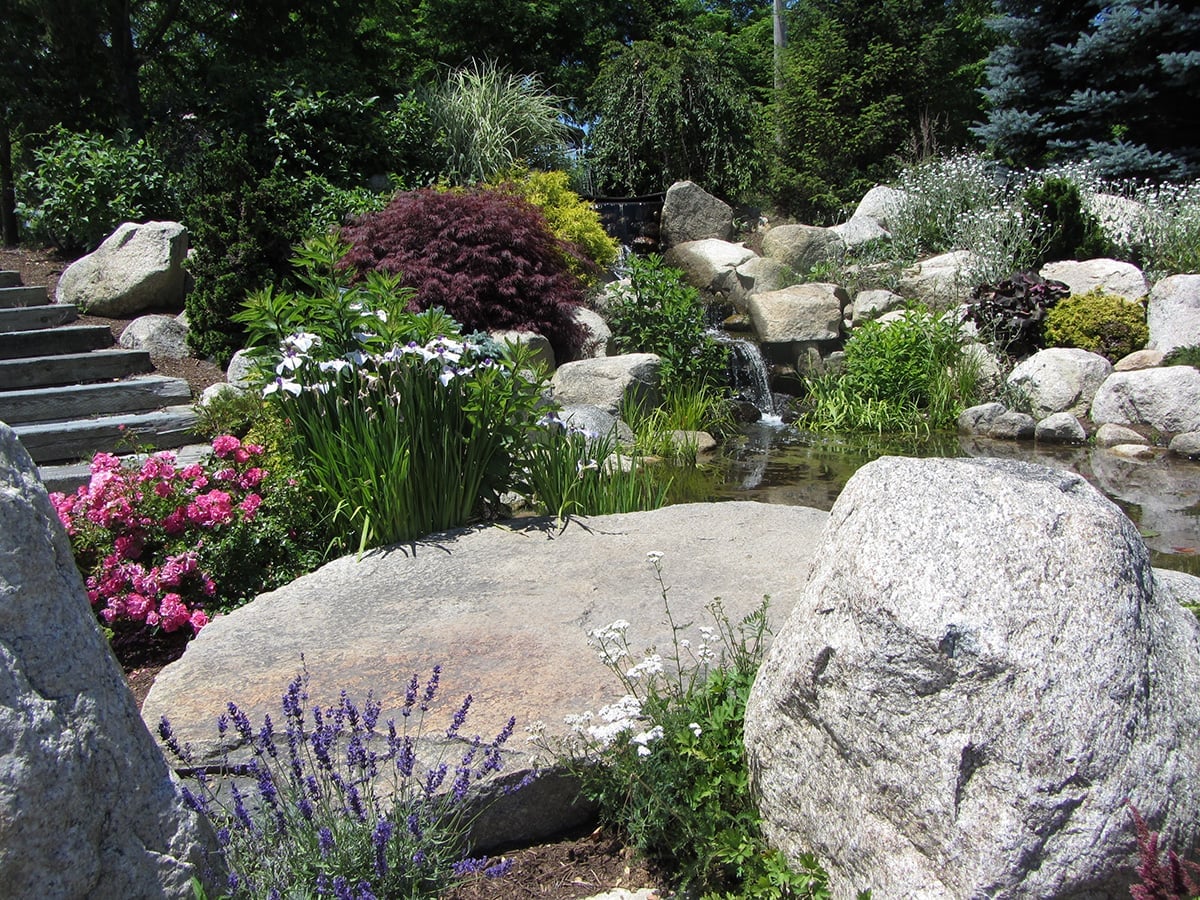
A formal pond with a straight edge and a fountain feels controlled. A naturalistic pond does something else. It places large gray boulders right at the waterline, so the pond looks like it has always been there. The boulders are not lined up. They sit at different angles, with flowering plants in pink and white growing between them. The palette stays simple: green from the plants, gray from the stone, and those pink and white blooms for contrast. Bright daylight makes the water reflect the sky and the boulders. The layout is roomy, with the pond as the hero element and the garden arranged around it. A useful principle for materials is that rough, irregular stone reads as more natural than smooth, round rock. If your yard has a slope, a naturalistic pond with boulders can handle that grade better than a flat liner pond. Just keep the boulders partially submerged so the waterline feels organic.
Incorporate Textured Boulders into a Japanese Garden Design
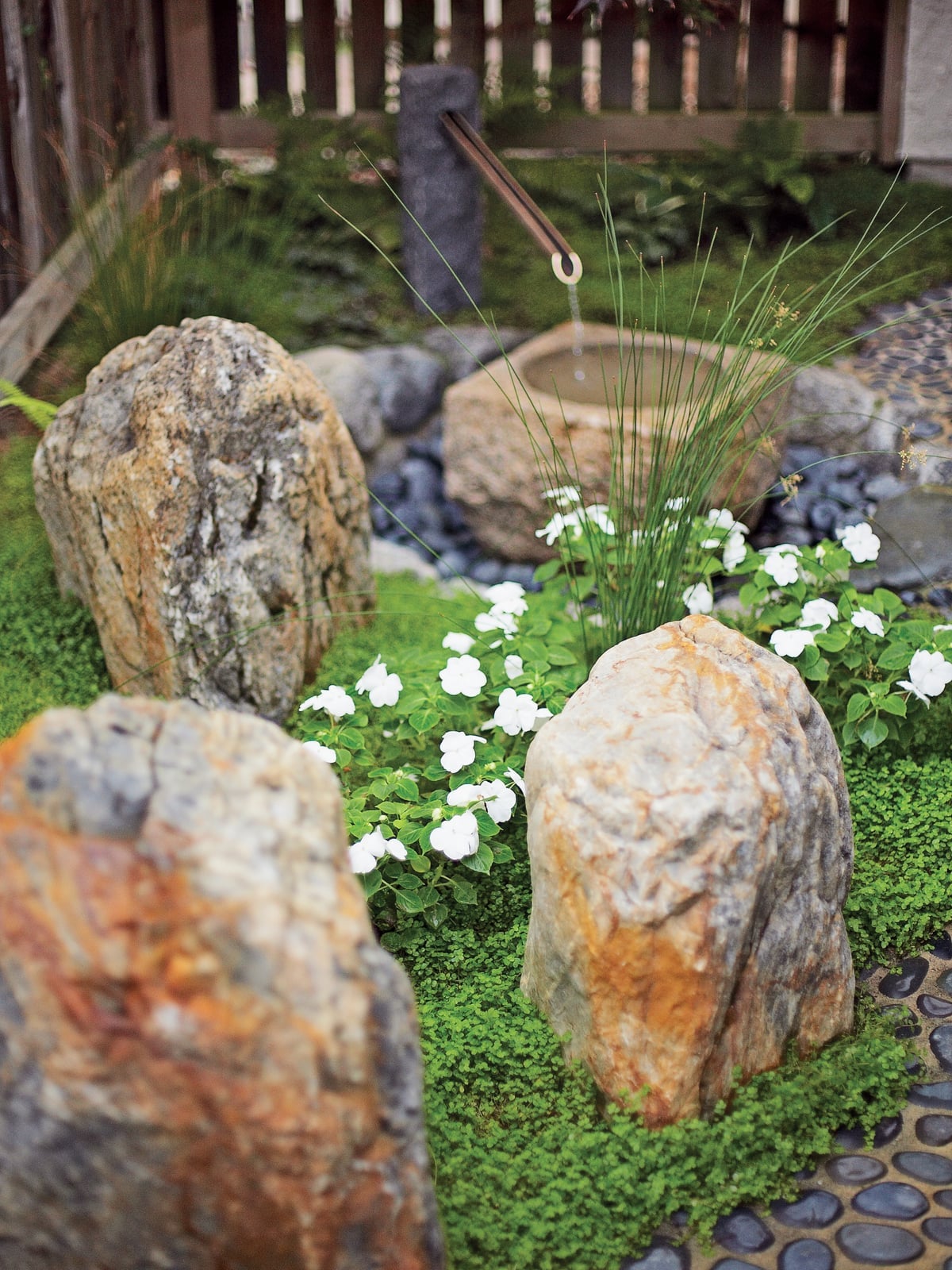
A Japanese garden uses boulders not as decoration but as bones. The textured boulders here are placed in a compact vignette with a water basin and small plants. The palette is green, brown, and white, with the wood of the basin and the pebbles underfoot. The arrangement feels deliberate, not random. The boulders have visible cracks and lichen, which gives them age. A renter-friendly swap for this look is to use large ceramic or concrete forms that mimic the weight of stone. They sit on the surface, so you can move them when you leave. The style is defined by asymmetry and restraint. What breaks it is adding too many colors or plants that bloom heavily. Stick to one or two foliage textures and let the boulders carry the composition.
Design a Tropical Resort Garden with a Bouldered Waterfall
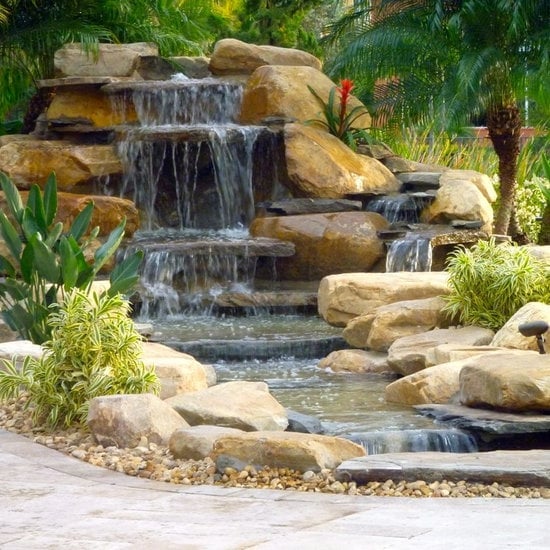
A multi-tiered waterfall made from large tan boulders is the hero element here. The water cascades over each level into a pool below, and the sound does the work of masking street noise. The palette is tan from the stone, blue from the water, and green from the surrounding tropical planting. The waterfall is centered with the planting built around it in layers. Bright daylight hits the water and creates highlights on the boulders. The concrete base of the pool is hidden by the stone. A styling variation is to change the planting around the waterfall. For a resort feel, use broad-leaf plants like palms or bananas. For a drier climate, use agave and yucca. The water feature stays the same, but the mood shifts entirely.
Use a Tall Red Stone Feature as a Garden Art Piece
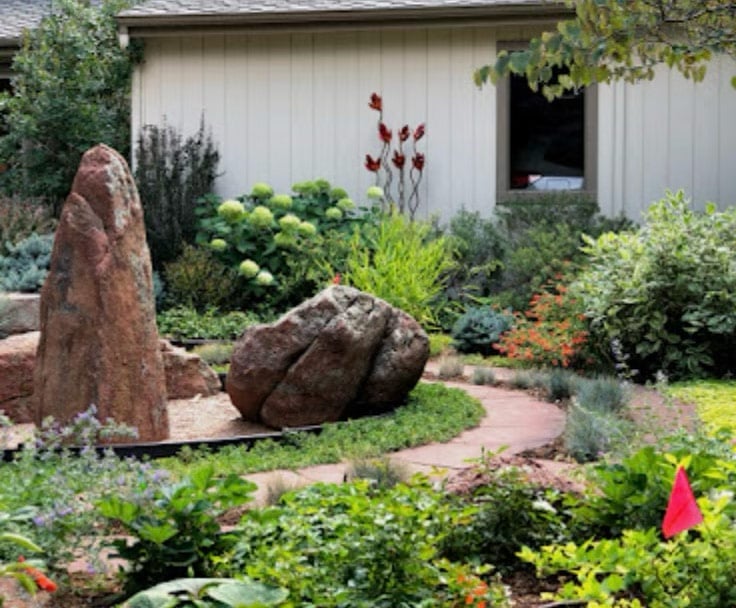
What if a rock does not have to look like a rock? A tall red stone, almost like a sculpture, stands upright in a garden bed. It is surrounded by lower green plants and a curving pathway of beige gravel. The palette is red, green, and beige, with the red stone as the clear focal point. The pathway guides the eye around the feature. Soft daylight keeps the red from looking harsh. The stone is supported by a metal base or buried deep enough to stand on its own. A practical consideration for durability is that a stone this tall needs a stable footing. If the ground freezes, the base should go below the frost line to prevent tipping. For a renter, a tall stone on a concrete paver works as a temporary art piece that you can roll out of the way.
Integrate Large Rocks into a Modern Backyard Patio Landscape
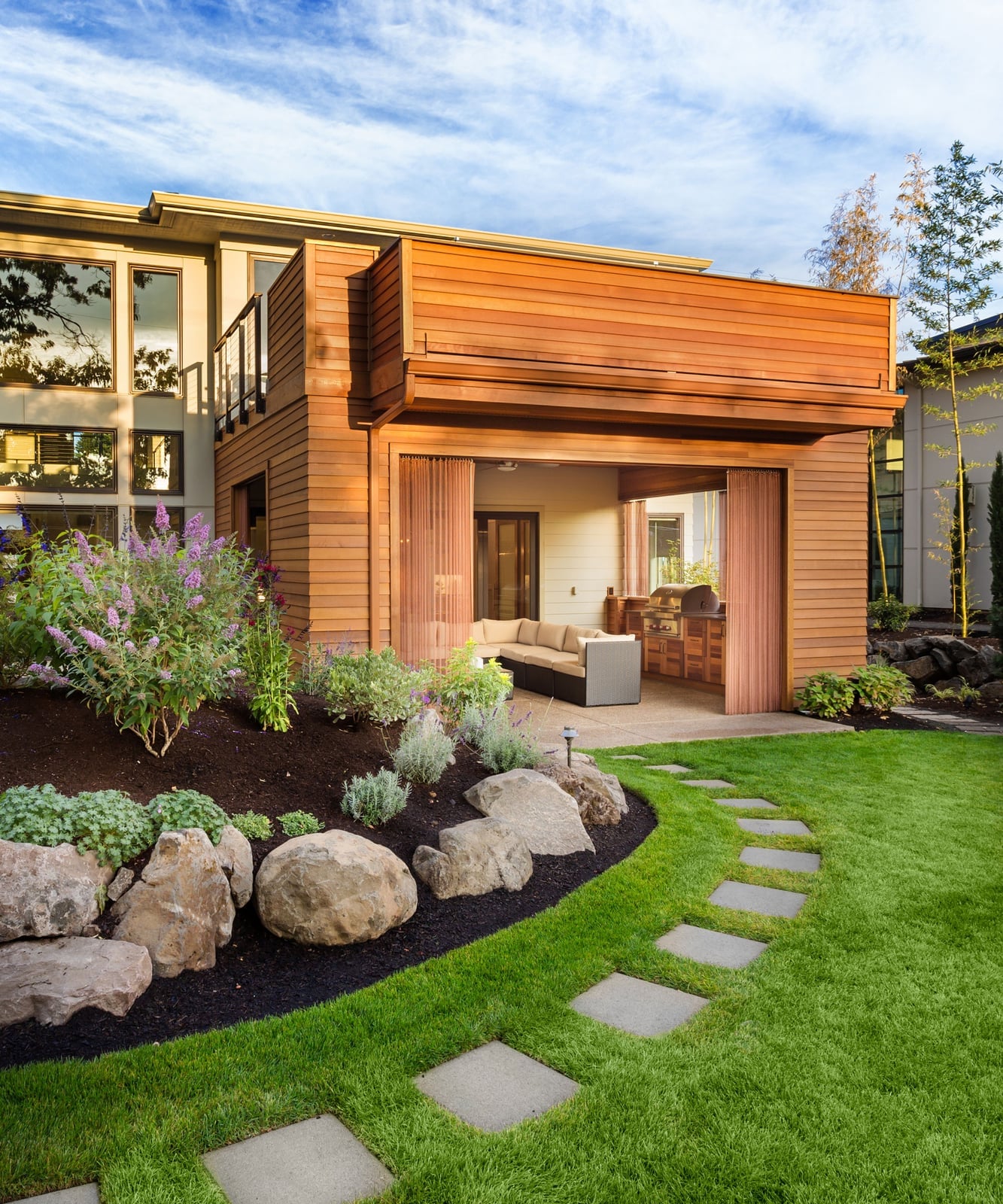
A modern backyard patio with a wood-clad exterior and concrete pavers uses large rocks to soften the transition from house to yard. The rocks are placed between the patio and the grass, breaking up the hard line between the two materials. The palette is wood tones from the siding, gray from the stone and concrete, and green from the grass. The layout defines zones: an outdoor kitchen and a sectional sofa on the patio, with a stepping stone path leading to the grass. Evening light casts long shadows and makes the rocks appear sculptural. A key rule of scale and proportion is that rocks should be at least as large as the furniture nearby. A small rock next to a sectional looks like an accident. A boulder the size of an ottoman looks placed on purpose.
Construct a Naturalistic Retaining Wall with Large Boulders
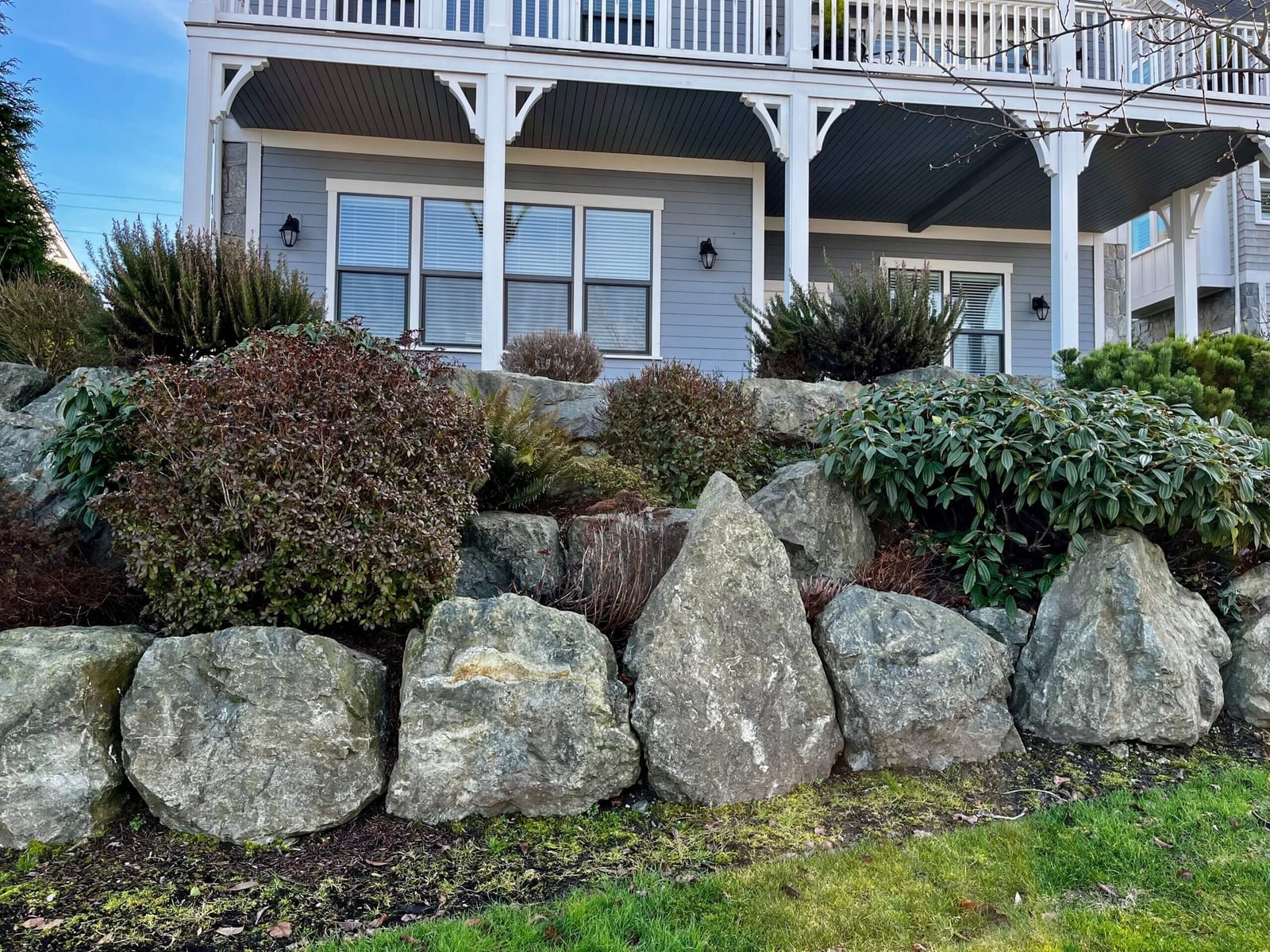
A retaining wall built from large boulders handles grade changes without looking like a hard edge. The overcast daylight flattens shadows, so the stone texture reads more through shape than contrast. Gray boulders stacked in a staggered line hold back soil while shrubs and grass soften the base. This layout works because the rocks are set deep enough to feel permanent, not perched. The principle is simple: bury at least a third of each boulder so the wall reads as part of the ground, not a pile on top of it. That anchor makes the whole structure feel grounded, even with plants growing between the stones.
Create a Rustic Fire Pit Area with Large Rock Accents
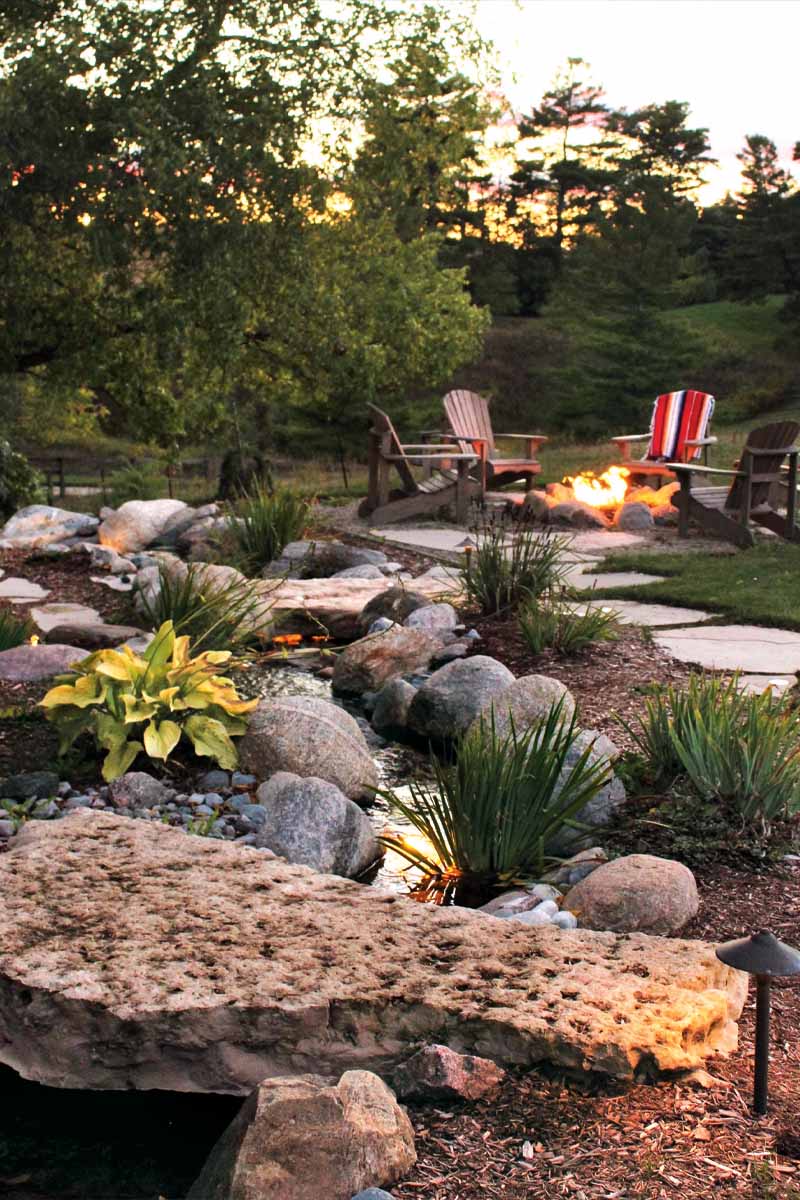
A gravel fire pit area with Adirondack chairs and large rocks scattered around the edge feels more settled than one where the rocks ring the fire directly. Dusk light and fire glow soften the brown and green palette, making the stone and wood look like natural extensions of each other. The layout puts the fire pit at the center, stepping stones leading in, and boulders placed at irregular intervals to break up the circle. That spacing keeps the seating area open while the rocks add visual weight. Set a few large rocks outside the main ring to anchor the zone and keep the fire area from feeling crowded.
Design a Serene Garden Path with Large Boulders and White Pebbles
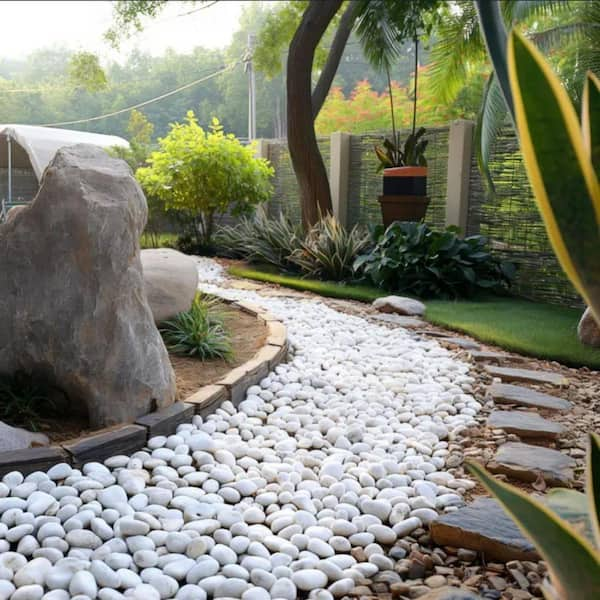
A winding path of stepping stones flanked by one large gray boulder and white pebbles creates a quiet transition through the garden. The bamboo fence behind adds a vertical screen, so the eye moves along the ground instead. The boulder sits slightly off the path edge, not centered, which makes the route feel discovered rather than designed. White pebbles reflect soft daylight and keep the palette light against the dark stone and green foliage. The material contrast is the point: smooth pebbles against a rough boulder, hard stone against soft moss or ground cover. It is a restrained combination that holds its calm even as plants grow in.
Feature a Multi-Tiered Slate Waterfall in a Naturalistic Garden
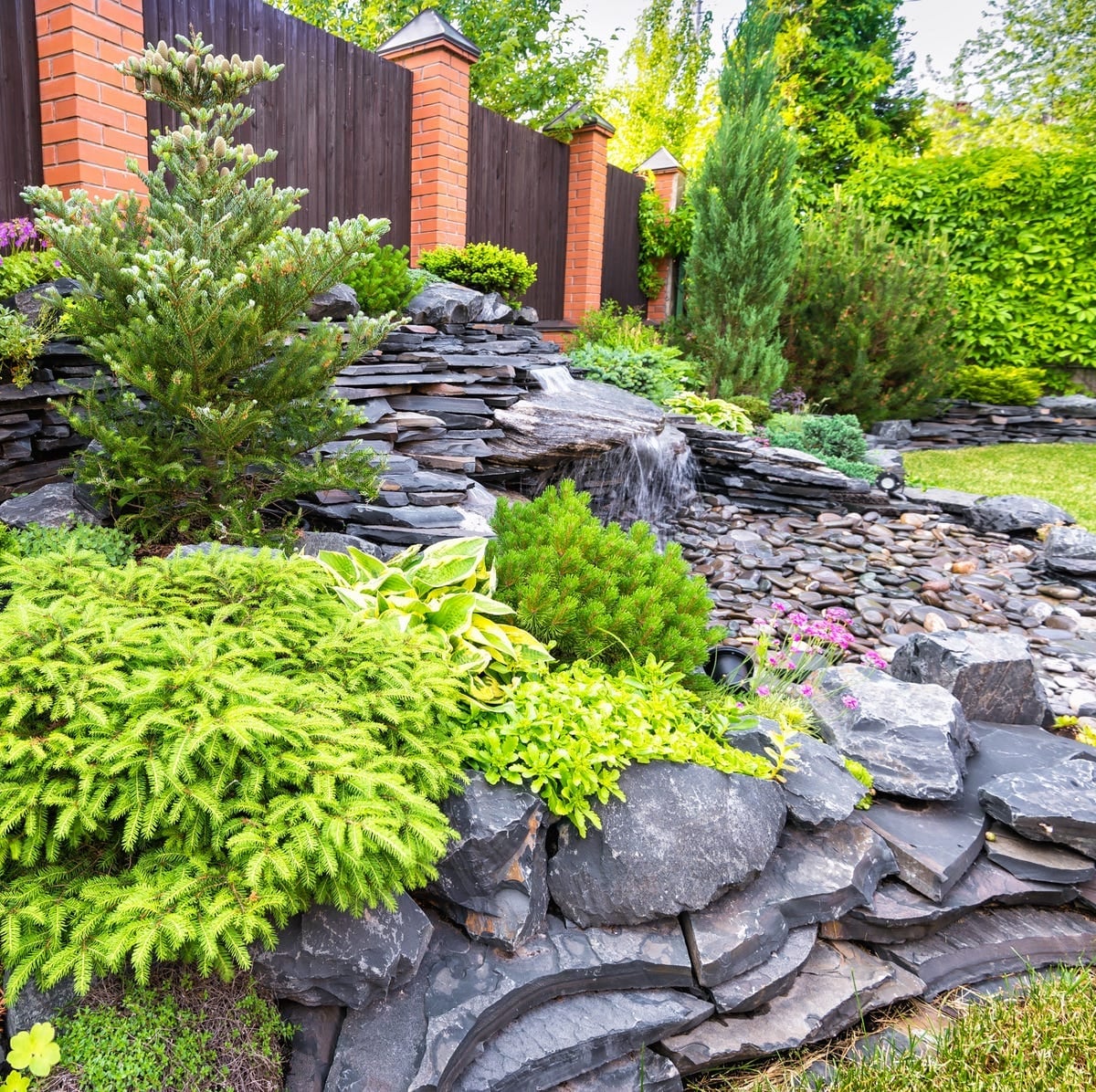
A multi-tiered slate waterfall is the kind of feature that does the work without demanding attention. Bright daylight catches the water at each drop, so the movement shows clearly even from a distance. Large rocks frame the sides, their gray and brown tones matching the slate, while shrubs soften the edges. The tiered design slows the water naturally, creating separate pools rather than one loud splash. That makes the sound more layered and the visual more interesting. The layout places the waterfall slightly off-center in the garden, letting the rest of the planting balance it. A simple hardscape like this needs little maintenance beyond clearing leaves from the catch basin.
Integrate Large Rocks with Vibrant Flowers in Garden Beds
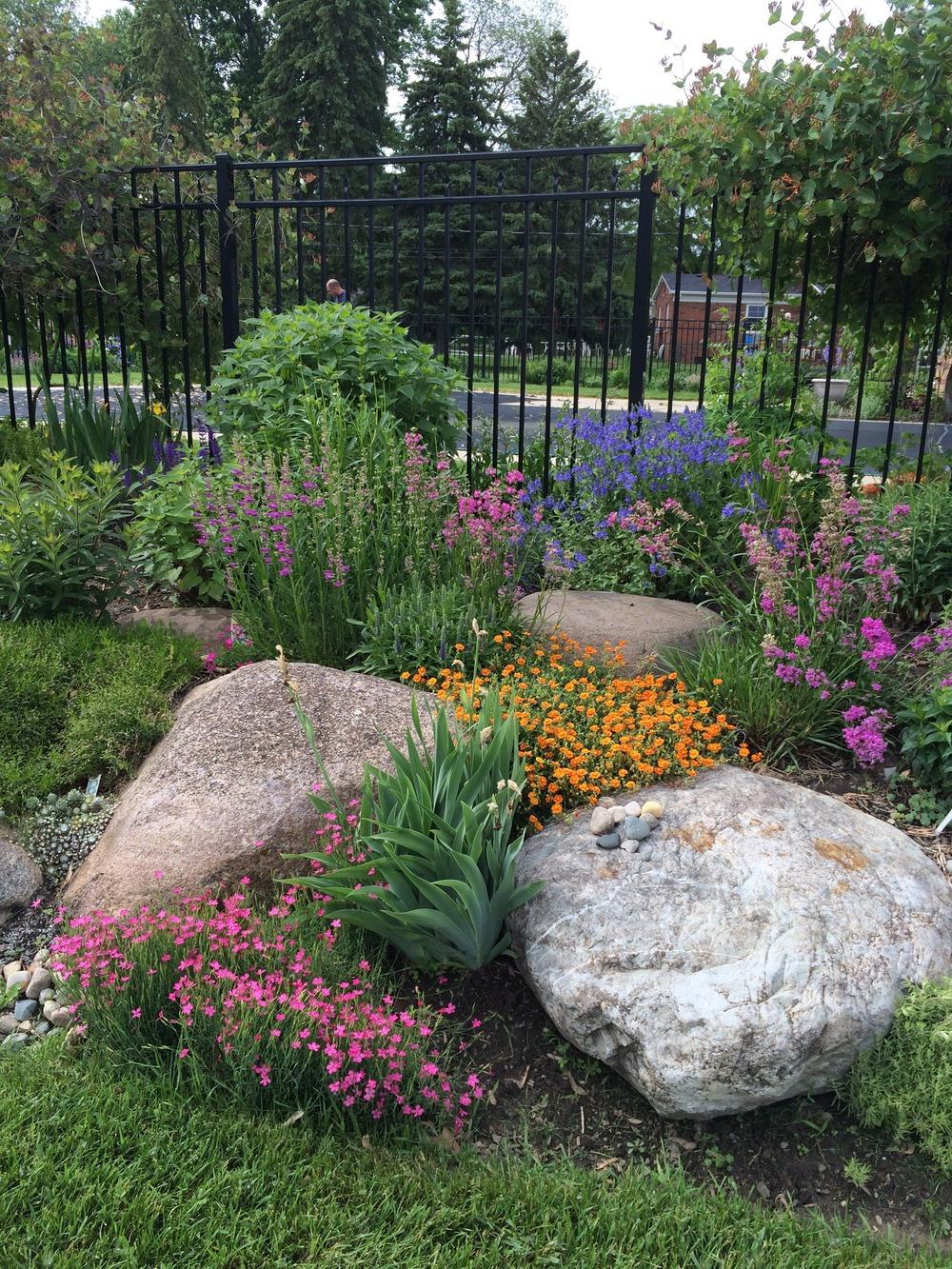
Mix large rocks with flowers by placing the boulders first, then planting around them. In this garden bed, gray boulders sit among greens, pinks, and oranges, with flowers tucked into the gaps. That placement keeps the rock visible even as the blooms fill out. The cottage-style palette benefits from the neutral stone because it stops the color from reading as busy. One large rock can balance a whole drift of flowers, so you do not need many boulders to anchor a bed. Plant low growers near the base so the rock stays the focal point rather than disappearing behind foliage.
Create a Modern Garden Pathway with Large Stepping Stones and Rocks
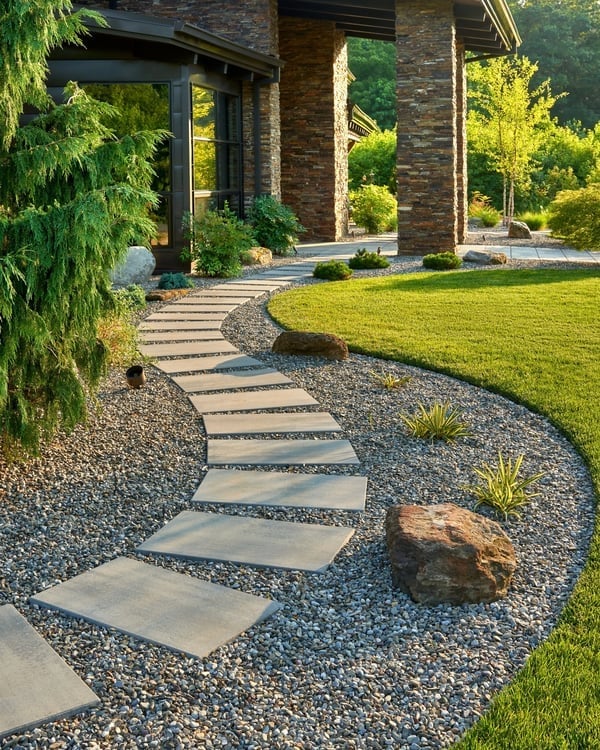
A curving pathway of large stone pavers cuts across a lawn, with scattered rocks of varying sizes placed along the edges. The late afternoon sun casts long shadows, making the gray and brown stone tones stand out against the green grass. The layout feels roomy, so the path has room to breathe. A practical rule for a modern garden path: keep the spacing between pavers consistent, then cluster the decorative rocks in odd numbers. That simple ratio stops the walkway from looking random and gives the whole scene a deliberate, balanced rhythm.
Place a Large Boulder Next to a Modern Building
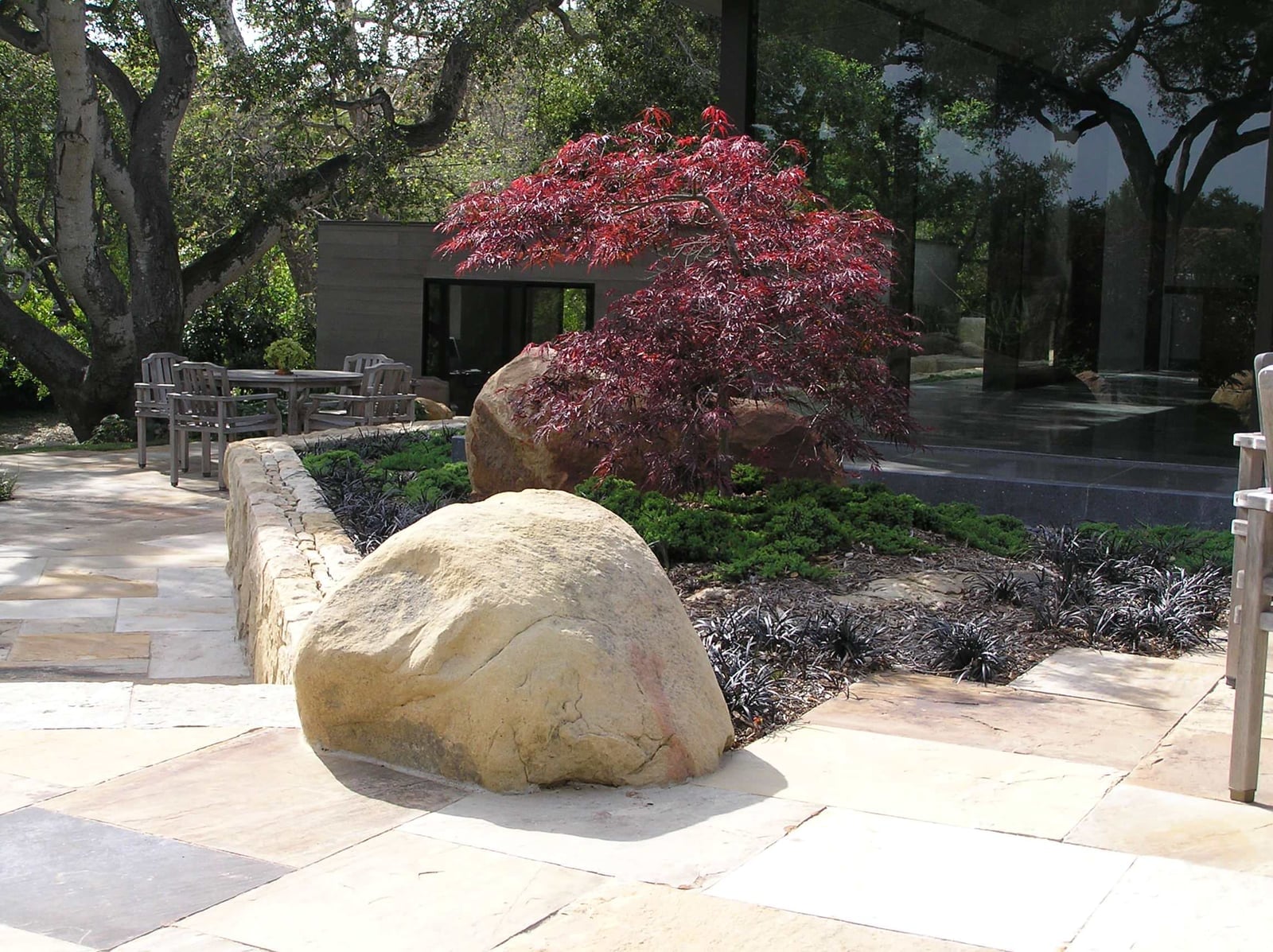
A single large tan boulder sits beside a modern building, paired with a Japanese maple and a simple outdoor seating area. The boulder anchors the corner, giving the patio a natural counterpoint to the clean lines of the tile and wood. For renters, this approach is a smart swap: instead of installing a permanent planter or wall, place a boulder on the ground. It changes the garden’s scale without a lease violation. The key is choosing a rock with enough mass to hold its own against the building’s height. A boulder that is too small will just look like a misplaced stone.
Use a Textured Boulder as a Focal Point in a Modern Tropical Garden
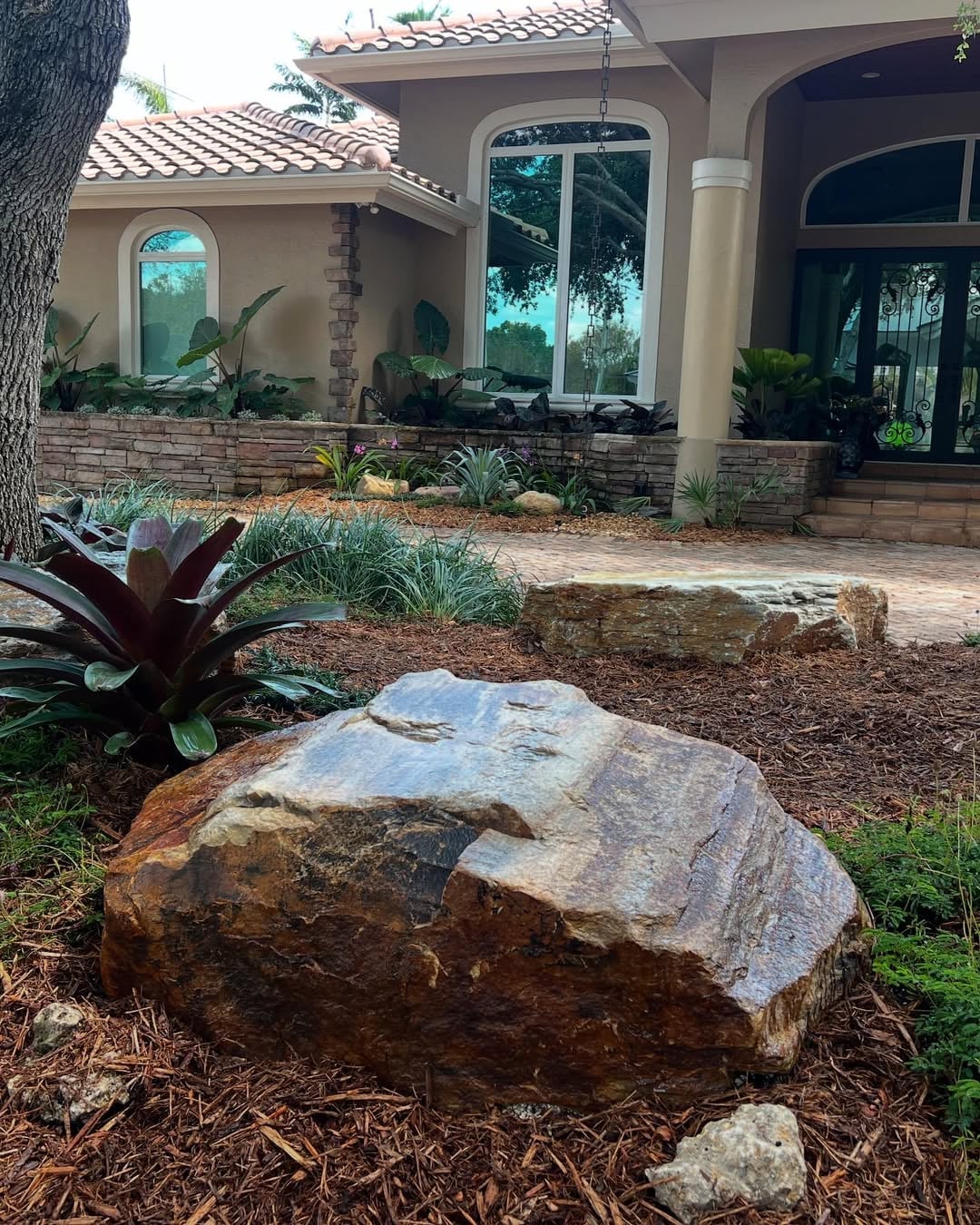
A modern tropical garden usually relies on layered foliage for drama. But swap the dense planting for a single large textured boulder, and the look shifts. Here, a single brown and gray rock sits at the garden entrance, surrounded by a ring of mulch and punctuated by a bromeliad and ornamental grass. The boulder becomes the anchor. The bright daylight hits its rough surface, making every crack and crevice visible. The contrast between the hard rock and the soft leaves of the plants is what gives this vignette its impact. It is a simple arrangement: one hero piece, a few plants, and plenty of negative space.
Highlight Rock Texture with a Large Boulder Vignette
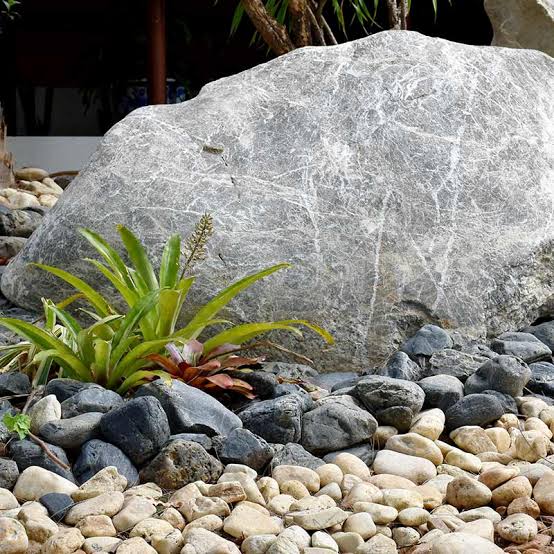
In overcast daylight, the surface of a large gray boulder becomes the main event. It sits among smaller rocks and a single succulent plant, with gravel spread at its base. The muted light softens shadows, letting the stone’s natural texture show without glare. The arrangement feels quiet, almost spare. For a garden vignette, let the rock’s surface do the work. Choose a boulder with visible veins, pits, or lichen. The roughness of the stone is the decoration. The gravel and the succulent are just supporting players.
Incorporate Large Rocks into Modern Architectural Gabion Walls
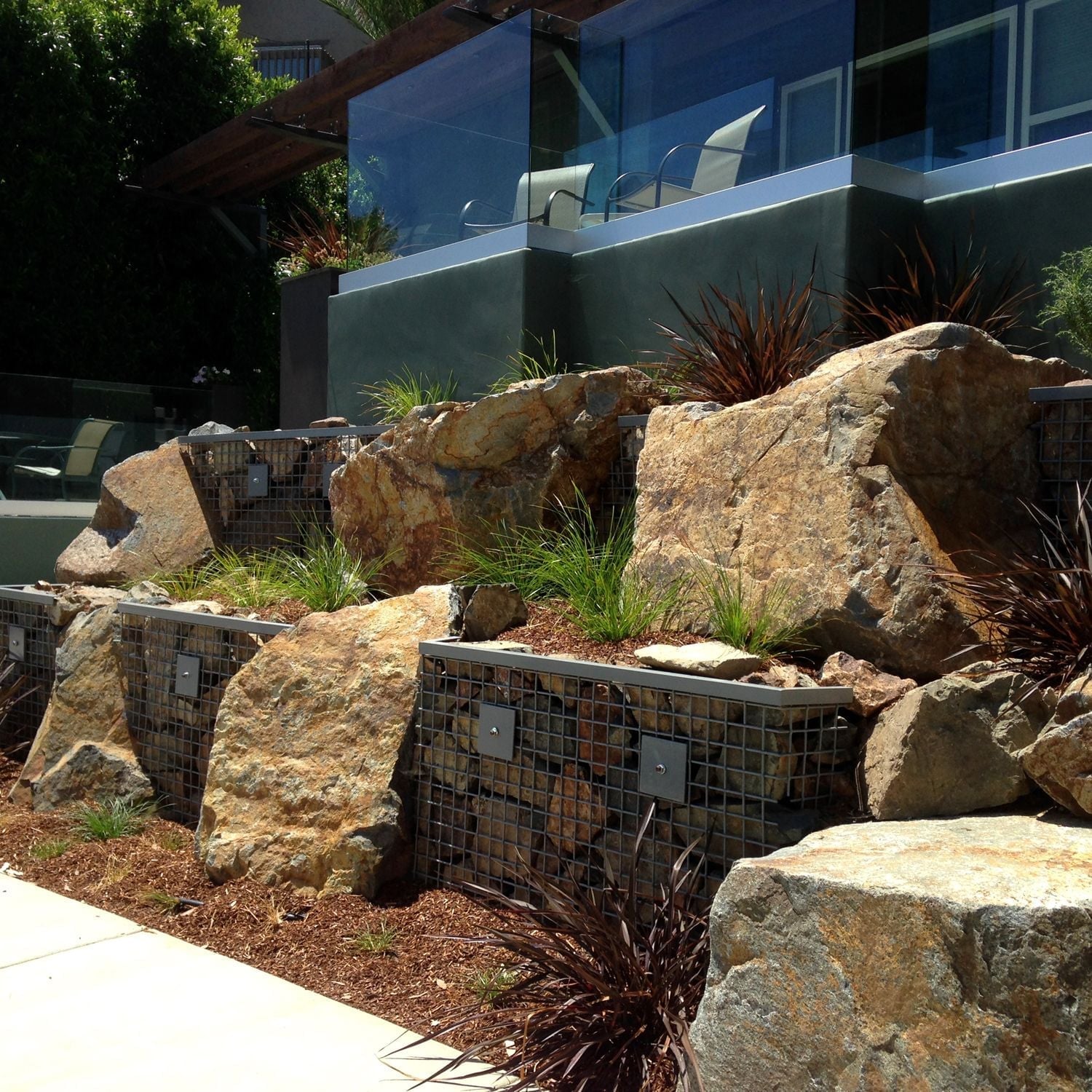
A gabion retaining wall filled with large rocks is a direct way to add mass and texture to a modern garden. In this design, stacked metal cages hold tan and gray stone, with ornamental grass planted at the base. The combination is straightforward: the metal grid keeps the rocks in place, and the rocks themselves provide the visual weight. The bright daylight hits the stones evenly, making the wall read as a single, solid form. For a modern garden, this is a clean alternative to poured concrete or stacked stone. The rock fill gives the wall a natural feel without sacrificing the architectural line.
Use Large Gray Rocks in a Modern Garden with Red Flower Accents
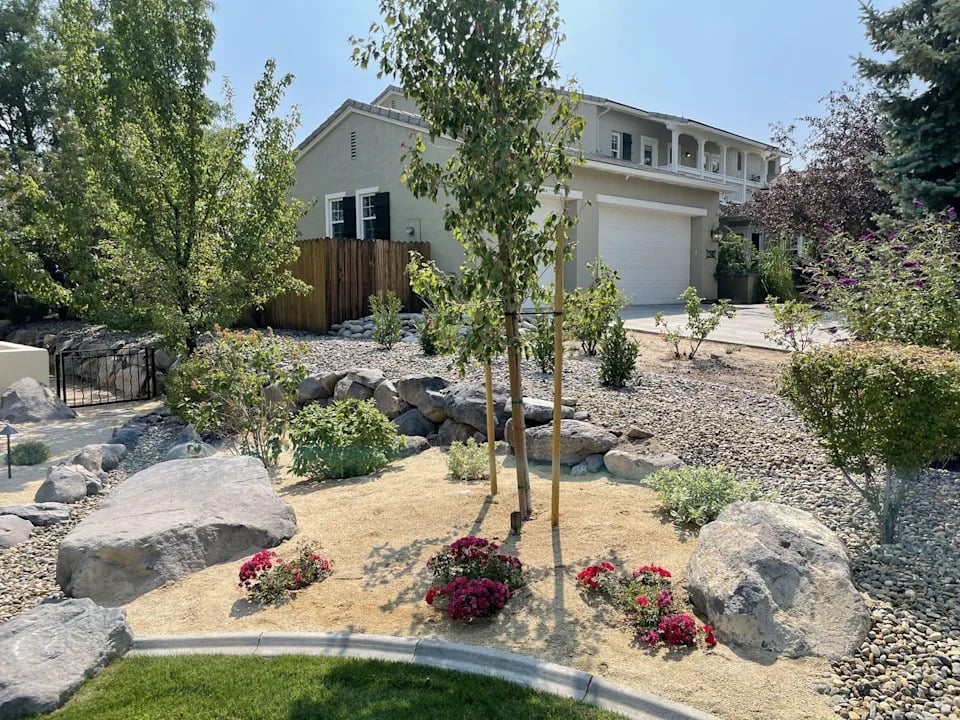
A limited palette keeps a modern garden from feeling busy. Large gray rocks anchor the space while red flowers add a deliberate pop of color. Tan gravel and green foliage fill in the middle, creating a balanced composition. The gray rocks act as a neutral backdrop, letting the red blooms stand out without competing. The ratio is roughly eighty percent neutral tones to twenty percent accent color, a formula that feels balanced. To recreate it, look for one bold flower color and repeat it in small clusters instead of scattering it evenly. This creates a curated, not chaotic, garden.
Integrate Large Boulders with Concrete Steps in a Front Yard
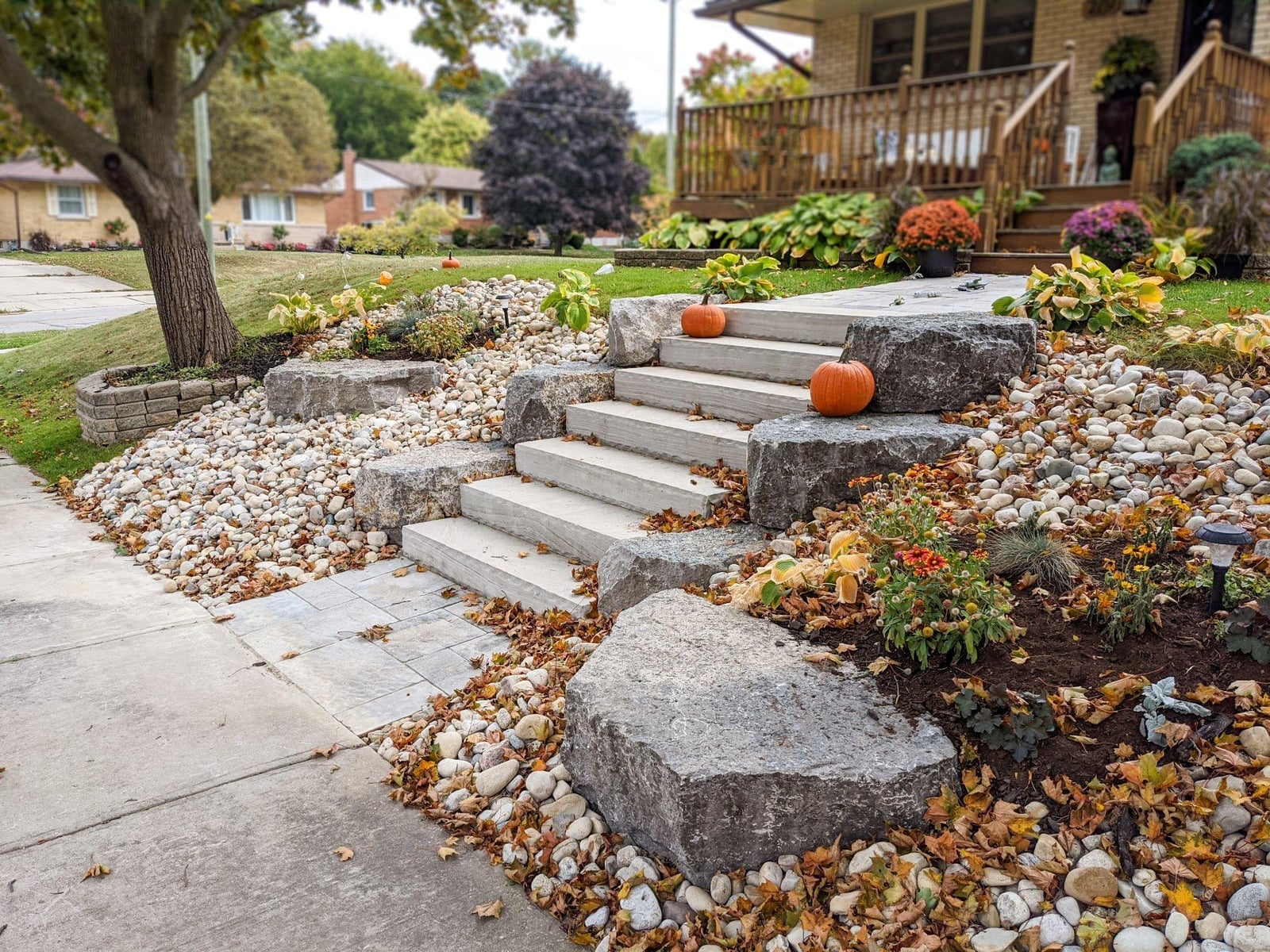
The concrete steps and large boulders share a similar gray-beige tone, which makes the transition from hardscape to landscape feel seamless. Orange pumpkins on the steps add a seasonal jolt of color, proving that even a small accent can shift the mood. The layout places the boulders alongside the path, so they guide the eye up toward the entrance without blocking it. This arrangement works because the boulders are set back enough to leave the walkway clear, a simple spacing trick that keeps the entry functional.
Create Contemporary Front Yard Pathways with Large Boulders
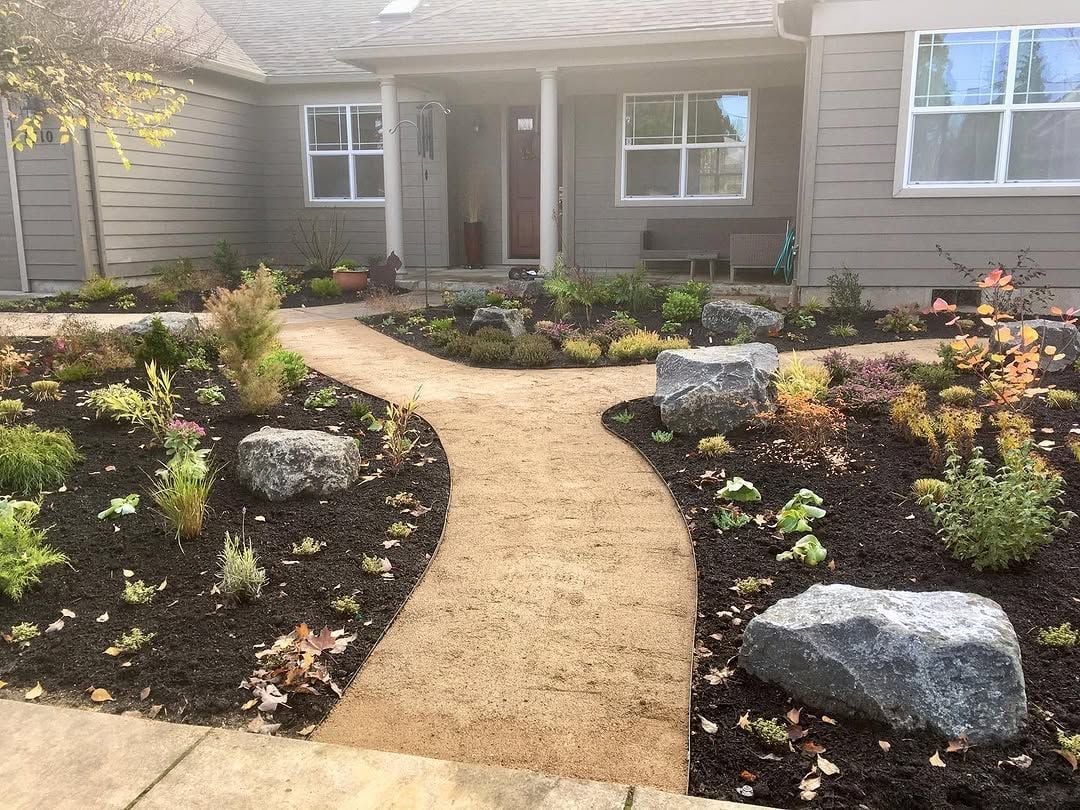
When laying out a path, the line it draws matters as much as the surface. A curving gravel route softens the geometry of a house and invites a slower pace. Large boulders placed at intervals along the curve break up the line and create visual pauses. The tan and gray tones of the rocks match the gravel, so the path reads as a single composition rather than a collection of parts. Diverse plantings around the boulders add texture and keep the look from feeling sparse. The key is to vary the size of the rocks and the spacing between them, so the arrangement feels natural, not like a row of soldiers.
Design a Japanese Rock Garden with Multi-Level Waterfalls and Rocks
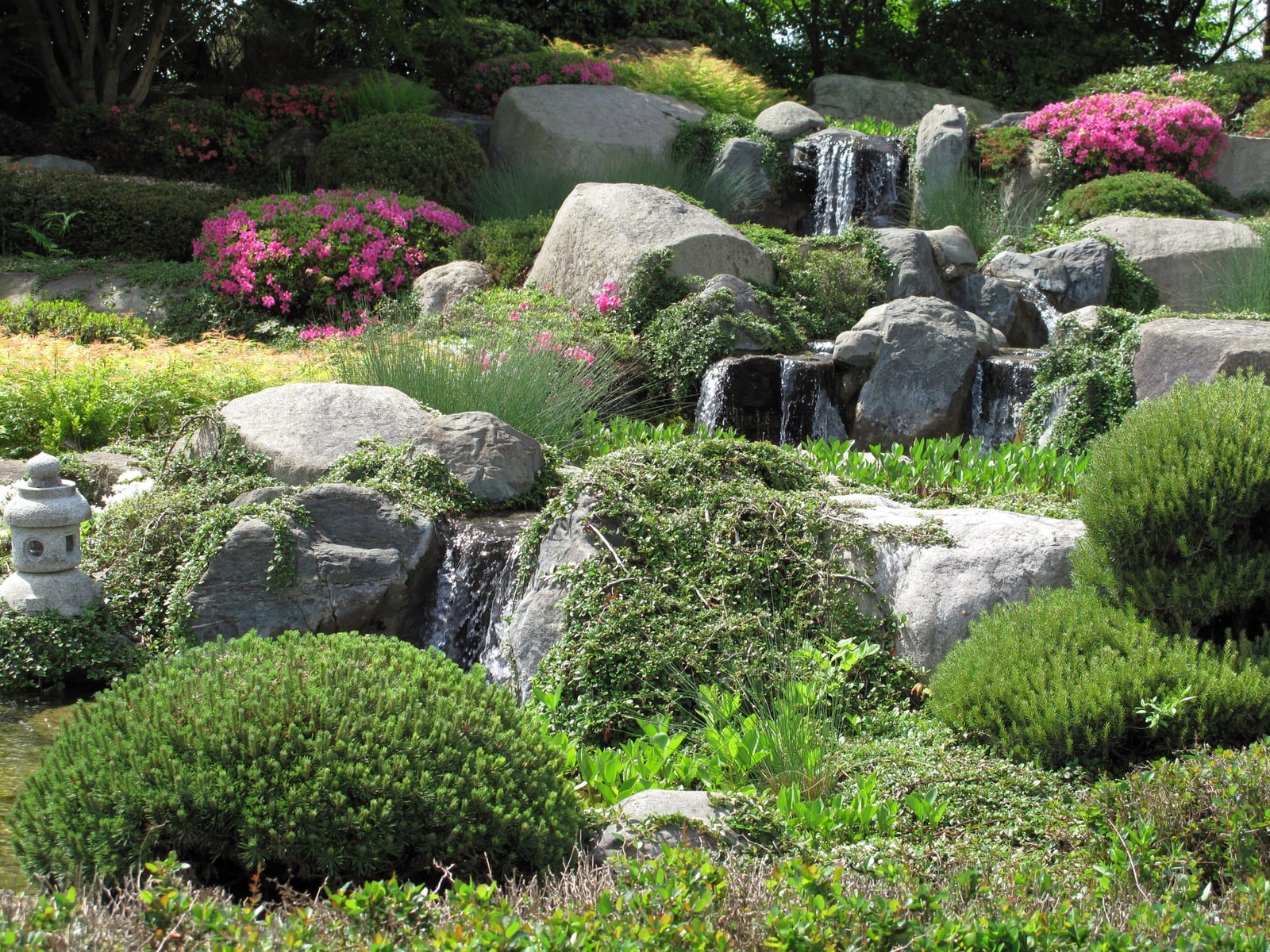
A Japanese rock garden often aims for stillness, but adding water changes the energy entirely. Here a multi-level waterfall cascades over stacked rocks, creating sound and movement that draw you into the space. The large rocks anchor the base of each tier, while smaller stones and a stone lantern provide scale. The water runs over dark gray stone, which picks up the green of surrounding shrubs and the soft pink of a flowering tree. The layout uses height variation to separate zones: the waterfall at the back, a viewing area in front, and rocks that guide the eye across the scene. This kind of garden works best when the water feature is visible from a primary sitting area or window, so the sound becomes part of daily life.
Build a Naturalistic Rock Wall with Lavender and Shrubs
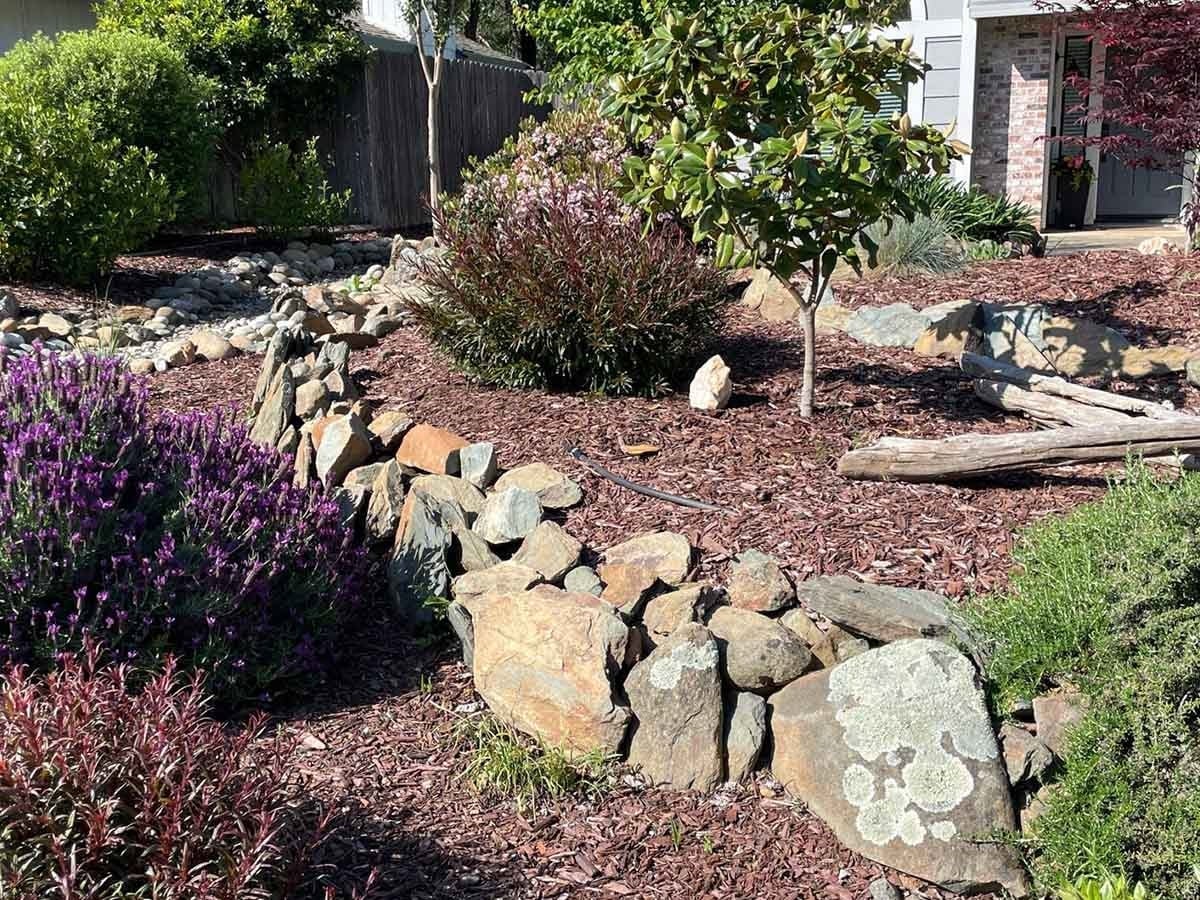
A rock wall built from varied stone sizes looks more organic than one made from uniform blocks. Here the wall uses earth-toned rocks stacked with visible gaps, which softens the structure and allows plants to weave through. Lavender spills over the top, while shrubs at the base fill in the lower edge. The combination of purple flowers and green foliage against the gray-brown stone creates a layered effect that suits a cottage or naturalistic garden. The wall defines the garden bed without feeling rigid, and the plants help it settle into the landscape over time.
Use Large Tan Boulders for Curb Appeal in Garden Beds
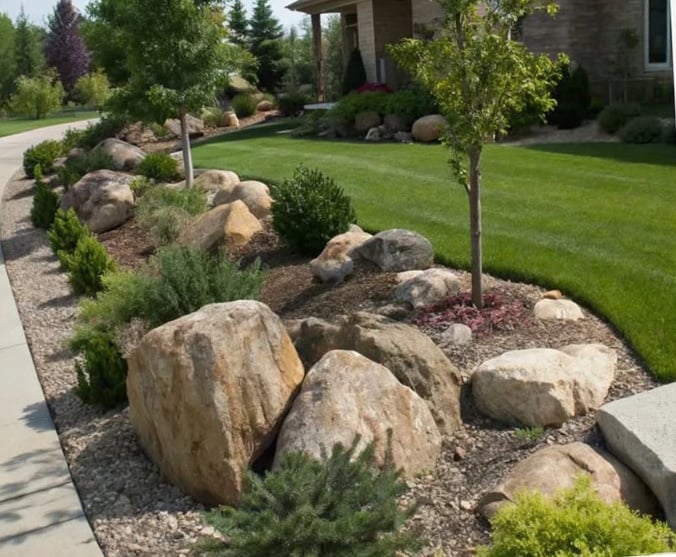
A row of large tan boulders can set the tone for the whole front yard. Placed along the edge of a lawn, they anchor a garden bed filled with small trees and shrubs under sunny daylight. The warm tan tones bridge the green of the plants and the brown of the mulch, so the bed looks like one cohesive shape. For a clean line, nestle each boulder about a third of the way into the soil. The palette stays simple: tan, green, and brown, which keeps the layout from feeling busy from the street. 32 looks that actually work.
Create a Natural Stone Wall with Integrated Vegetation
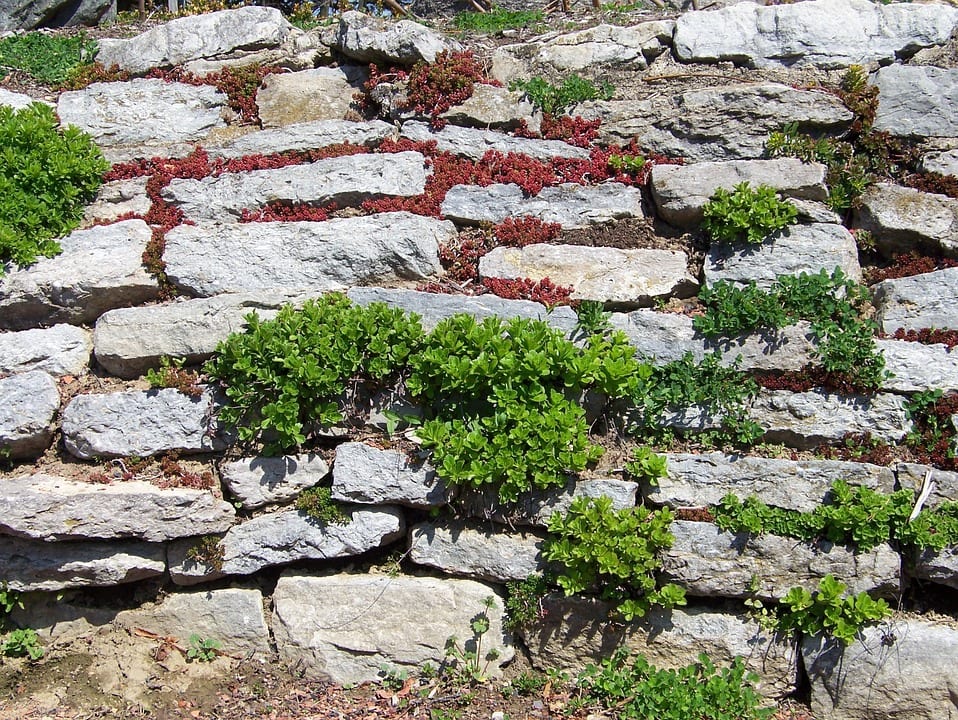
For a stone wall with plants: let the wall be the structure and the plants be the softening layer. In this design, a stacked gray stone wall runs horizontally through the garden, with various plants growing directly from gaps between the stones. The overcast daylight mutes the gray stone and the red-green foliage, so the wall looks like a natural part of the landscape, not a hard boundary.
For a renter-friendly take, use a low stacked stone wall without mortar. It can be rearranged or removed when you move out. Tuck small succulents or creeping herbs into the crevices as you stack. The plants will root into the soil behind the wall, and the whole assembly stays stable without permanent construction. This approach keeps the garden flexible without sacrificing the look of an established wall.
Incorporate Tiered Stone Steps Bordered by Natural Boulders
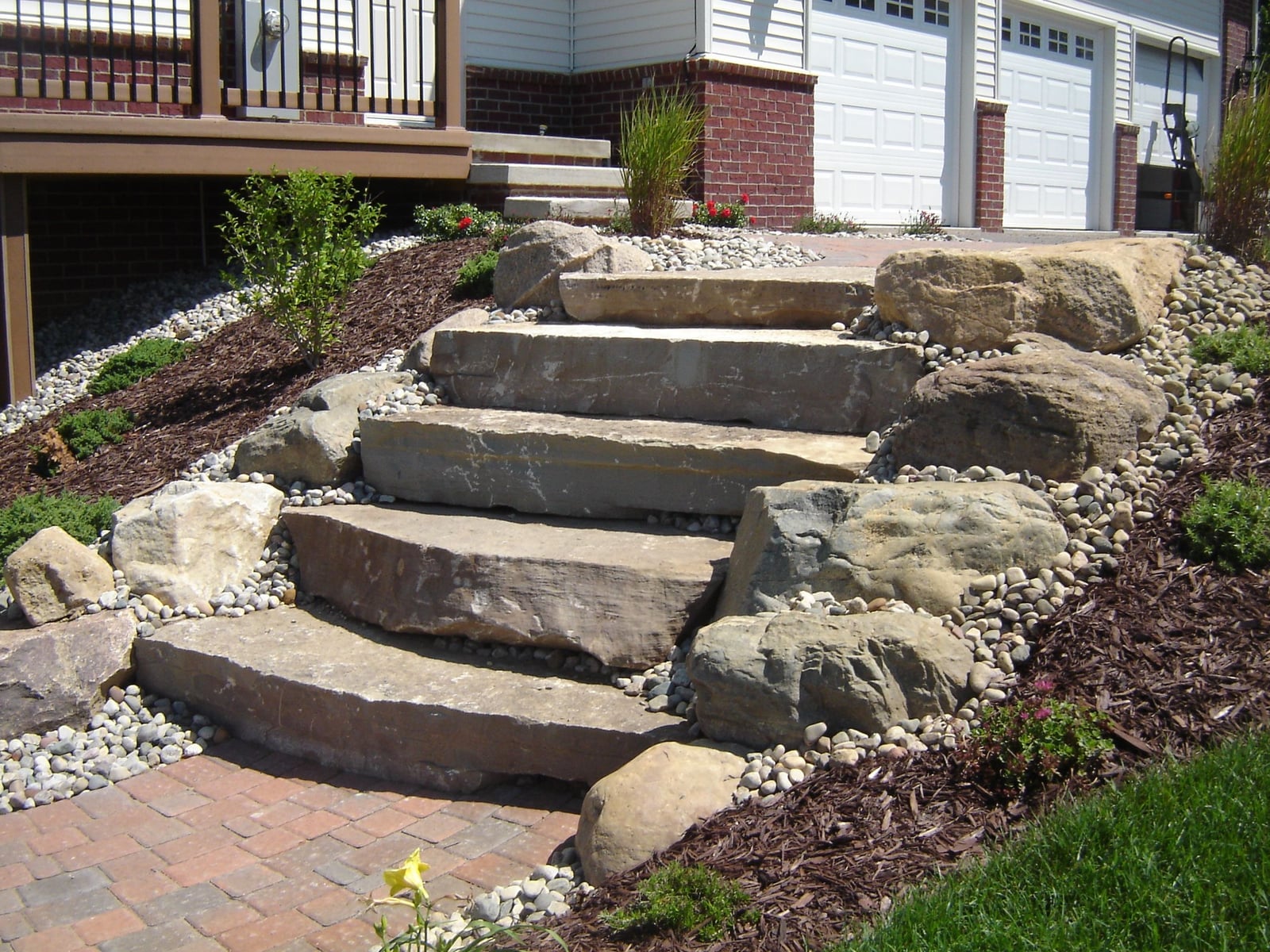
Massive cut stone steps make a garden path feel permanent. These tiered steps use large gray slabs, bordered by natural boulders and brick pavers, climbing a slope under bright daylight. Each tread is wide enough to feel solid underfoot, and the boulders on either side prevent the path from visually spilling into the surrounding mulch and plants. The palette stays within gray, brown, and green, so the path looks like a natural extension of the garden instead of an inserted walkway.
Arrange Smooth Gray Boulders in Mulch for a Modern Look
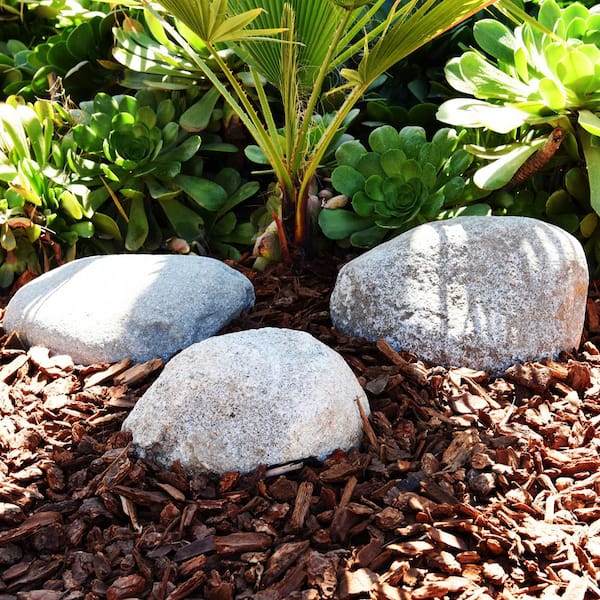
Smooth gray boulders placed in dark brown mulch create a clean, low-maintenance vignette. Three boulders sit together in a compact garden bed, their rounded surfaces contrasting with the fine texture of the mulch and scattered succulent leaves. The gray tone keeps the look cool and modern, while the mulch provides a dark backdrop that makes the boulders stand out as focal points. For a modern xeriscape, space the boulders so there is breathing room between them. Clustering too tightly makes the arrangement feel cramped.
Integrate a Water Feature with Large Rocks and White Gravel
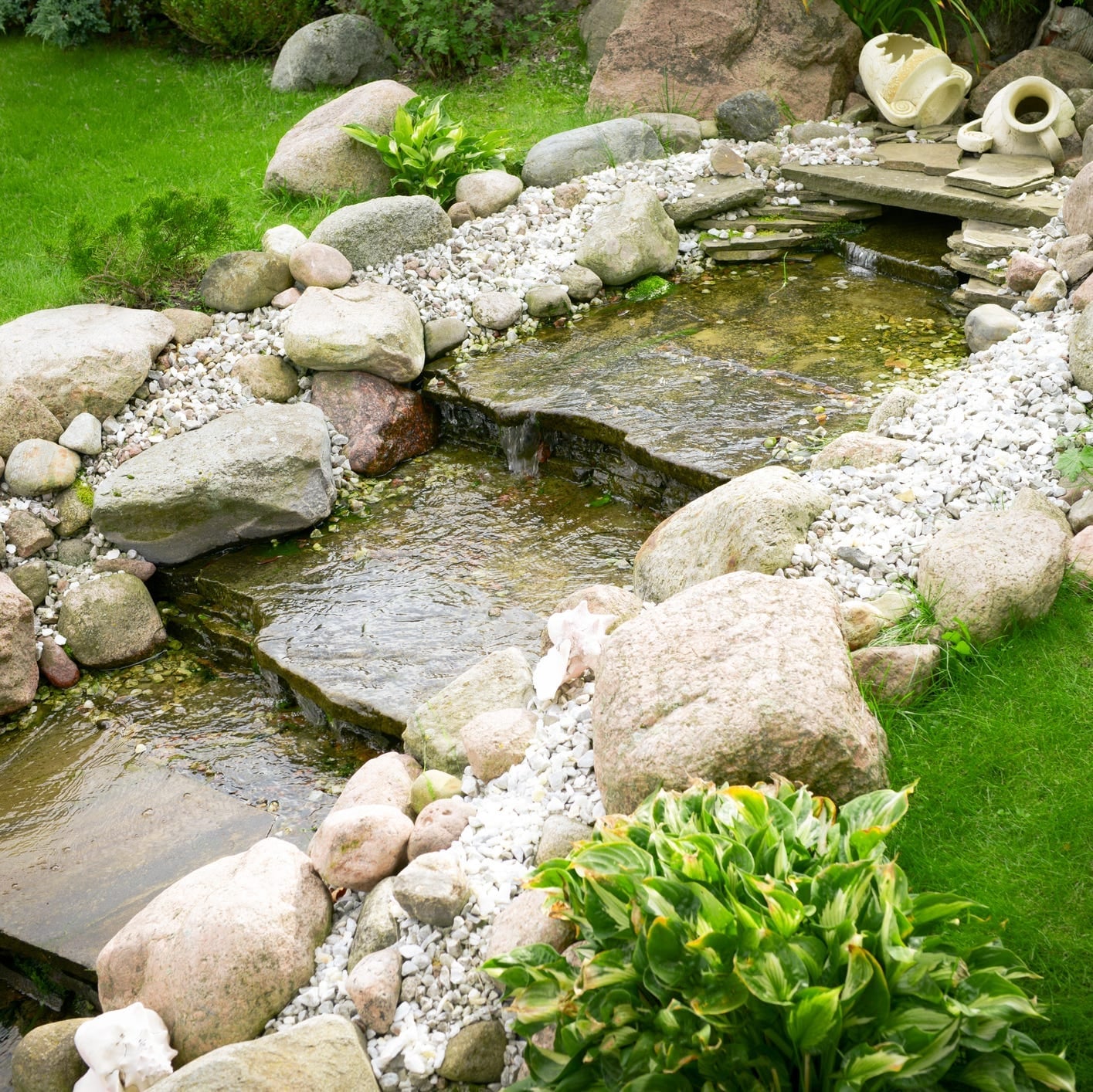
A winding water feature lined with large rocks and bordered by white gravel offers a cleaner alternative to a pond. The water flows over a stone path, with large rocks placed at intervals to break the flow and create sound. White gravel surrounds the feature, reflecting daylight and keeping the area bright even under tree cover. The palette of greens, grays, and white keeps the garden from feeling muddy.
For layout, position the water feature so it curves away from the main seating area rather than running straight at it. This draws the eye along the path without dominating the whole garden. The rocks should be set slightly back from the water’s edge to leave room for the gravel to act as a buffer zone, preventing soil from washing into the stream during rain.
Build DIY Stone Steps from Large Flagstones on a Garden Slope
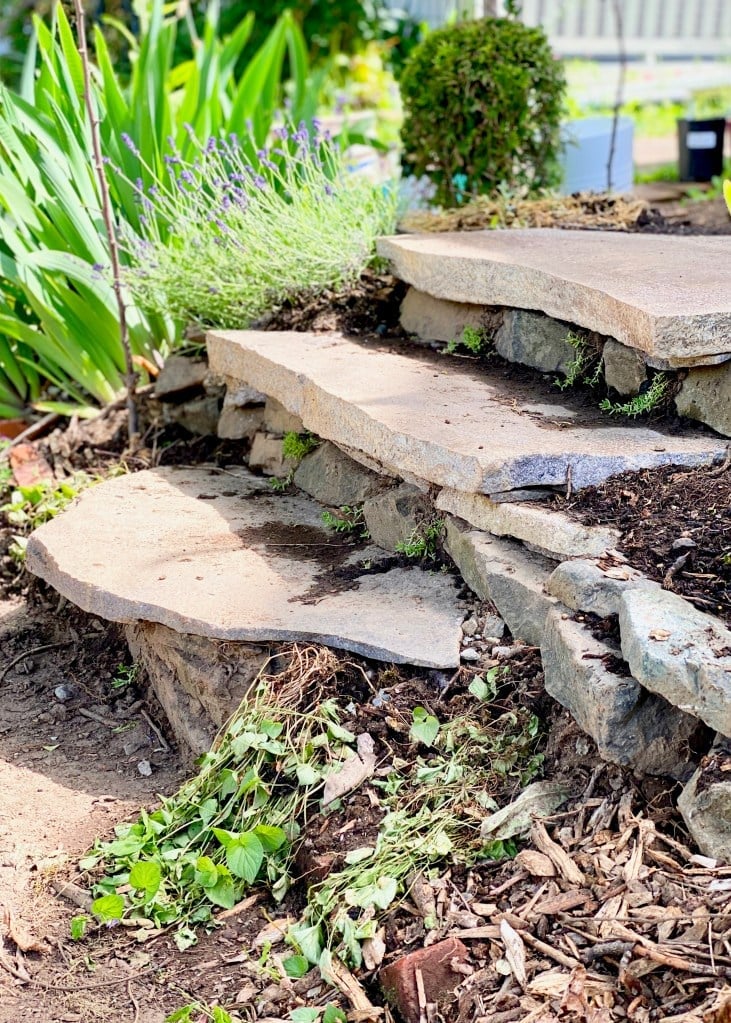
A garden slope can seem like a missed opportunity until you see what uneven flagstone steps do for it. The beige stone treads look natural against the soft green of lavender and the dark brown of woodchip mulch, so the path feels like it was always there. The compact scale keeps the vignette from overwhelming the slope. Choose flagstones with one fairly flat side for the tread and let the other edges stay rough. Bury the lowest stone a few inches into the soil so it looks grounded, not perched.
Use Large Boulders to Define Garden Borders Along a Lawn
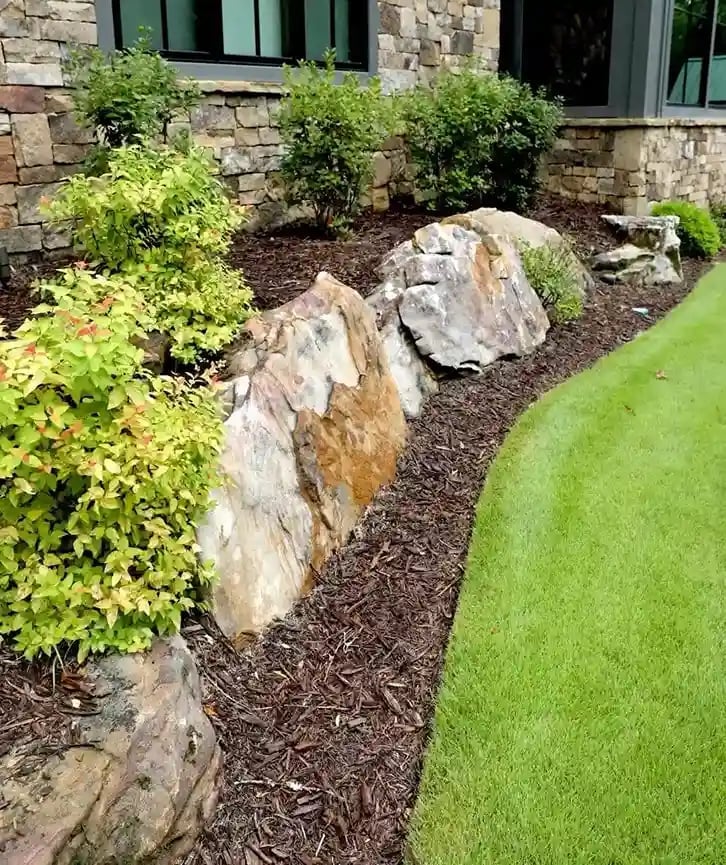
A straight edge between garden bed and lawn works fine, but large textured boulders give that line a reason to exist. The gray and beige stones break up the green and brown palette without adding a single plant. Placed at irregular intervals along the border, they keep the eye moving instead of stopping at a hard edge. The key is to bury each boulder at least one-third of its height so it appears grounded. Leave a few inches of mulch around the base to blend the stone into the bed. This border feels planned but not overly tidy.
Final Thoughts
Landscaping with large rocks is about working with what’s already solid. The best placements look like they’ve always been there, not like something was added last weekend. Bury a third of each boulder for a settled look. Group odd numbers for visual balance. Let the rock’s natural shape guide its spot.
Keep an eye on drainage around large stones. Rain can shift smaller gravel over time. Check your USDA zone before choosing plants to tuck around them. A well-placed rock outlasts any flower, so take your time getting the angle right. The garden will feel older the day you finish.