You know that feeling when you finally find a garden idea that looks exactly right for your space, but the instructions are either too complicated or the result looks a bit… sad? We’ve been there. That’s why we went deep into the world of upcycled tire planters. After filtering through hundreds of options, we narrowed it down to 29 creative and genuinely doable ideas that actually deliver on style. Inside, you’ll find everything from playful and colorful designs to more rustic and even whimsical creations. These projects are taking over Pinterest for a reason in 2026: they’re the perfect blend of sustainable, budget-friendly, and high-impact design. And stay until the end — we break down the most common mistakes that can ruin these looks. 📌 Save this to Pinterest for later — you’ll want to revisit these ideas.
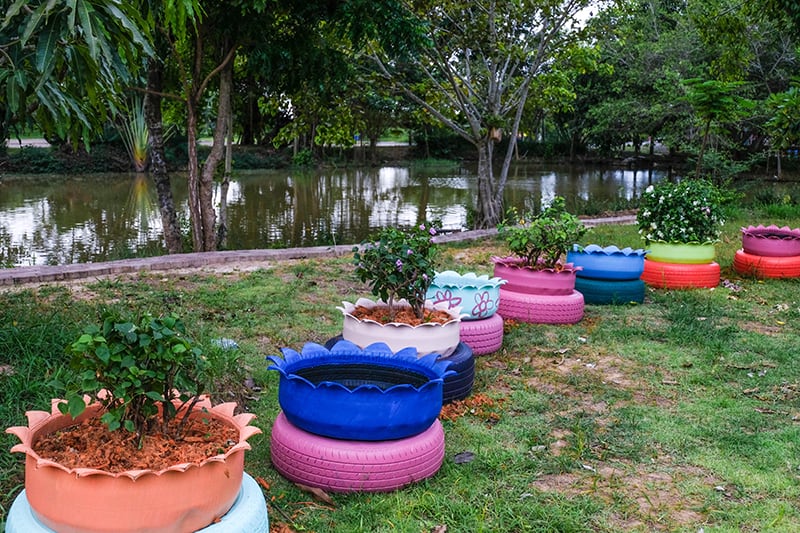
1. Colorful Tire Planters Lining a Natural Waterside Path
There’s a certain magic to how these brightly painted tires pop against the soft, natural backdrop. This design works because of the powerful use of color contrast. The vibrant, artificial blues, pinks, and oranges stand out dramatically against the muted greens and browns of the grassy bank and water. Furthermore, the repetition of a single form—the tire—creates a sense of rhythm and cohesion, turning a collection of discarded objects into a deliberate and charming pathway border. It guides the eye along the water’s edge beautifully.
“When painting tires, don’t skip the prep work.”
For outdoor projects, you absolutely need to use a primer specifically designed for rubber or plastic before you apply your color. A product like Rust-Oleam Plastic Primer creates a bond that your topcoat can adhere to. Without it, even the best exterior paint will start to peel and flake within a single season of sun and rain. Apply one thin coat of primer, let it dry completely for at least an hour, and then you can go in with your chosen color.
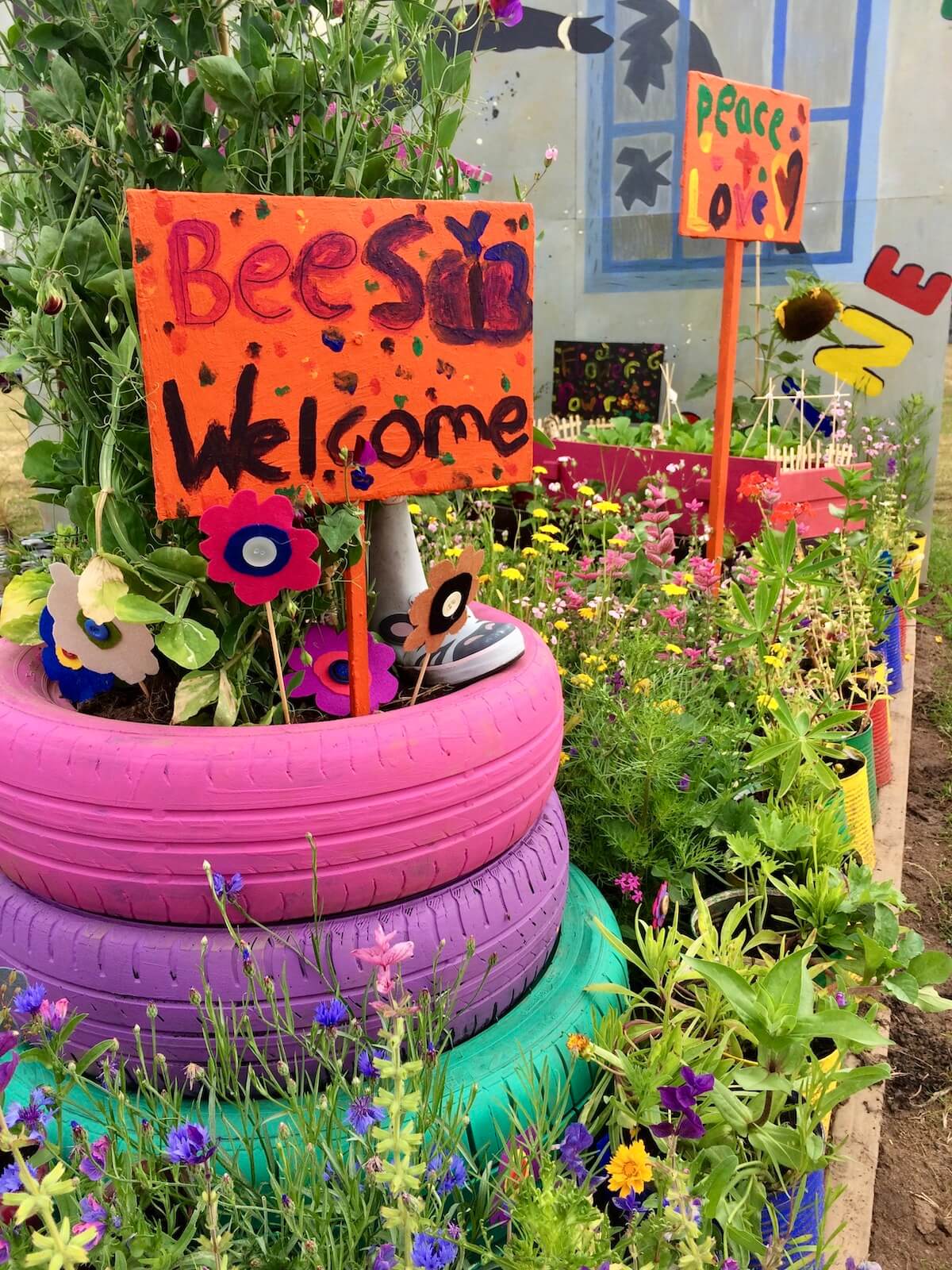
2. Stacked Rainbow Tire Planters with a ‘Bees Welcome’ Sign
that makes this idea so charming is the unapologetic sense of play. It’s the combination of the handmade ‘Bees Welcome’ sign and the whimsical felt flower decorations. Without these elements, you’d just have a stack of colorful tires. But with them, you have a story. It’s a joyful, personal invitation to pollinators and people alike. This is what transforms a simple DIY project into a piece of garden art with personality and a point of view. It’s a reminder that decor doesn’t have to be serious to be effective.
“The visual formula here is pure, saturated fun.”
Think of it as 60% bold color (the pink, purple, and teal tires), 30% natural texture (the diverse flowers and greenery), and 10% quirky personality (the signs and felt decorations). You could easily swap the color palette—imagine a sunset-inspired stack of red, orange, and yellow—and as long as you keep that 10% of whimsical detail, you’ll achieve the same happy, inviting energy. The key is that final layer of handmade charm.
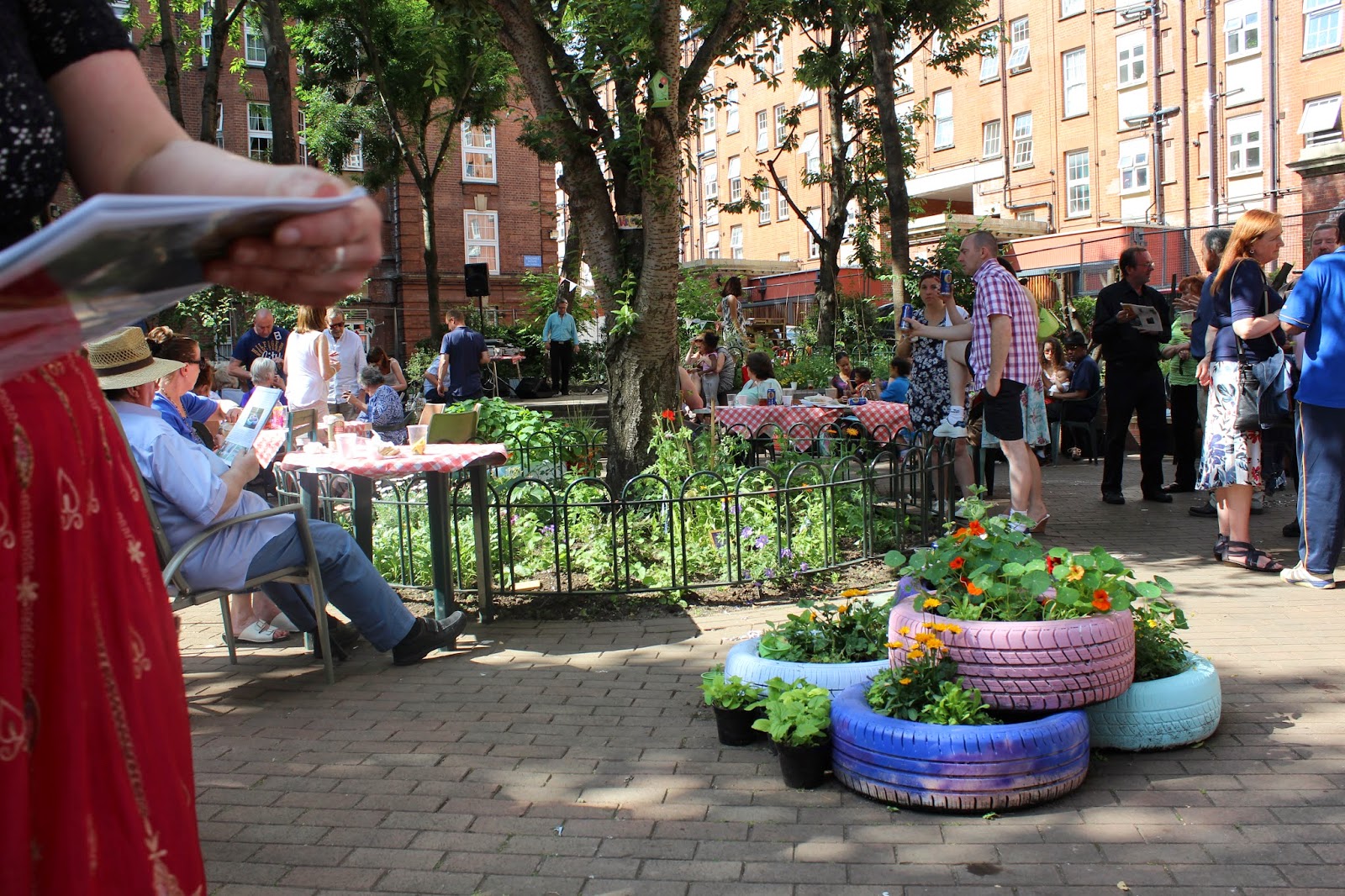
3. Pastel Tire Planters on a Lively Brick Patio
This scattered, informal arrangement is perfect for larger patios or deck spaces, ideally 150 square feet or more. The idea is to create pockets of interest rather than a single focal point. It allows foot traffic to meander and gives a casual, party-ready vibe. For smaller spaces, like a balcony or a narrow side yard (under 75 square feet), you’d be better served by a vertical arrangement, like the tiered planter in Idea #6, to maximize your floral display without eating up precious floor space.
“Let’s have some real talk about drainage.”
While these look fantastic, a tire sitting flat on a brick patio can trap moisture underneath, leading to algae growth on your bricks and potentially creating a mosquito breeding ground if water pools inside. You must drill several 1/2-inch drainage holes in the bottom sidewall of each tire before filling it with soil. This allows excess water to escape properly, protecting both your plants and your patio surface. It’s a non-negotiable step.
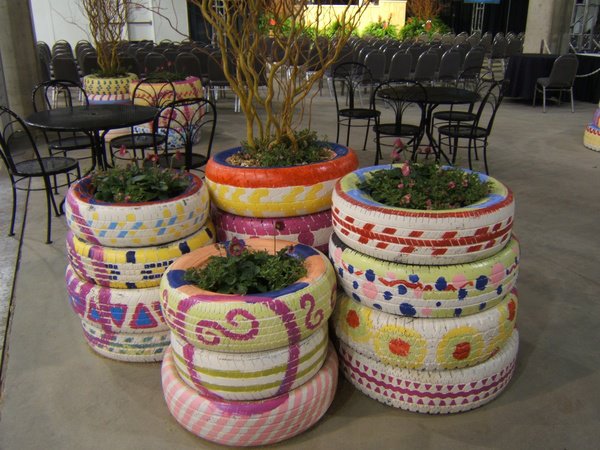
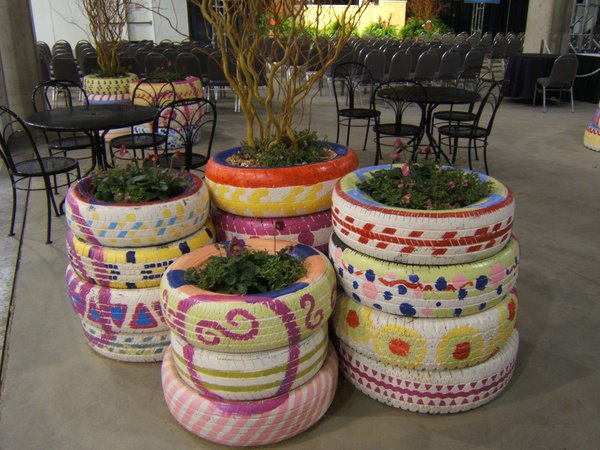
4. Eclectic Painted Tire Stacks with Spindly Branches
The whimsical, bare branches add such great height and structure. Here’s how to create that look yourself. Estimated time: 1 hour. Materials cost: under $15.
“Find some interesting, spindly branches from your yard or a park (check local rules first!).”
Clean any dirt or loose bark off the branches with a stiff brush.
If you want them to last longer, apply a thin coat of clear matte spray sealant.
Once your tire planter is filled with soil, simply push the clean branches firmly into the center.
Arrange them at varying heights and angles to create a sculptural, natural look that contrasts with the geometric tires.
You can get this playful, eclectic vibe for next to nothing. The tires themselves are often free from a local auto shop (they’re usually happy to have you take them). A can of spray paint is about $8-12. The biggest cost would be soil and plants, but you can easily propagate existing plants or get starters from a friend. For the branches? Totally free. Facebook Marketplace and neighborhood free-cycle groups are also amazing sources for leftover exterior paint if you want more color variety without buying full cans.
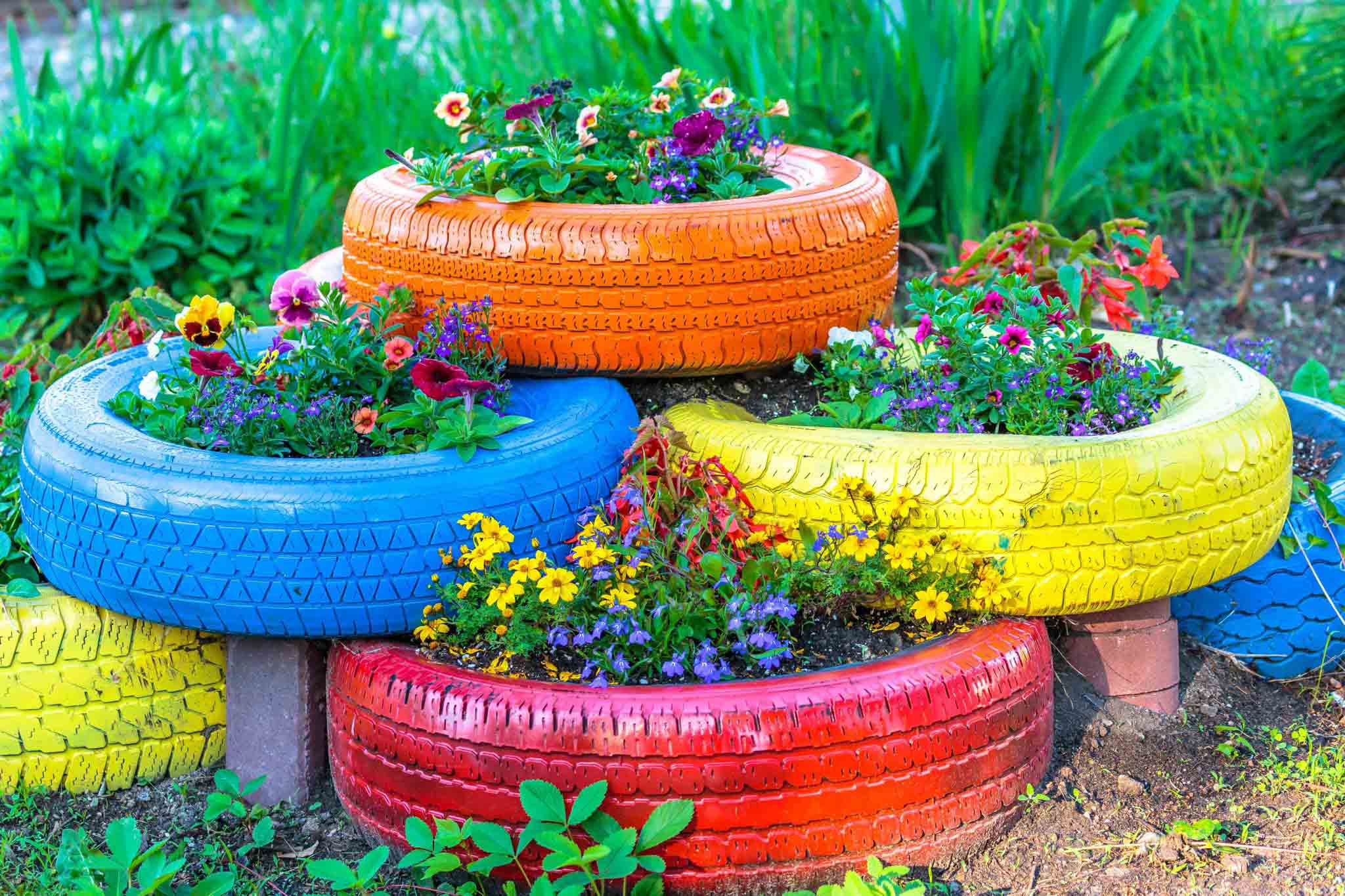
5. Vibrant Primary-Colored Tire Planters in a Staggered Arrangement
This design succeeds by embracing bold simplicity. The use of primary (red, blue, yellow) and secondary (orange) colors creates an immediate, high-energy impact that feels both classic and playful. It’s a nod to childhood building blocks. The staggered heights are also key; by stacking some tires two-high and leaving others as singles, the arrangement has a dynamic rhythm that prevents it from feeling static or boring. It draws your eye up and around the composition, rather than just in a straight line.
“Be prepared for some color upkeep.”
Bright, saturated colors like red and yellow are notorious for fading faster in direct sunlight compared to blues or greens. To keep these looking their best, you’ll likely need to do a touch-up coat every other year. When you first paint them, use an exterior paint with built-in UV protection. An alternative with less maintenance would be to use black or gray tires and let the vibrant colors come purely from the flowers themselves, which you’ll be changing out seasonally anyway.
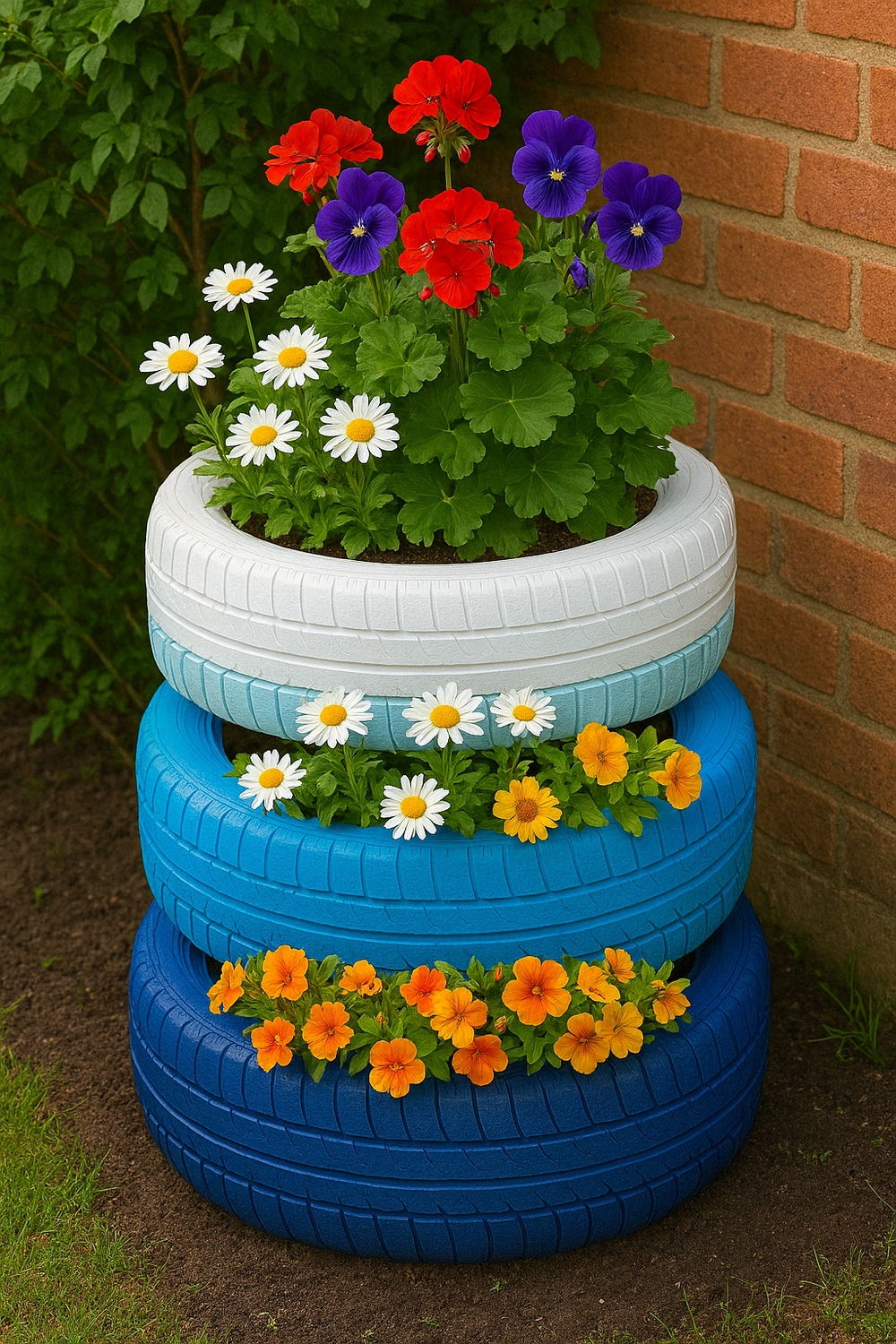
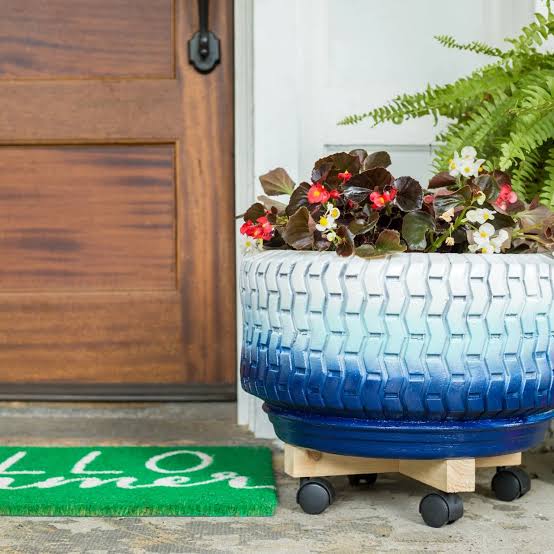
6. Three-Tier Blue and White Planter with Mixed Flowers
When creating a stacked planter like this, soil compression is a real issue. To ensure the bottom tiers have enough aeration and prevent the soil from becoming a dense brick, mix in about 20% perlite or pumice with your potting soil. Also, make sure each tire has its own independent drainage. Before stacking, drill drainage holes around the bottom rim of the top and middle tires. This prevents the top tire from waterlogging the one below it, which is a common reason for root rot in stacked designs.
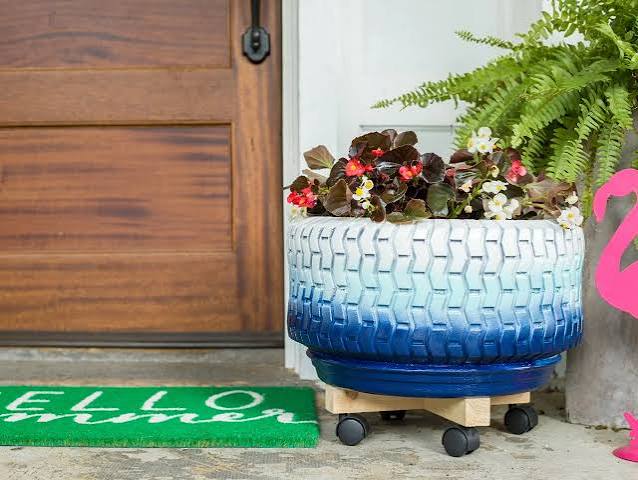
“The single element that makes this work so well is the simple, clean color gradient.”
Moving from a dark blue at the base to a light blue and finally to a crisp white creates a sense of lightness and upward momentum. It feels intentional and designed. If all the tires were the same color, it would look much heavier and more utilitarian. This subtle ombre effect is what elevates the stack from a pile of tires to a polished garden feature, drawing your eye up to the beautiful floral arrangement at the top.
7. The Essential Guide to an Upcycled Tire Planter
Before you even think about paint colors, let’s talk about the tires themselves. Old tires can leach chemicals into the soil over time. While the general consensus is that this is a minimal risk for ornamental plants and flowers, you should never use untreated tires to grow edible plants, herbs, or vegetables. If you intend to grow food, you must line the inside of the tire completely with heavy-duty, food-grade plastic sheeting to create a barrier between the soil and the rubber. It’s an extra step, but it’s crucial for safety.
“Before you commit to turning that old tire into decor, run through this quick ch”
Before you commit to turning that old tire into decor, run through this quick checklist:
- Does the tire have any exposed steel belts or wires? If so, it might be a safety hazard. Choose another one.
- Do you have a powerful drill capable of punching through thick rubber for drainage holes? A standard drill might struggle.
- Have you confirmed where you can get exterior-grade primer and paint? The stuff you use for interior walls won’t last a month.
- What’s your plan for moving it? Once filled with wet soil, a single tire planter can weigh 50-100 pounds.
8. Yellow Tire Planter Featuring a Colorful Deer Motif
This planter is a brilliant exercise in layering. The formula is approximately 70% soft, cheerful base (the light yellow paint), 20% detailed pattern (the deer silhouettes), and 10% vibrant floral punch (the red and pink flowers). The key is the high-contrast relationship between the simple base color and the intricate, multi-hued pattern. You could apply this same math to other styles: imagine a navy blue base (70%) with a white geometric pattern (20%) and bright yellow flowers (10%) for a more modern, graphic look.
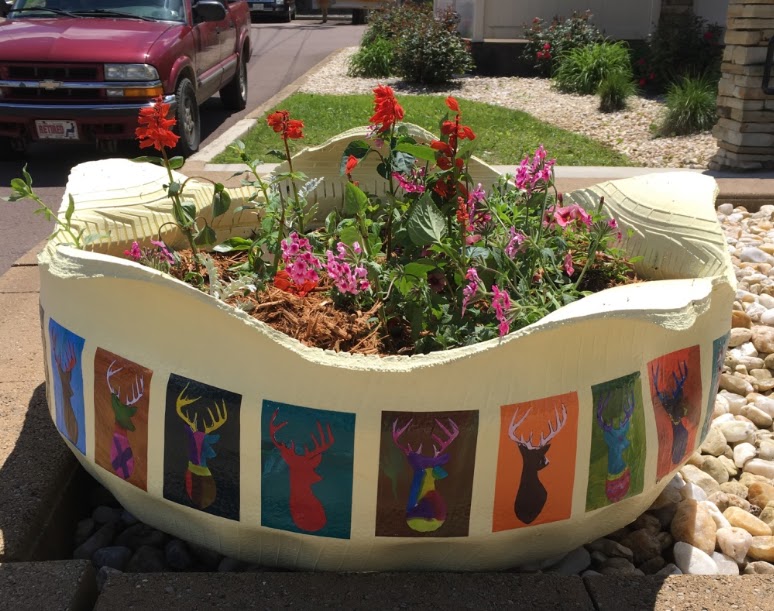
“This look is tapping directly into the ‘Cottagecore’ and ‘Craftcore’ trends that are still going strong on Pinterest and Instagram.”
The combination of a rustic, upcycled object (the tire) with a charming, almost folk-art-style decoration (the deer) feels personal, handmade, and nostalgic. People are craving decor that tells a story and feels unique, rather than mass-produced. This planter is a perfect example of that desire for personalized, whimsical touches in our outdoor spaces.
9. Bold, Matte Red Tire Planter with Lush Greenery
The single most important element here is the matte finish of the paint. A glossy red tire would have reflected the sun, looking like plastic and feeling cheap. The deep, matte red, however, absorbs the light, giving it a velvety, sophisticated texture that feels more like a piece of modern sculpture. It allows the tire’s intricate tread pattern to become an interesting textural detail rather than a distraction. That finish is what makes it feel bold and intentional, not just like a painted piece of junk.
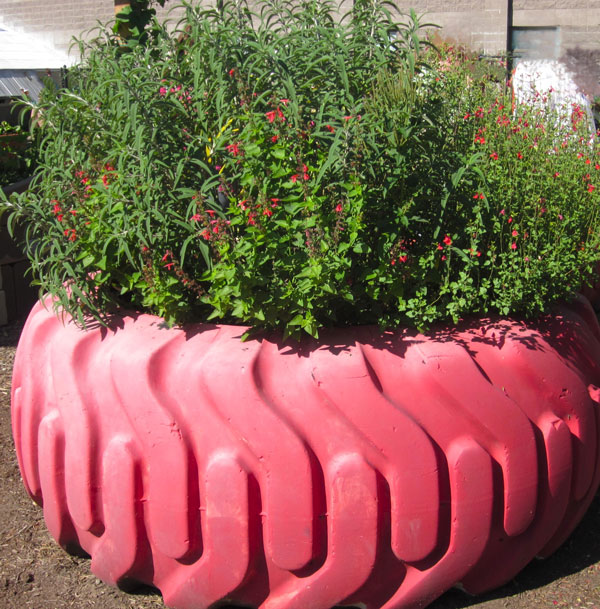
“Recreating this bold statement piece is surprisingly affordable.”
Recreating this bold statement piece is surprisingly affordable.
- Used Tire: Free – $10 (check local auto shops)
- Paint: $15 – $25 (one can of matte red spray paint and a primer)
- Plants: $20 – $40 (for a mix of established leafy greens and small flowers)
- Soil & Mulch: $10 – $20
- TOTAL: $45 – $95
Budget alternative: Find a smaller tire and use tester pots of exterior paint instead of a spray can. Propagate plants from your own garden for free.
10. A Rustic Cluster of Brightly Painted Tire Planters
The success of this grouping lies in its carefully orchestrated imperfection. The colors are all bright but from different families (purple, yellow, green, blue), which keeps it from feeling too matchy-matchy. They are clustered casually rather than in a rigid line, suggesting organic growth. Crucially, the weathered white wall behind them acts as a perfect neutral canvas, allowing the colors to pop without competing for attention. It’s the balance between the vibrant planters and the rustic, faded background that creates the charm.
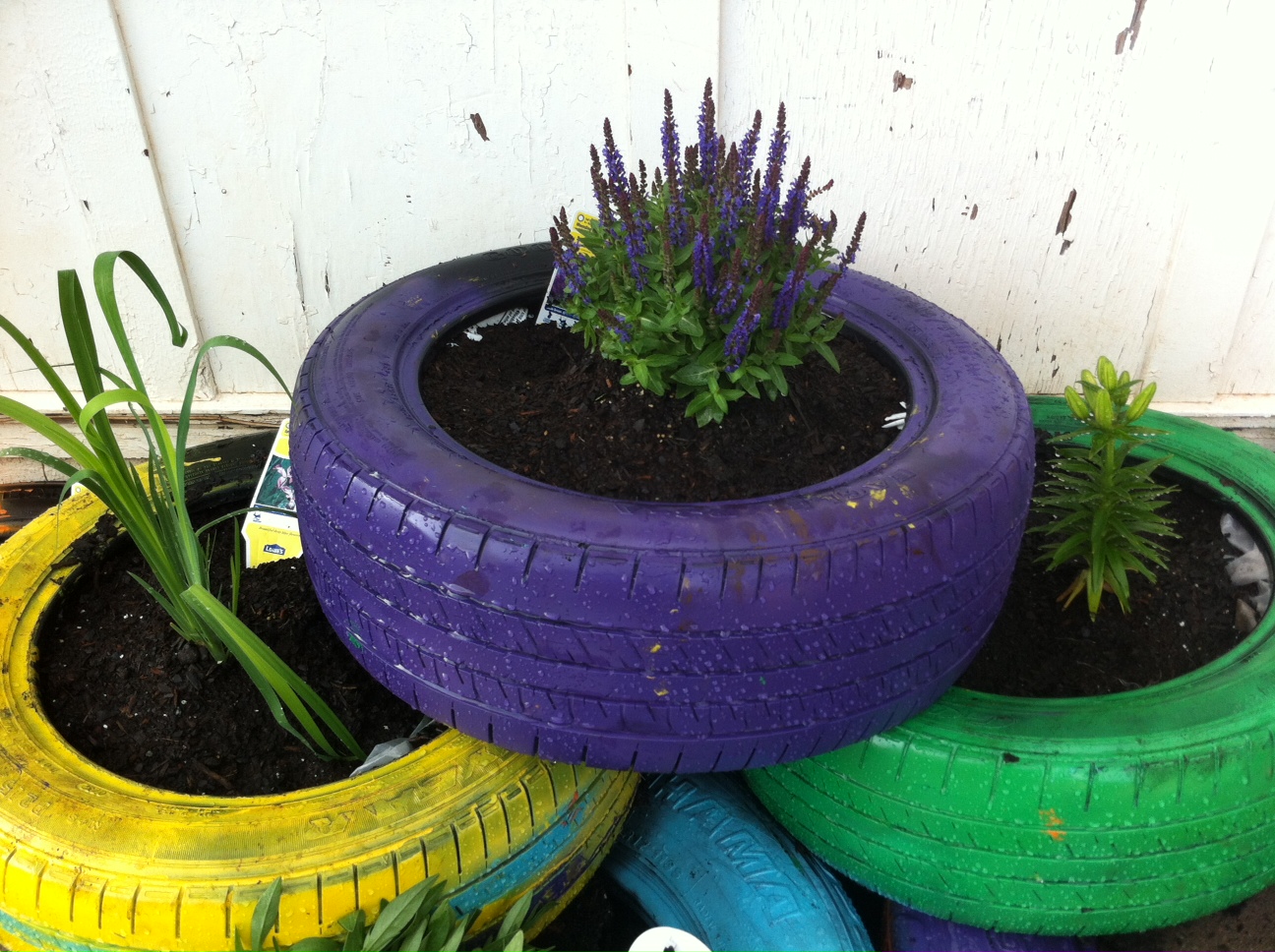
“When creating a cluster, always place your darkest or largest planter towards the back and in the middle.”
This grounds the arrangement and creates a sense of depth. Then, arrange the brighter, smaller planters around it, pulling them forward slightly. This technique is a simple trick borrowed from classic landscape design and photography, and it fools the eye into seeing more depth and dimension than is actually there. It prevents the cluster from looking like a flat, jumbled mess.
11. Simple Light Blue Tire Planter with Red Geraniums
This is the quintessential budget garden project, and it’s beautiful in its simplicity. One tire, a bit of leftover paint, and a handful of classic, hardy flowers like geraniums. You can often get a half-used can of exterior paint for a few dollars from a Habitat for Humanity ReStore or a local recycling center. Geraniums are famously easy to care for and provide a huge pop of color for around $5-10 per plant. The total cost here could easily be under $20, proving you don’t need a huge budget for a cheerful garden accent. Compare this to the multi-tier project in Idea #12 for a more involved approach.
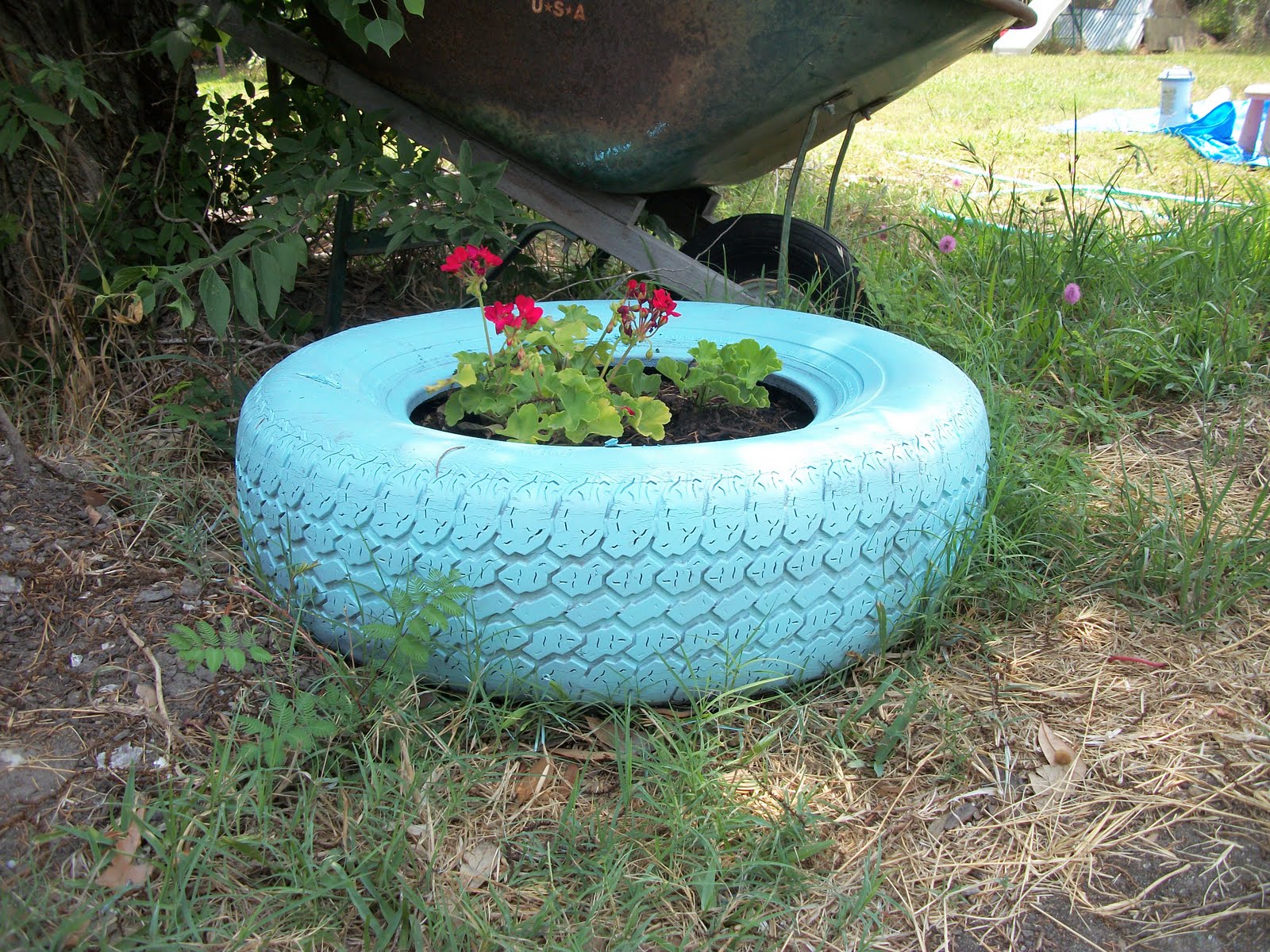
“A word of warning about placement: putting a tire planter directly on your lawn is a recipe for a dead, yellow circle of grass.”
The tire will block sunlight and compact the soil. Instead of placing it right on the grass, either lay down a small patch of mulch first or place it on an existing garden bed or patio. If it must be on the lawn, be prepared to move it every week or so to keep the grass underneath alive, which is a huge pain once it’s full of heavy soil.
12. Stacked Red ‘Brickwork’ Tire Planter with Pansies
The hand-painted brick pattern is what gives this planter its storybook charm. It’s easier than it looks! Est. time: 2 hours. Materials cost: $20.
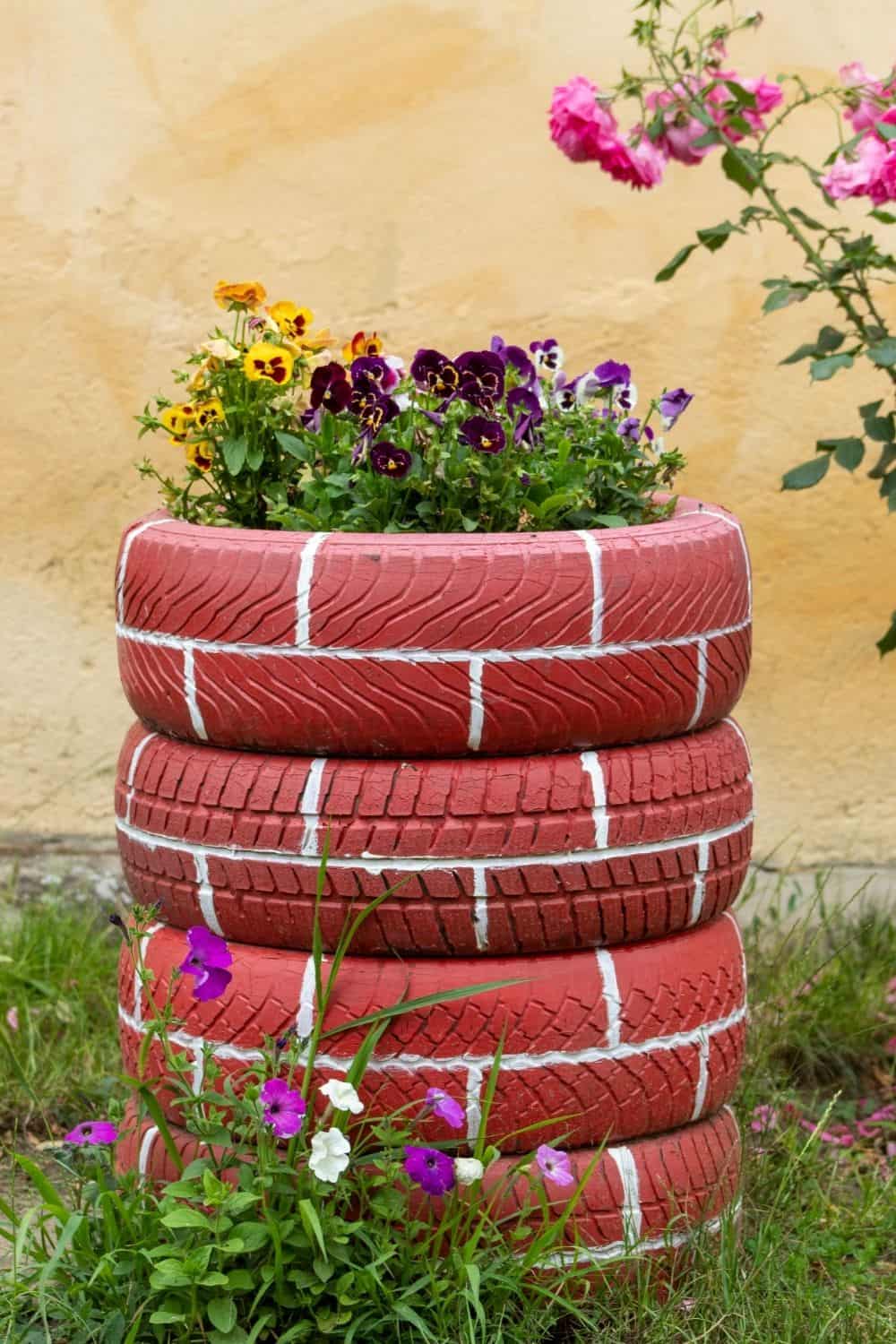
“After painting your tires a solid base red and letting them dry completely, get a small craft brush and some white exterior paint.”
Paint rough, slightly wavy horizontal lines around the tire to act as your mortar lines. Don’t worry about them being perfectly straight.
Once the horizontal lines are dry, add short, vertical lines to create the brick shapes.
Vary the length of the ‘bricks’ and stagger the vertical lines on each row. The imperfection is what sells the look!
A tall, vertical feature like this is a fantastic solution for small spaces. Because its footprint is just the size of a single tire, it works well on narrow balconies, tight corners of a patio, or flanking a doorway where you don’t have a lot of horizontal ground to spare. It draws the eye upward, creating an illusion of more space. It’s a much smarter use of a tight spot than the sprawling, informal layout seen in Idea #3, which requires a much larger area to feel balanced.
13. Patriotic Painted Tire Planter with Handprints and Stars
Planning a kid-friendly craft project like this is a great idea, but a little prep goes a long way. Here’s your checklist:
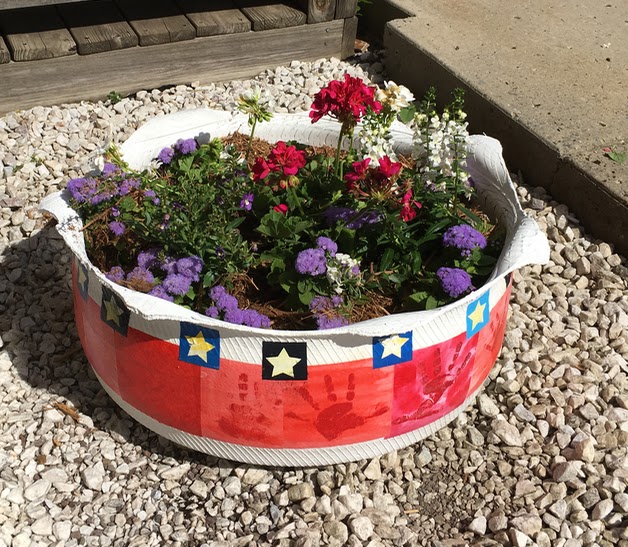
“Have you cleaned the tire thoroughly?”
Use a strong degreasing soap to remove any road grime, otherwise the paint won’t stick.
Are you using non-toxic, water-based paint for the handprints? Make sure it’s safe for little hands. You can always seal it with a clear, durable topcoat later.
Do you have a designated ‘messy zone’ set up on a tarp or cardboard? This will save your lawn or patio from becoming a permanent art installation.
What’s your plan for the ‘grown-up’ parts, like drilling drainage holes and moving the heavy final product?
The single element that makes this planter so special is, of course, the handprints. They transform the project from a simple patriotic decoration into a personal time capsule. It’s not just a planter; it’s a memory of a specific afternoon, of tiny hands covered in paint. This is something that can’t be bought. While the ‘Angry Birds’ planter in Idea #14 is super fun, the personal touch here gives this one a unique and sentimental warmth that’s truly irreplaceable.
14. Stacked Red ‘Angry Birds’ Character Tire Planter
This is all about translating a 2D character onto a 3D form. The formula is 80% iconic character base (the solid red body and distinctive face), 10% complementary planting (the orange and purple flowers that echo the game’s vibrant palette), and 10% textural context (the gravel ground covering that lets the character stand out). The key is simplifying the character into its most recognizable shapes—the angry eyes and yellow beak are all you need to sell the idea. Don’t overcomplicate it with extra details.
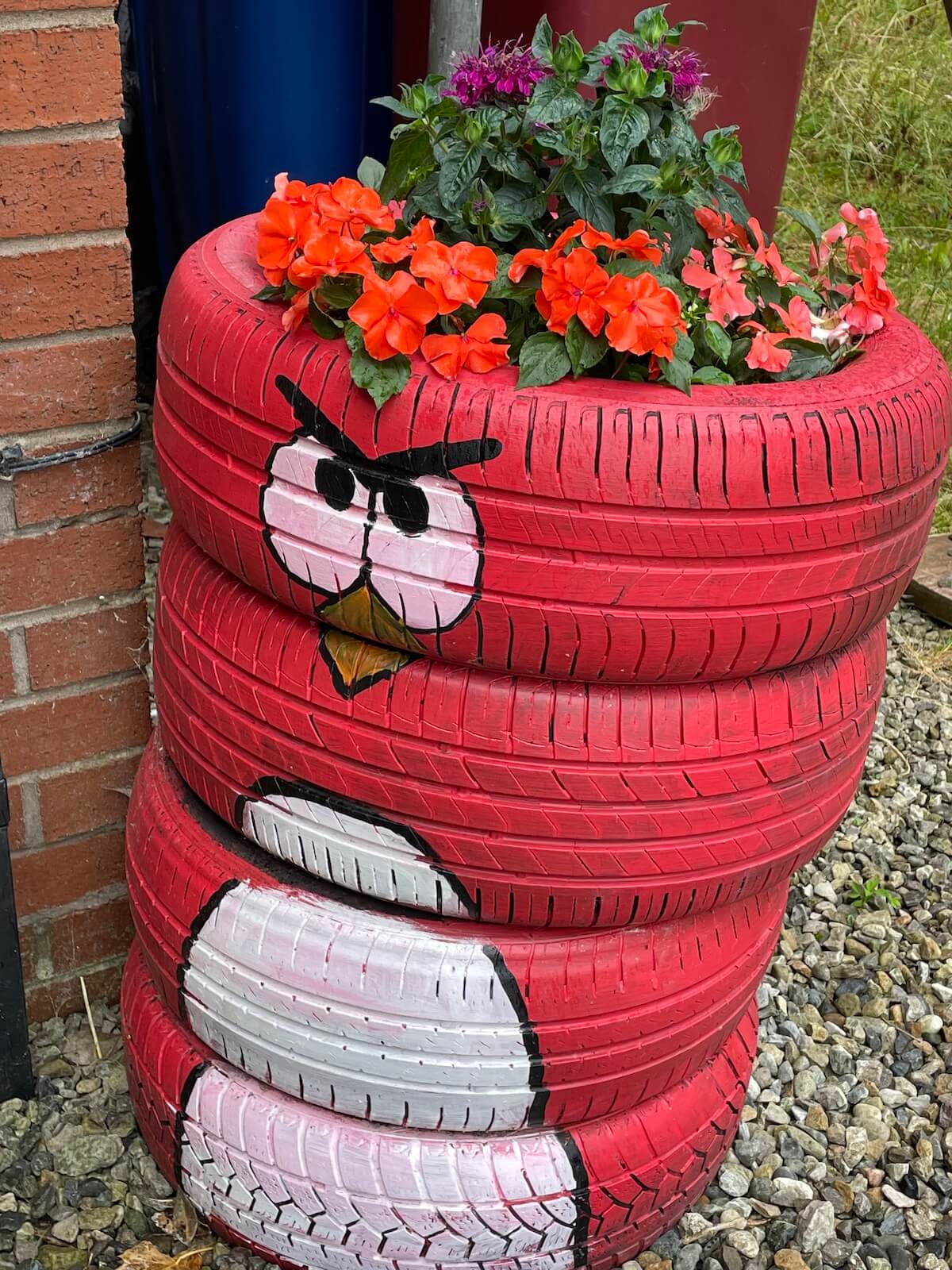
“When painting a recognizable character, getting the proportions right is everything.”
Before you even touch a paintbrush, find a good reference image and use a piece of chalk to sketch the face directly onto the tires. Chalk is forgiving and easy to wipe off. This allows you to adjust the size and placement of the eyes and beak until they look perfect. Only after you’ve finalized the chalk sketch should you go in with permanent paint. This extra 15-minute step is the difference between ‘clearly Angry Birds’ and ‘weird red face’.
15. Whimsical Red Ladybug Tire Planter with Googly Eyes
Those googly eyes are the secret ingredient! They add life and movement in the most charming way. Here’s how to make them last outdoors.
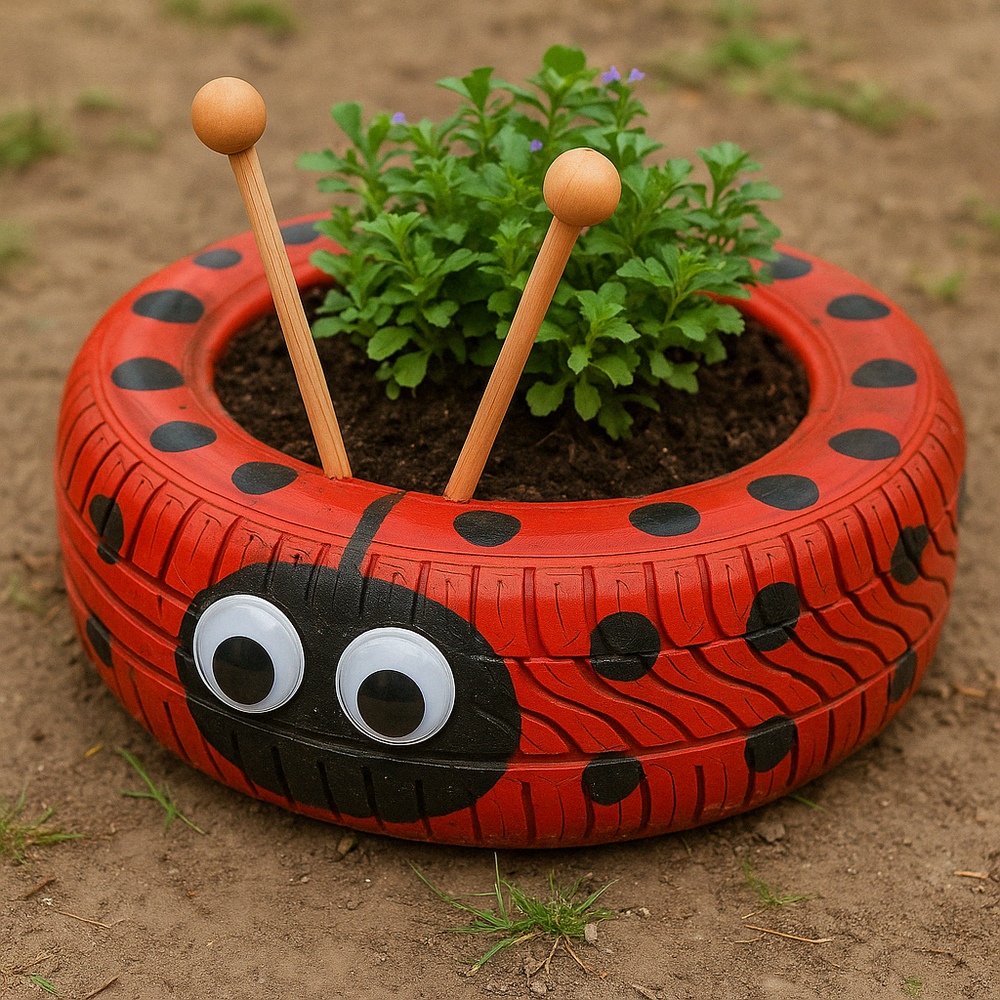
“Buy the largest googly eyes you can find at a craft store (at least 3-4 inches in diameter).”
The bigger, the better.
The self-adhesive backing on most googly eyes is not strong enough for rubber or outdoor conditions. Ignore it.
Use a generous amount of a heavy-duty, waterproof construction adhesive like ‘Liquid Nails’ or ‘E6000’.
Apply the adhesive to the back of the eye, then press it firmly onto the painted tire ‘head’.
If possible, lay the tire down so the eyes are facing up while the adhesive cures for a full 24 hours. This ensures a permanent bond.
This design is a masterclass in anthropomorphism—giving human-like qualities to an inanimate object. By adding just a few simple cues (spots, a ‘head,’ and especially the eyes and antennae), our brains instantly see a ladybug instead of a tire. The choice of a universally beloved insect makes it feel friendly and approachable. It works because it doesn’t just decorate the tire; it completely transforms its identity into something else, sparking imagination and a little bit of joy.
16. Pale Green Tire Planter with Pink Flowers on a Wood Fence
that truly elevates this idea is mounting the planter on the fence. By lifting it off the ground, it becomes a piece of vertical wall art, not just a container on the floor. This placement allows the pink and magenta flowers to cascade beautifully and brings color and life to eye level. It breaks up the dark, uniform surface of the wooden fence, turning a boring boundary into a deliberate part of the garden’s design. It’s a simple change in elevation that makes a world of difference.
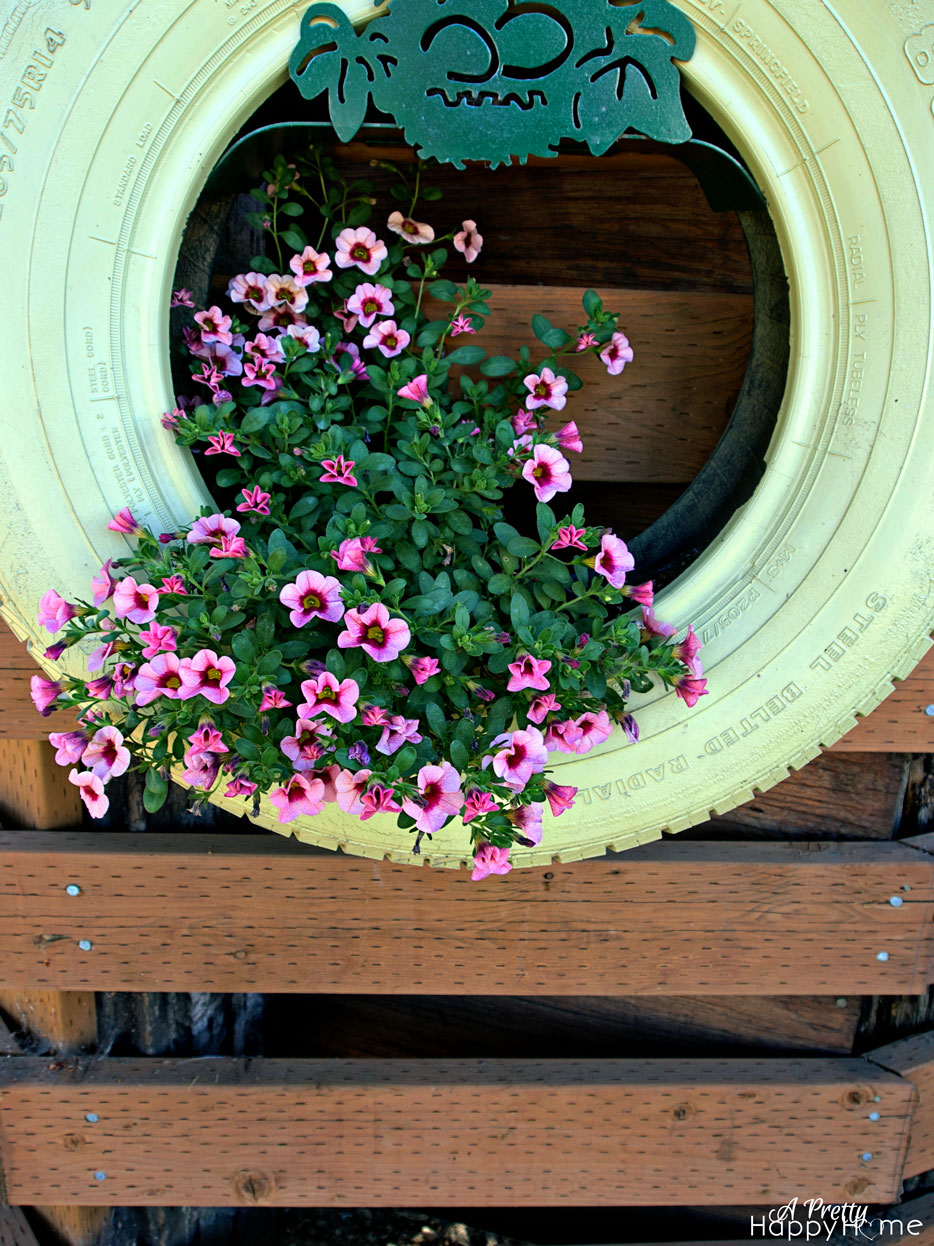
“A hanging tire planter will dry out much faster than one on the ground.”
Air circulates around all sides, wicking moisture from the soil. In the peak of summer, you may need to water this every single day, especially if it’s in direct sun. To help it retain moisture, mix some water-retaining crystals into your potting soil before planting. Also, be mindful of weight. A tire filled with wet soil is heavy. Ensure you are using very sturdy hooks or bolts that are secured into the fence posts or studs, not just the thin fence slats.
17. Unpainted Tire Planters with Vibrant Red and Bronze Foliage
This look is all about the power of contrast between the container and its contents. By leaving the tires their original dark, matte black, they become a neutral, sculptural frame. This allows the fiery red geraniums and the rich, bronze texture of the canna lilies to be the undisputed stars of the show. If the tires were painted a bright color, it would create a visual competition. Here, the utilitarian nature of the unpainted tire provides the perfect gritty, industrial counterpoint to the lush, vibrant foliage, making the plants seem even more colorful and alive.
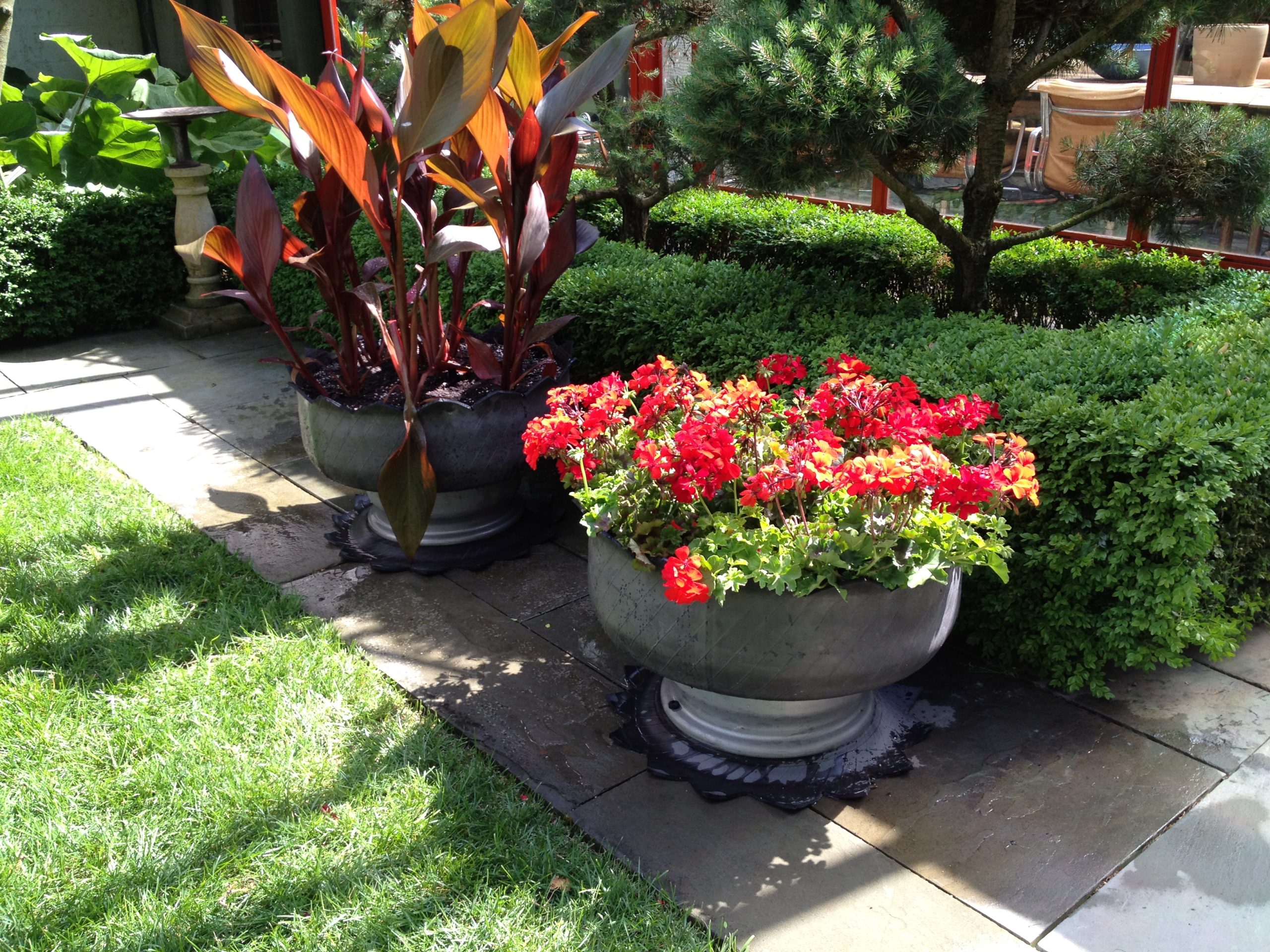
“Want this high-impact look for less?”
The tires are free from an auto shop. The trick is saving on the plants. Instead of buying large, fully grown canna lilies and geraniums, buy them as smaller, ‘starter’ plants early in the season for a fraction of the price. They’ll grow to fill the planter within a few months. Even better, canna lilies grow from tubers that you can dig up in the fall (in colder climates) and save to replant the following year, meaning you only have to buy them once.
18. Worn White Tire Planter with Mixed Foliage and Red Coleus
The defining feature here is the beautifully aged and weathered patina. The chipped white paint and visible wear on the tire give it a sense of history and character that a pristine, freshly painted planter would lack. It feels authentic and lived-in, perfectly complementing the slightly wild, overgrown look of the foliage. This texture—the cracked concrete, the worn tire—is what gives the scene its rustic, found-object charm. It proves that sometimes, a little imperfection is a good thing.
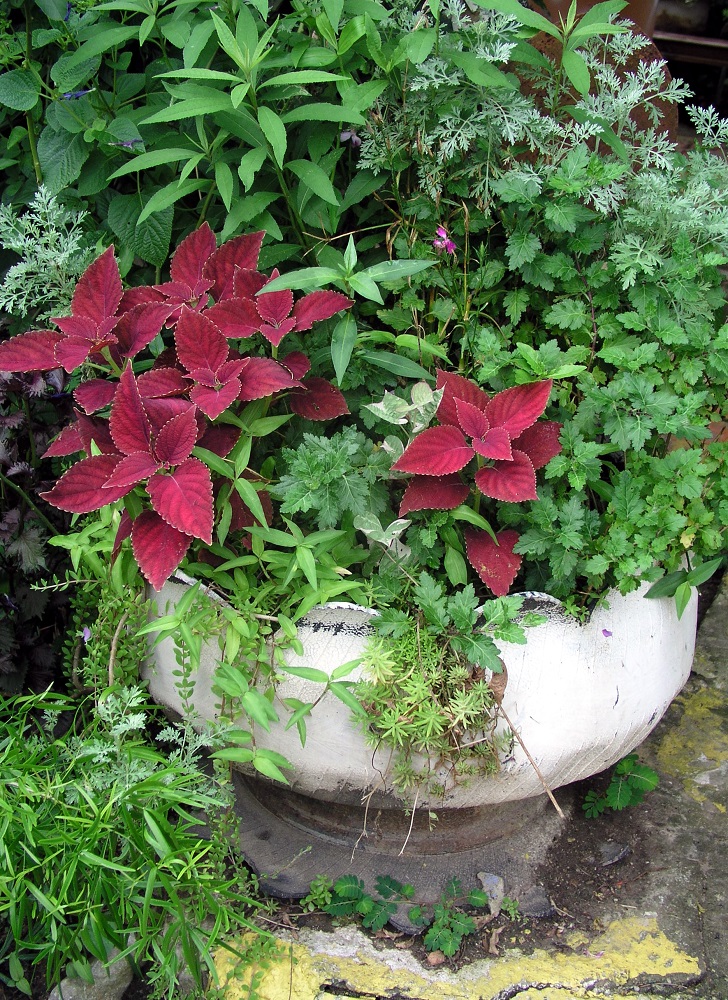
“Let’s be honest about coleus: it’s a drama queen.”
That gorgeous, deep red foliage requires consistent moisture. If you let the soil in this planter dry out even once on a hot summer day, you’ll come back to a sad, completely wilted plant. While it usually perks up dramatically after a good watering, it’s a plant that demands attention. If you’re a ‘forget to water’ type of gardener, you might be better off choosing a hardier plant like a sweet potato vine or drought-tolerant sedum for a low-maintenance tire display.
19. White Tire Rooster Planter with Red Comb and Yellow Beak
Creating the rooster’s tail is the most creative part of this project. It requires sacrificing a second tire. Estimated time: 2.5 hours. Materials: 2 old tires, jigsaw with a metal-cutting blade, heavy-duty bolts.
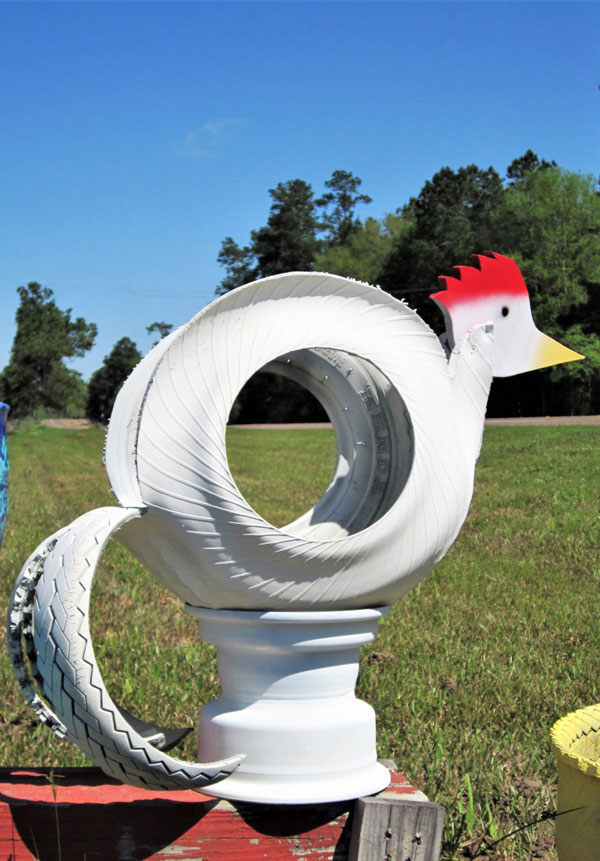
“Take your second tire and, using the jigsaw, carefully cut out a crescent-shaped section about 1/3 of the tire’s circumference.”
From that crescent, cut long, feather-like strips of varying lengths.
Drill holes through the base of your ‘feathers’ and through the back of your main rooster body tire.
Secure the tail feathers to the body using nuts and bolts.
Paint the whole assembly white once it’s constructed for a unified look.
Cutting tires is difficult and potentially dangerous work. The rubber is thick and often contains steel belts. You must use a jigsaw equipped with a fine-toothed metal-cutting or demolition blade. Go slowly, wear thick gloves and safety glasses, and be aware that the blade can get hot and bind up. Securing the tire firmly so it doesn’t move while you cut is non-negotiable. If you’re not comfortable with powerful cutting tools, it’s best to admire this idea from afar or stick to designs that use whole tires, like the swan in Idea #26.
20. Repurposed White Bicycle Wheel with Succulent Planters
This is a brilliant example of repurposing with a twist. It works because it plays with expectations. A bicycle wheel is a familiar, graphic, circular shape, but seeing it used as a vertical garden is a delightful surprise. The delicate, varied forms of the succulents contrast beautifully with the rigid geometry of the spokes and rim. The use of different small containers—a brown pot, a blue can—adds to the eclectic, found-object aesthetic, making it feel curated and personal.
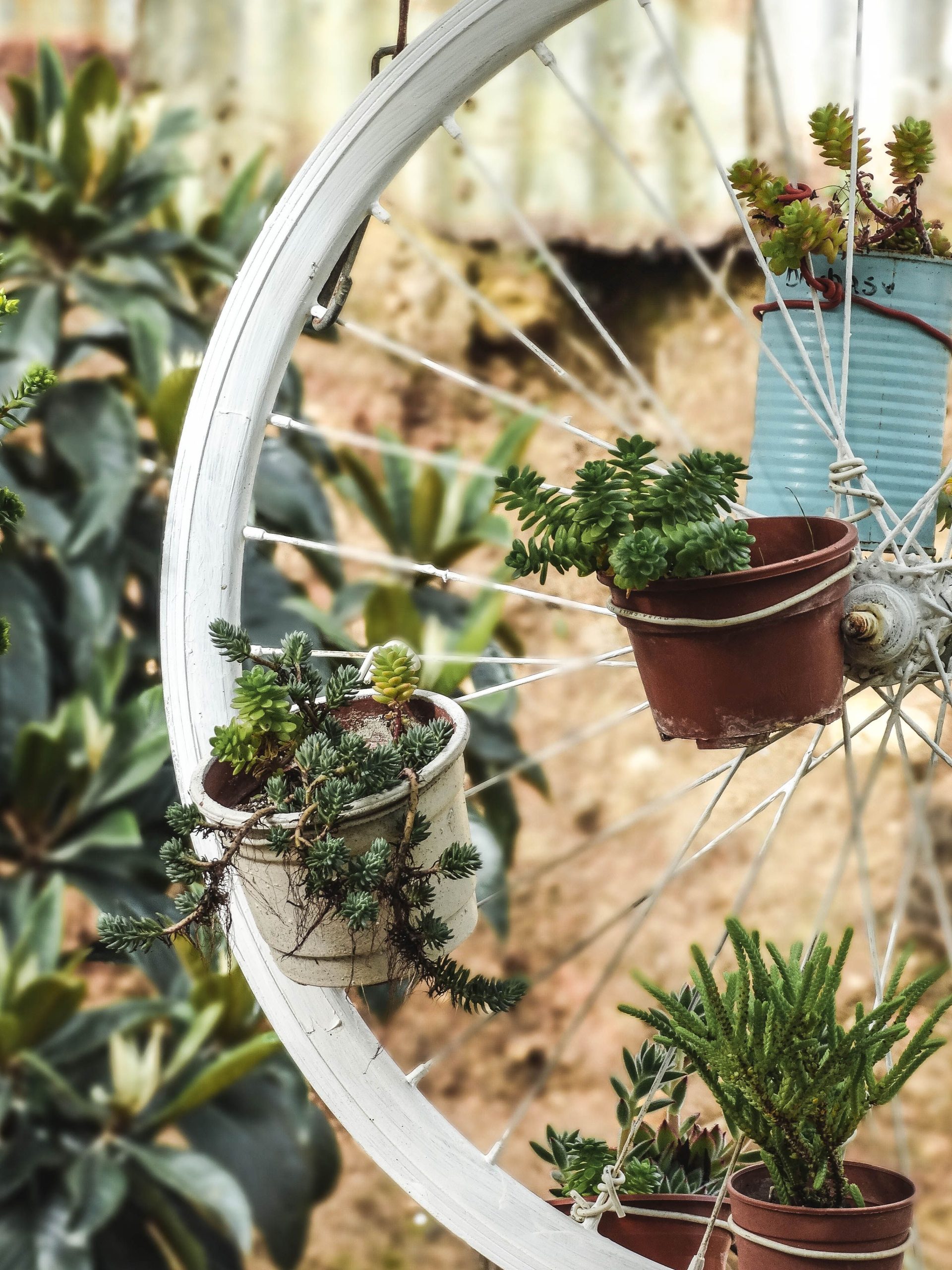
“This idea is perfect for extremely tight spaces where even a small floor planter is too much.”
Think of a narrow balcony wall, the side of a garden shed, or a small section of fence. The entire footprint is only a couple of inches deep. It makes a huge visual impact without taking up any living space. It’s an ideal solution for adding greenery to an apartment balcony or a tiny patio where every square inch counts. It provides the garden feel without the garden space.
21. Colorful Painted Tire Planters Against a Splatter-Paint Wall
The undisputed star of this entire scene is the paint-splatter wall. It’s a maximalist, high-energy backdrop that gives the simple tire planters a completely different context. Instead of a garden setting, this feels like an urban art installation. The wall provides a chaotic, colorful energy that makes the solid-colored tires look grounded and intentional by comparison. Without that Jackson Pollock-esque background, this would just be a nice collection of planters; with it, it’s a bold artistic statement.
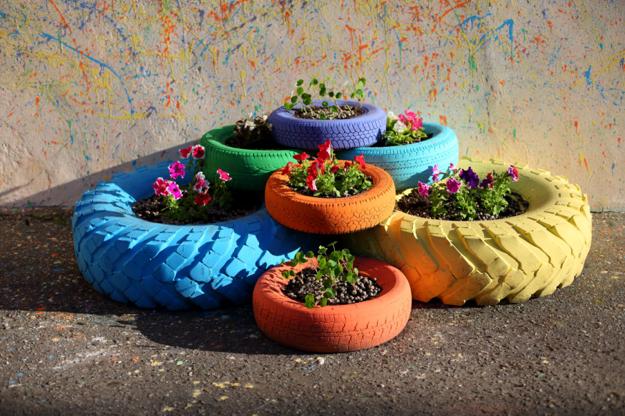
“This is a very specific, high-energy look that could easily become a visual nightmare.”
A backdrop this chaotic only works if the other elements are simple. Notice how the planters are all solid colors—if they also had patterns, the result would be a mess. This idea is also not for the faint of heart or for those who might sell their home soon. A paint-splatter wall is a very personal taste and has a huge impact on the feel of a space. It requires total commitment to a playful, eclectic vibe.
22. A Guide to Stacked Tire Landscaping
When creating a stacked tire landscape feature for retaining a slope or creating a large flower bed, stability is key. For any stack over two tires high, you should drive a central stake or rebar through the middle of the tires and into the ground. This will prevent the stack from shifting or toppling over, especially as the ground settles and the soil gets heavy with water. For wider, wall-like structures, you should also stagger the tires in a running bond pattern, similar to bricks, for interlocking strength.
“a large-scale tire landscaping project, do a quick reality check:”
a large-scale tire landscaping project, do a quick reality check:
- How many tires do you actually need? Measure your space and calculate. You might need 20, 50, or more.
- What is your source for the tires? Do you have a way to transport them? A standard car can only fit a few at a time.
- What is your soil plan? Filling a large tire structure requires a significant amount of soil, which is both expensive and heavy to move.
- Does your local area have any regulations about using tires in landscaping? It’s worth a quick check with your city or HOA.
23. Bright Orange Tire Planter with Contrasting Plant Forms
The visual success here comes from the smart use of contrasting forms. You have the strong, geometric, and man-made circle of the bright orange tire. Inside it, you have two distinct natural forms: the tall, wispy, vertical grass and the low, bushy, mounded plant. This trio of shapes—one circular, one vertical, one horizontal—is a classic design principle that creates balance and interest. Your eye is drawn to the interplay between the different silhouettes, making the composition feel dynamic and complete.
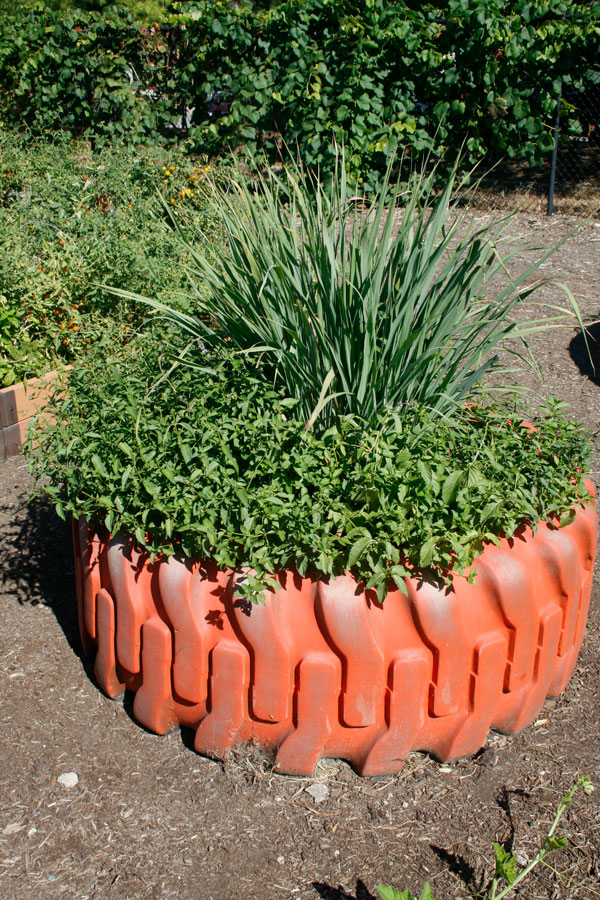
“The formula for this striking look is simple: 50% bold, monochromatic container, 25% tall ‘thriller’ plant, and 25% low ‘filler’ plant.”
The bright orange is the main event, grabbing your attention from across the yard. The tall, wispy plant adds height and drama, while the bushy lower plant grounds the arrangement. You could trade the orange for a cobalt blue, the wispy grass for a tall salvia, and the filler for a sweet potato vine, and the balanced, eye-catching result would be just as effective.
24. Chartreuse Hanging Planter with Lightbulb and Butterflies
The single element that takes this from a cute DIY to something truly memorable is the hanging green lightbulb. It’s completely unexpected and adds a touch of surrealist whimsy. It serves no practical purpose, which is precisely why it’s so delightful. It’s a purely artistic choice that sparks curiosity and makes you look twice. Along with the decorative butterflies, it contributes to a magical, fairy-garden narrative that elevates the entire piece beyond a simple planter.
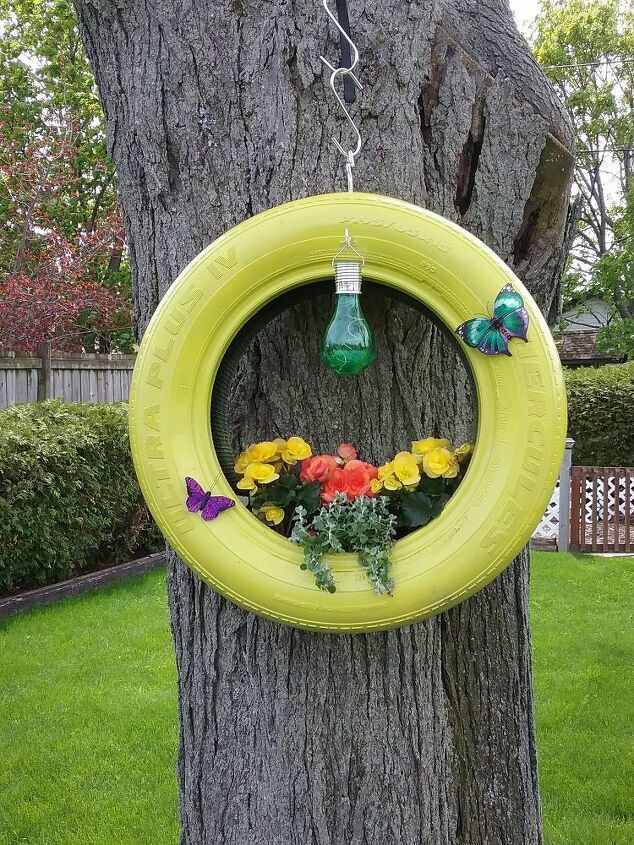
“You can achieve this whimsical look for just a few dollars.”
The tire is free, and a can of chartreuse spray paint is about $10. For the quirky details, look at thrift stores. You can find old, colorful lightbulbs (non-functional is fine!), decorative butterflies, or other small trinkets for pennies. The flowers can be inexpensive annuals like marigolds or petunias. This is a look that’s all about creativity, not cost. It’s about assembling found objects in a new and interesting way. Check out the bicycle wheel planter in Idea #20 for a similar found-art vibe.
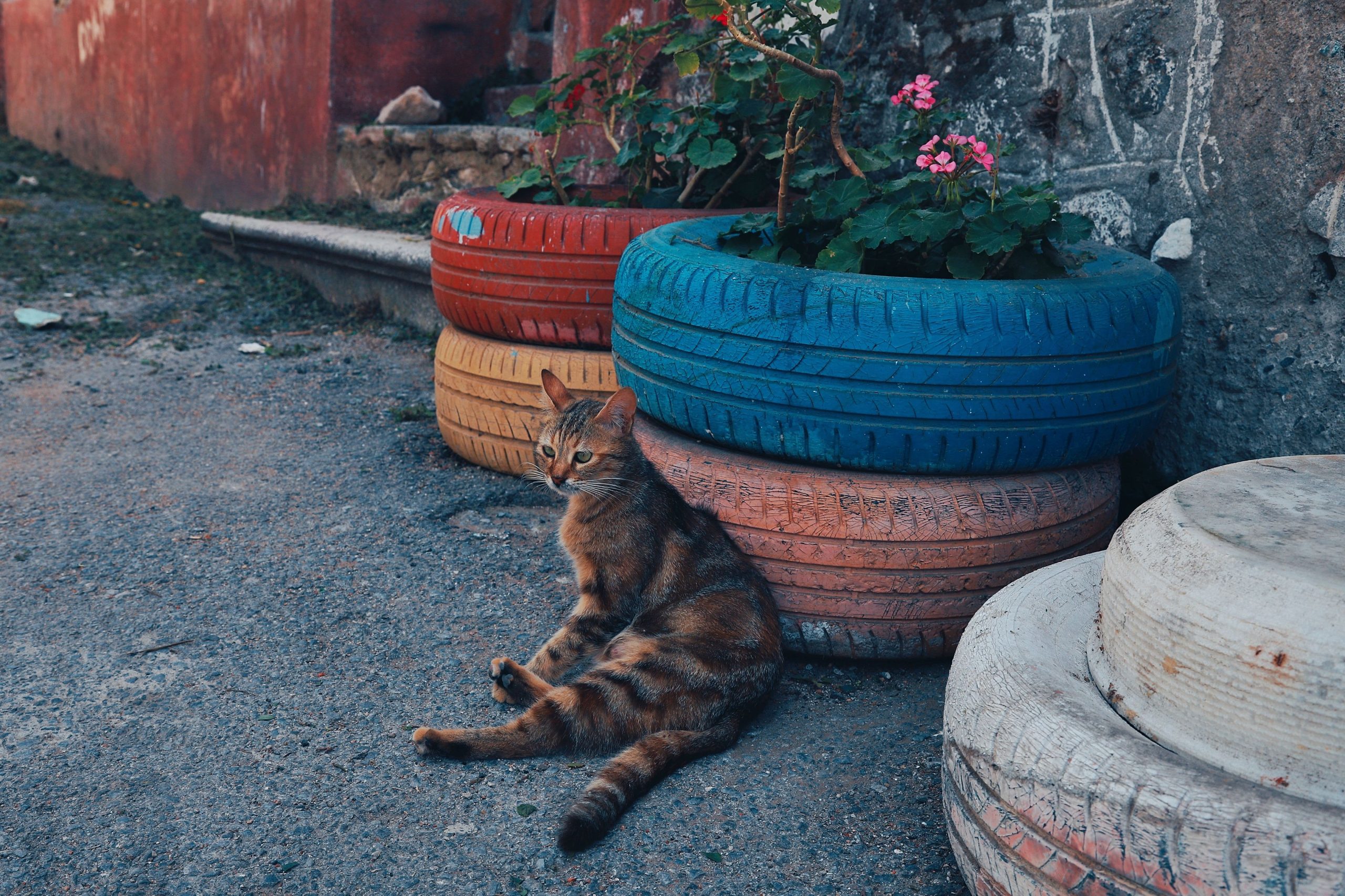
25. Stacked Painted Tires with Foliage Beside a Weathered Wall
Here’s a realistic cost estimate for this rustic, stacked look.
“Used Tires (3): Free – $20
Exterior Paint: $20 – $40 (for 3 different sample-s”
- Used Tires (3): Free – $20
- Exterior Paint: $20 – $40 (for 3 different sample-sized pots in red-orange, blue, and yellow)
- Plants & Soil: $25 – $45 (a mix of foliage and small flowering annuals)
- TOTAL: $45 – $105
Budget alternative: Check local recycling or waste centers for free leftover paint. Propagate plants from friends’ gardens or grow from seed to bring the plant cost down to almost zero. The most expensive part is often buying new soil.
This composition works because it feels perfectly balanced between the man-made and the natural. The stacked, painted tires have a rough, urban, upcycled feel. The weathered red wall and asphalt ground reinforce this. Then, the soft green foliage and delicate pink flowers spill out, softening the hard edges and bringing life to the scene. The cat sitting there is the final touch, adding a sense of calm and domesticity. It’s this blend of gritty and gentle that makes the image so compelling.
26. White Swan-Shaped Tire Planter with Red Flowers
Creating the swan’s elegant neck and head requires a very specific cut. This is an advanced project. Est. time: 3 hours. Materials: 1 tire, jigsaw, heavy-duty bolts, white paint.
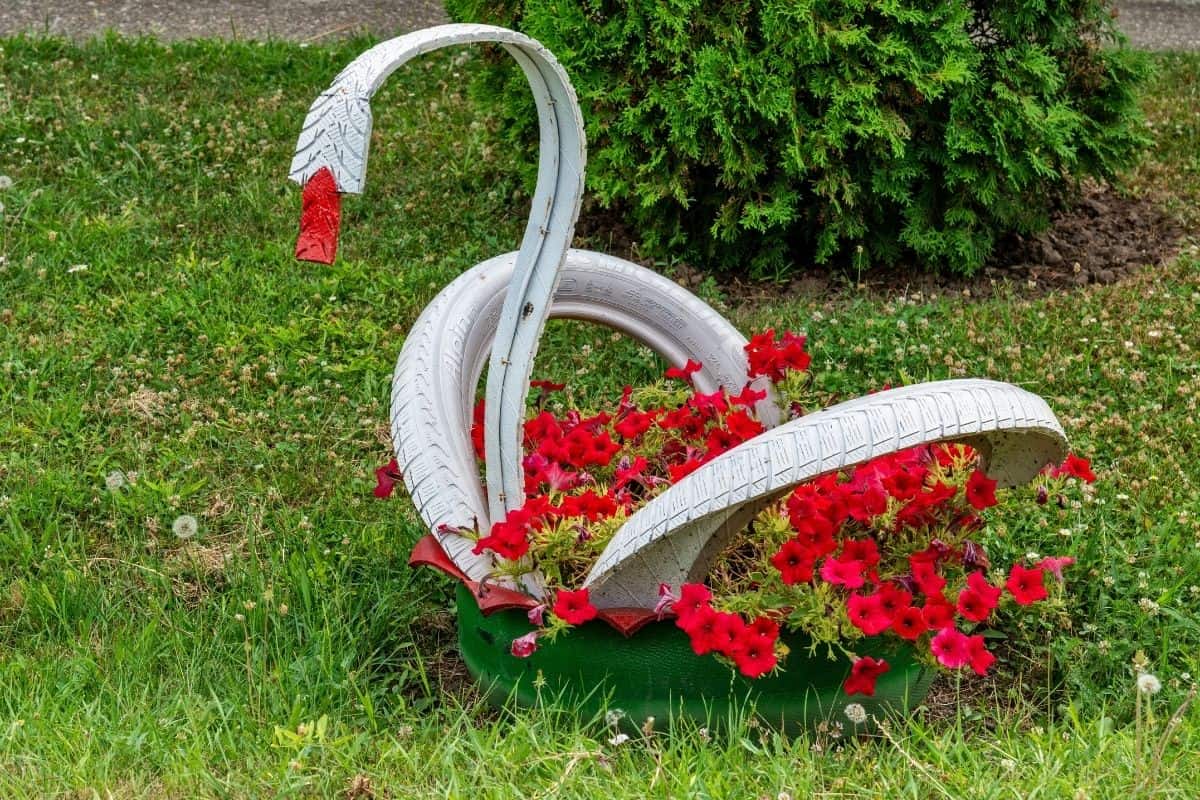
“Lay the tire flat.”
You’re going to make two parallel cuts that go around about two-thirds of the tire’s circumference, leaving one-third intact as the base.
The cuts should be about 4-6 inches apart, creating a long strip that will become the neck and head.
Carefully flip the tire inside out. This is the hardest part and may require two people. The cut strip will pop up and create the neck.
Shape the end of the strip into a head shape. Bolt the ‘beak’ to the body to hold the curve.
Paint the entire thing white and the base green.
The single most important part of this entire project is the act of flipping the tire inside out. It’s a difficult, muscle-intensive step, but it’s what creates the magic. This inversion is what forces the cut strip to pop upwards and create the swan’s graceful, curved neck. Without that flip, you just have a tire with a flap cut in it. The tension created by turning the tire inside out is the structural secret that gives the swan its iconic and surprisingly elegant shape. It is, quite literally, a transformative move.
27. Painted Half-Tire Hanging Planter with Delicate Pink Flowers
A half-tire planter is an absolutely brilliant choice for narrow, high-traffic areas. Because it sits flush against the wall, it doesn’t jut out and get in the way like a full-tire planter would. This makes it ideal for balconies, narrow porches, or along a walkway next to your house. You get all the visual impact and planting space of a hanging basket but with a much slimmer, space-saving profile. This is small-space gardening at its smartest, maximizing wall space instead of precious floor space.
![[Painted Flower Pot] Metal Painted * Hanging Tire Flower Pot, Creative * Colored Tire Succulent Planting Trough, Can Climb Vines, Outdoor Garden ...](https://quotableideas.com/wp-content/uploads/2026/07/painted-flower-pot-metal-painted-hanging-3.webp)
“To hang a half-tire planter securely, you need to distribute the weight.”
Don’t just drill two holes at the top. Instead, drill four: two along the top cut edge, and two a bit further down on the sides of the tire’s curve. Use four separate lengths of chain that meet at a single heavy-duty ‘S’ hook or carabiner. This four-point connection provides much better stability, preventing the planter from tilting forward and spilling soil once it’s heavy with water and plants.
28. Recycled Tire Planter with Ornamental Grass on a Blue Wall
This design is a masterclass in textural and color contrast. You have four distinct elements working together: the rough, matte black of the rubber tire; the smooth, vibrant blue of the painted wood wall; the earthy, warm orange of the terracotta pot; and the soft, feathery beige of the ornamental grass. Each material is highlighted because of its difference from the others. The black tire on the blue wall is a bold, graphic statement, while the terracotta pot adds a layer of warmth and tradition, making the whole composition feel balanced and sophisticated.
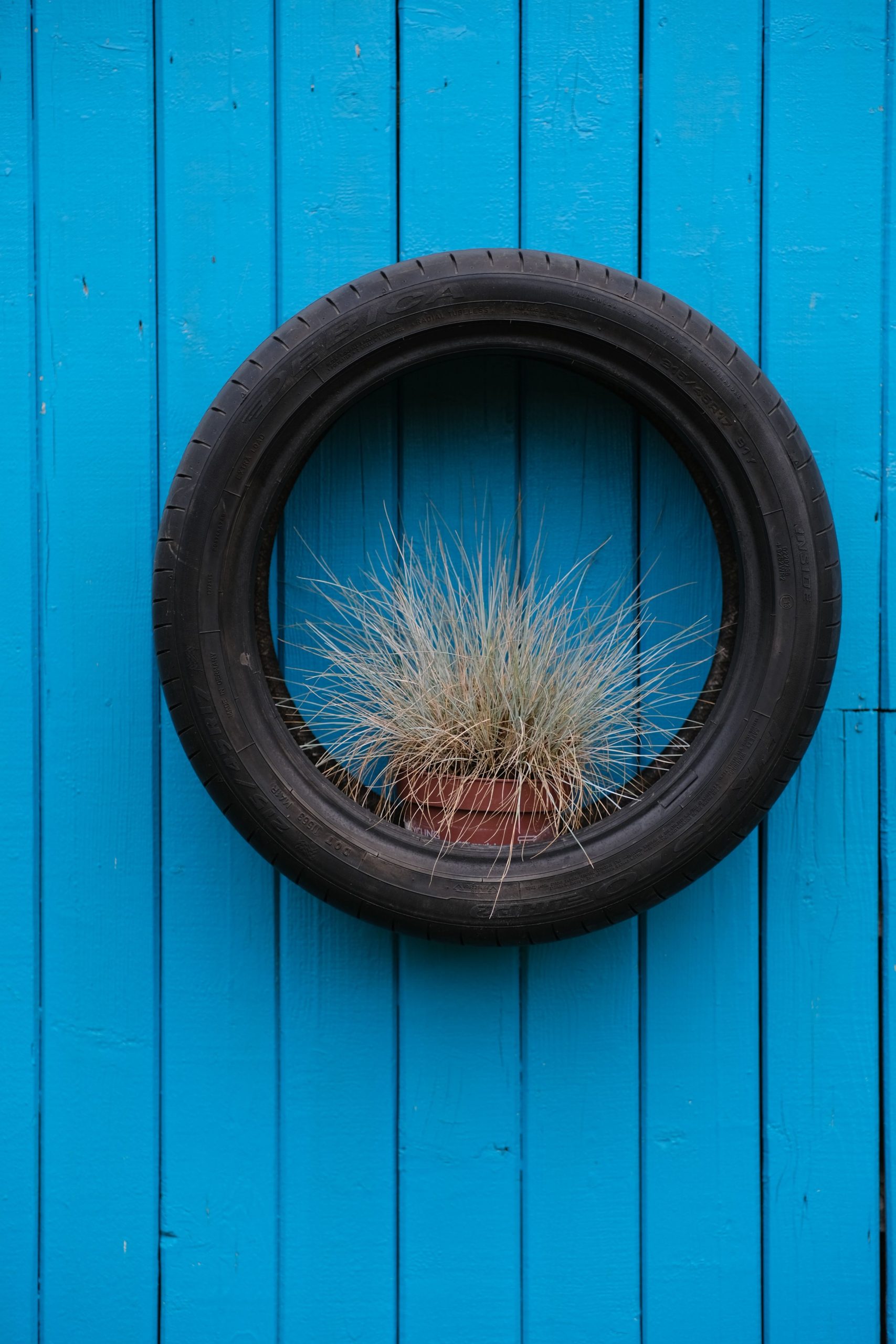
“This look is right on trend for 2026, tapping into the ‘Color Drenching’ and ‘Unexpected Juxtaposition’ movements.”
People are getting braver with bold, saturated wall colors, even in outdoor spaces. The idea of taking simple, utilitarian objects (a tire, a basic pot) and elevating them through dramatic color and placement is very current. It’s about finding beauty in everyday materials and using them in thoughtful, artful ways. This is less about ‘rustic DIY’ and more about ‘curated industrial sculpture’.
29. Giant Teacup Planter from Stacked Painted Tires
that absolutely makes this idea is the handle. Without it, you’d have a cute stack of polka-dotted tire planters. But the addition of that simple, curved J-shape, cut from another piece of tire and bolted to the side, instantly transforms the entire structure into a teacup. It’s a brilliant, whimsical leap of imagination that tells a story and makes everyone smile. It’s the single detail that gives the project its undeniable identity and ‘Alice in Wonderland’ charm. Everything else is just decoration by comparison.
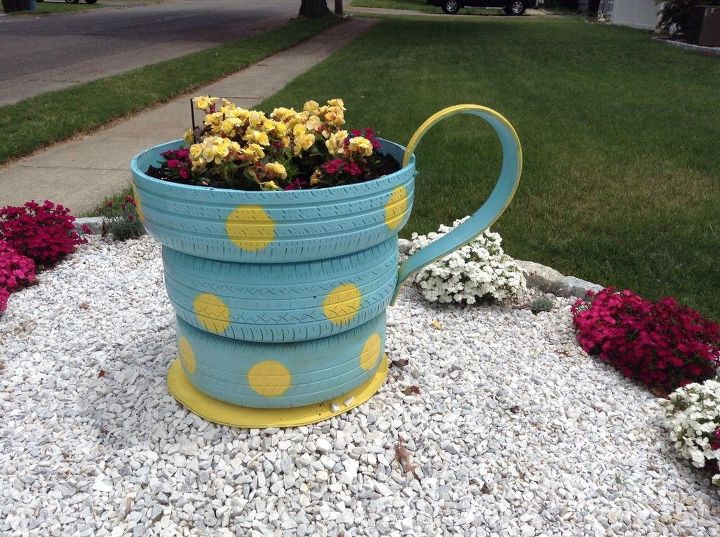
“A word of caution: a giant, whimsical feature like this can easily look out of place if the rest of your garden is very formal or minimalist.”
This teacup has a strong, playful personality, and it needs to be in a setting that feels similarly relaxed and creative. It works best nestled into a lush, informal garden bed, as shown, where it feels like a joyful surprise. If you place it in the middle of a perfectly manicured lawn, it can look less like a charming feature and more like a piece of misplaced playground equipment.
Roll Into Your Next Garden Masterpiece
With a little bit of paint and a whole lot of imagination, an old tire can become the most talked-about feature in your garden. Whether you go for a simple, colorful stack or a whimsical creature, the possibilities are endless. We hope these ideas have sparked your creativity and shown you just how amazing upcycling can be.
Ready to start your project? Pin your favorite ideas to your garden board and let the transformation begin!